
Just a few days ago, I was treated to a delicious apple pie baked by my better half. However, as is the trend nowadays, I had to photograph it before I could take a bite. Here’s how the photograph came about: it was captured to share on Instagram and promote our homestay.
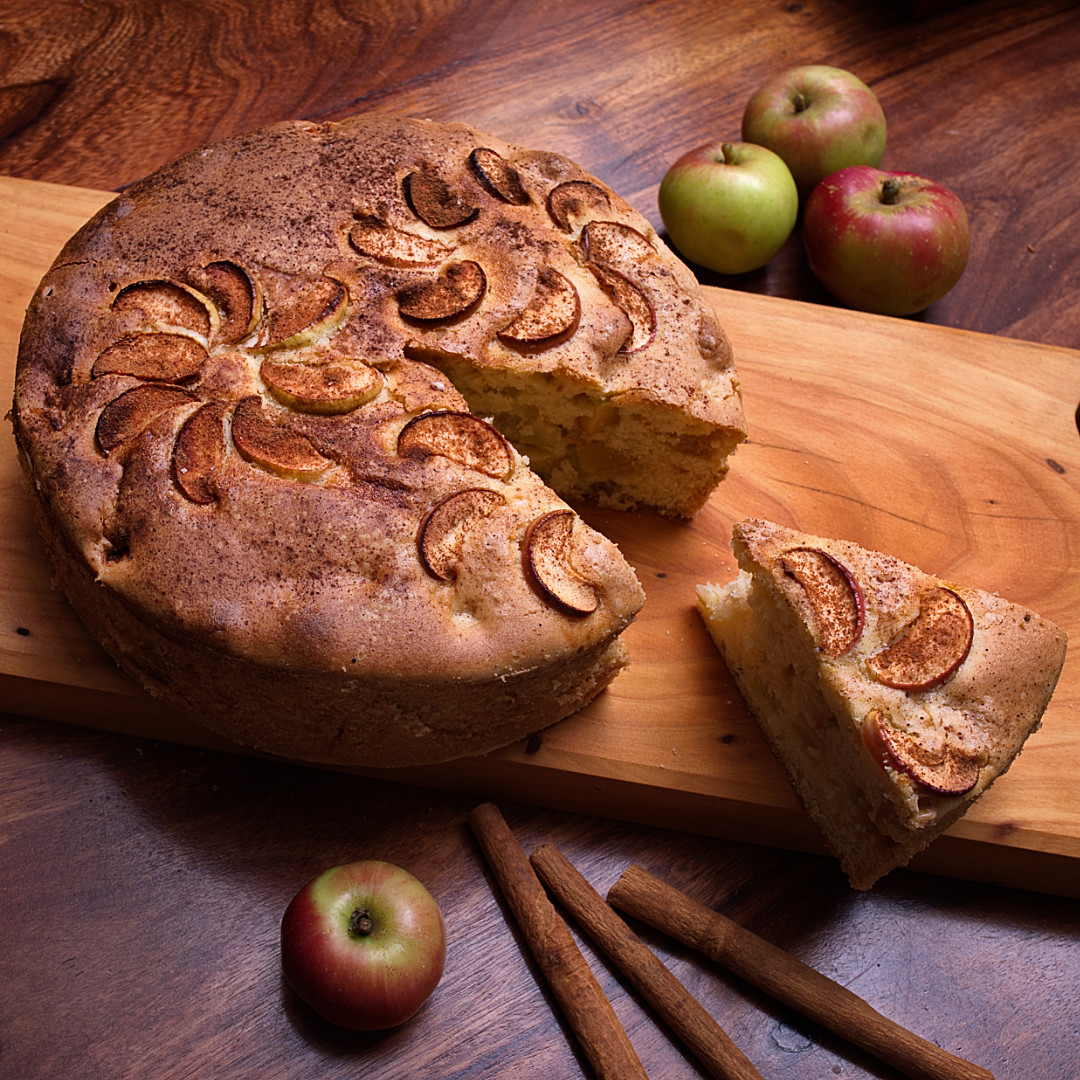
(The delicious apple pie. This was the image that we used for the Instagram post –Apple Pie on Instagram. The one on Instagram is of higher quality than the one here. The image here is a little compressed for use on this site. Do visit the link to see the better version of this photograph.)
The Apple Pie
With nothing to do at home and a small bounty of homegrown apples, baking an apple pie was an obvious outcome. I won’t go into the details of the recipe here, but I can tell you it smelled heavenly. Freshly baked and straight out of the oven, it was a challenge to photograph it before indulging. Since it was destined to be eaten right away, I didn’t use any of my usual food photography aids. Some examples of those aids which render the food useless for eating – Food Photography
The main ingredients were these aromatic, naturally grown Cortland apples and cinnamon, aside from whatever went into the crust. I’m not certain about the rum—though some of it definitely ended up in me while the pie was baking.
Set-Up
For the photography, I used the following equipment: a Nikon Df full-frame body, a Zeiss 25mm lens, and two speedlights triggered wirelessly by a Nikon SU-200, with one light blue colored gel filter.
To complement the apple pie, I needed some props. I used the leftover apples (which, incidentally, were not as beautiful as the ones that went into the pie), some cinnamon sticks, and a wooden chopping board. Everything was set up on an old wooden table.
Setting up the Composition
We didn’t want to place the pie directly on the table, so the chopping board came to the rescue. It’s a thick board, which presented both a challenge and a blessing. More about that aspect later on. For the photograph, I arranged three apples on one side, a small triangular piece of the pie a little away from the main pie, and three cinnamon sticks at the bottom of the frame.
Together, these three components formed a triangle or an arrow, directing attention toward the apple pie.
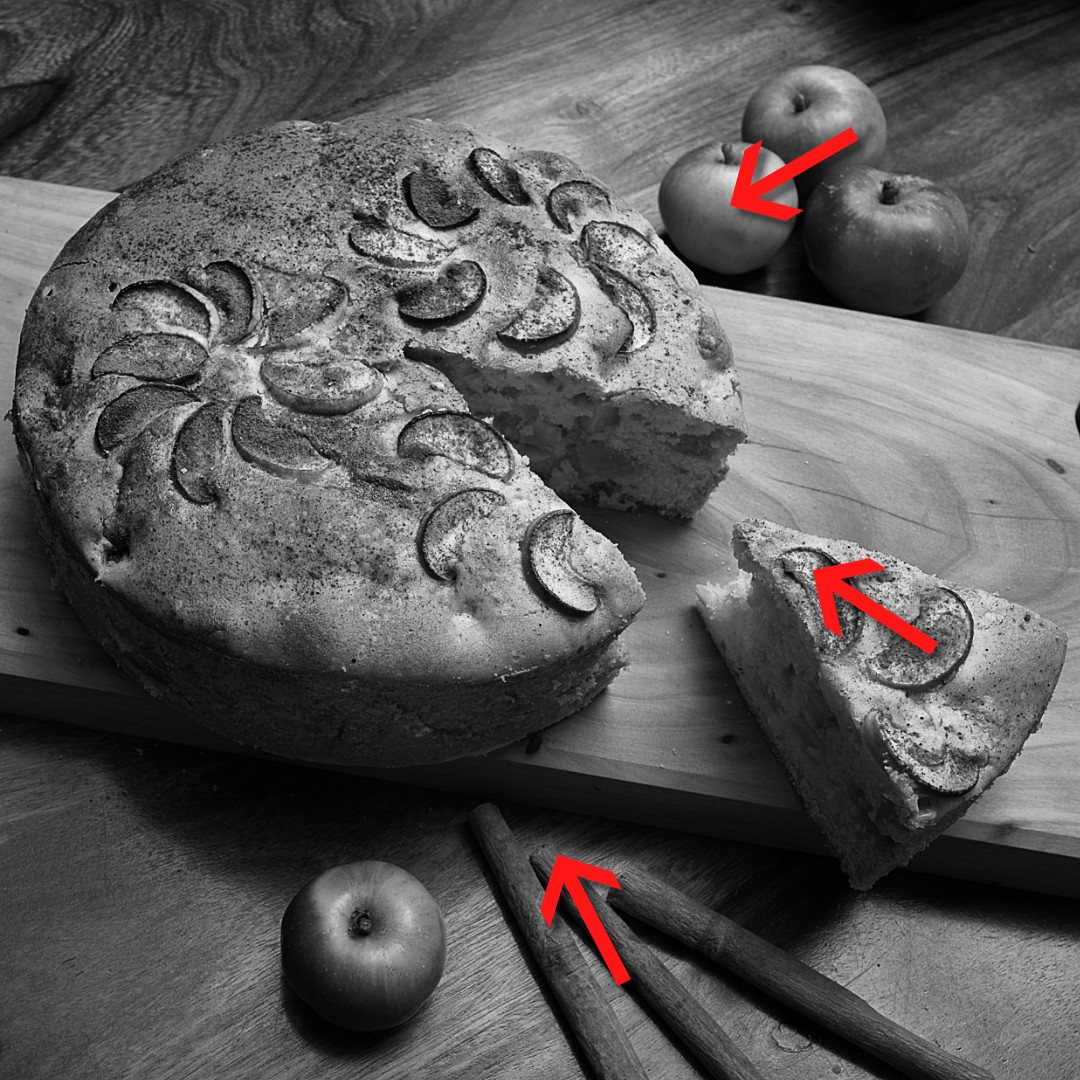
(The three supporting elements were placed in a manner that pointed to the main apple pie)
In compositional terms, this is called empowering the subject. All the supporting elements pointed to the pie!
I also prefer using an odd number of main and supporting elements. The three apples on top, one piece of pie, and three cinnamon sticks follow this principle. Odd numbers seem to work well in photographs.
The lone apple in the corner was placed by my assistant photographer, my daughter. She felt the corner looked too empty. Somehow, kids have an innate sense of balance in composition that tends to get overshadowed by conventional schooling.
There were some crumbs scattered around, which added a natural touch to the photograph. However, with Instagram’s small native resolution, they seemed more distracting than natural. I had to ‘clone’ them out during post-processing.
The thick chopping board provided a nice shadow, acting as an ‘underline’ for the main subject.
Lighting Set-Up
This article was an afterthought, so I didn’t capture any photographs of the actual setup. I’ll try to explain it as best as I can with the description here.
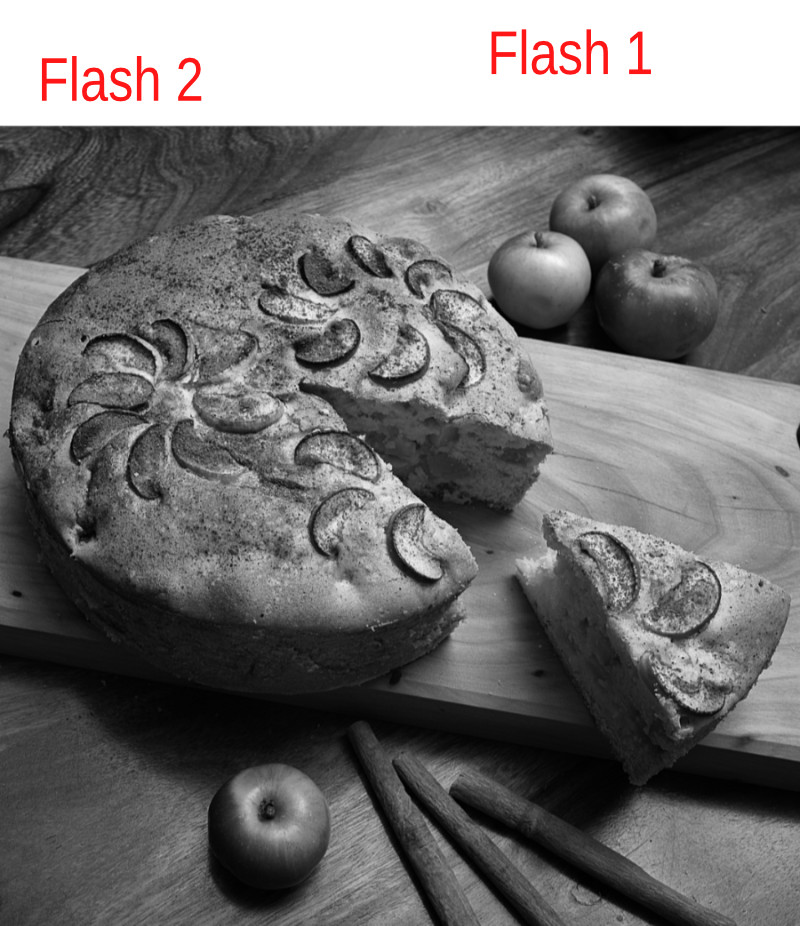
Flash 2 was a speedlight pointed up towards the yellow wall and ceiling above. The light reflected off these surfaces, adding a warm hue to the composition. I’ll refer to this unit as the ambient speedlight. Additionally, a bright tungsten bulb in the room, located behind and above my back, provided some warm, diffused light over the subject.
Flash 1 was a speedlight set to fire under a silver umbrella, providing slightly harsher light compared to the ambient speedlight. I also placed a light blue gel filter on it. The reflected light from the umbrella fell directly in the center of the composition. The umbrella itself was placed quite low, near the table.
For flash exposure, I used the i-TTL mode. The speedlights were triggered by the SU-800 mounted on my camera. For the ambient speedlight, I did not use any flash compensation. For the speedlight under the umbrella, I set a -2 EV flash compensation on the SU-800 unit.
This setup was quite different from the usual left-right dual-unit setup that most photographers use for food and product photography. The ambient light setup (Flash 2 and the room bulb) provided enough diffused lighting for the composition. It was Flash 1 that did the magic.
By firing the flash to create a glare or reflection from the shiny table surface, a touch of glamour was added to the image. The cool color from the blue gel filter gave this highlight character. Someone once pointed out to me that this effect makes the composition look like it’s being viewed in a glossy magazine or print, where the room light is reflecting off the paper. Maybe that’s what happens, maybe not. Regardless, I am partial to such subtle highlights in compositions.
Exposure and Post-Processing
The camera was set to manual mode with ISO at 100. I had to use an aperture of f/11. This provided me enough depth of field to have the top of the pie as well the surface of the table in reasonable sharpness. A thinner chopping board would have reduced the overall height and I could have gotten away with f/8 too then. Here, f/11 was the ideal aperture that I could open. Anything smaller than f/11 would have softened the image due to diffraction effects.
I set the shutter speed to 1/125 seconds to minimize reliance on the ambient bulb light. This is a common trick I use: increasing the shutter speed to reduce ambient light exposure. This doesn’t affect the speedlights, which have a very short firing duration and only last a fraction of the time the shutter is open, even at 1/125 seconds.
For post-processing, I used Affinity Photo, adjusting the curves slightly and adding some sharpening.
(The final image!)
… and the photoshoot ended
Needless to say, the perfectly baked pie made a fantastic subject.
Once the photo shoot was over, we were finally allowed to enjoy the pie and polished it off in minutes. There were several more pies in the oven, baking in rectangular aluminum foil pans to be gifted to some of our friends. So, how many of those three pies in the oven do you think we ended up gifting?
This article, originally published on my photography site, is now archived here; while some details may have lost their original context over time, it still offers an intriguing read.
Complete list of archived content – Photography Articles
Discover more from Maini's Hill Cottages
Subscribe to get the latest posts sent to your email.

Wow Shivam Jee !! Your new fan and follower here. I must say I am mighty impressed :)
You gave us some very important lessons that even amateurs like me can implement. I never gave any thought to the triangle being made or that the three objects are pointing towards the main object. That’s awesome :D I learned something today. Thanks.
LikeLiked by 1 person
Thanks. There are many such things that can empower the main element in the composition. Do check out my other articles too – https://maini.live/list-of-writings/
LikeLike
Sure I will 🙏
LikeLike
You’re Superman to get such a beautiful photograph done first 😂
Martha Stewart needs to watch out for your wife 😉
LikeLiked by 1 person
Yes, it definitely was a challenge getting the photograph first and then having the apple-pie. I’ll show your comment to my wife too. Thanks.
LikeLiked by 1 person
Please do! :)
LikeLike
Seeing the pic of the delicious Apple Pie- equal marks to the cook , the composer (your daughter) and the photographer ,makes a hope come to my mind that all is not lost in these COVID19 pandemic times . On showing this pic to all my nursing and doctor staff working in covid icu unequivocally bought a smile to all the faces (some were asked politely to wipe the drool from their chins).Thanks Dr Shivam .Now can you please courier us the pie……
LikeLiked by 1 person