
With the heat of summer settling in, nothing compares to the cool embrace of the hills—a perfect retreat for relaxation. Last weekend, that’s exactly what I did. Joined by a few close friends, we spent our time in a lazy rhythm, the evening slipping away as we chatted under the starlit sky. The next morning promised adventure, as we had planned a nature walk with our resident guide. The anticipation made it hard to sleep. As the first light kissed the snow-capped peaks, I was already up, camera in hand, ready to capture the beauty of the morning.

(Morning light on snow peaks – It is very rare to see the peaks in summers, due to direction of sun and atmospheric haze. We were lucky! Captured on Nikon Df with Zeiss 135mm lens at f/5.6 and 1/640 shutter speed, at ISO 100)
Both of my friends were ready, savoring a quick cup of tea as I captured the snow-peaks in the morning light. Soon, our local friend, the nature guide, joined us. Born and raised in these hills, he knows the forest like the back of his hand—a true Mowgli in every sense!
We set off on our trek, with me carrying only a Sigma 150-500mm lens mounted on a Nikon body. While not the sharpest lens, it does its job well enough for these kinds of adventures. After a short walk, we reached the spot where the road gives way to the wilderness. Two of our cottage dogs, who often act as night guards, decided to join us up to the edge of the jungle. It was amusing to watch them sniffing at chamomile blossoms lining the roadside.
As we quietly ventured into the forest, we walked single file, careful not to disturb the peace. The only sounds were the wind rustling through dry leaves, the birds singing, and the occasional crack of twigs underfoot. Every so often, someone would whisper a ‘wow’ or ‘amazing,’ as the beauty around us left us in awe.
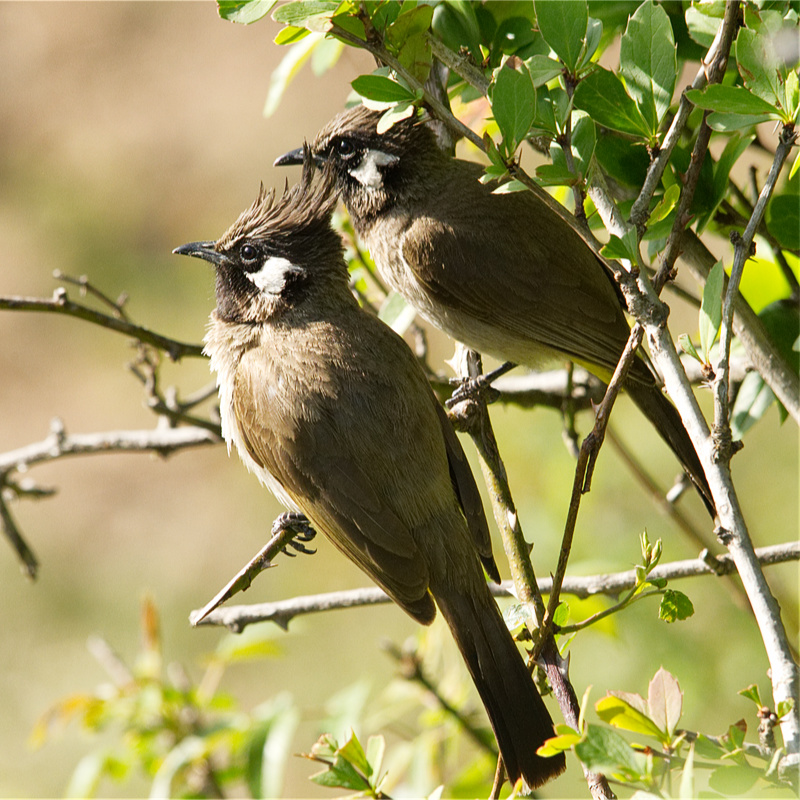
(Himalayan Bulbuls with their characteristic yellow vent. Nikon Df with Sigma 150-500 lens at f/11 and 1/1000 second… ISO 3200! God bless technology for letting me use such high ISOs.)
The first song that we heard up close was something that reminded me of ‘tea for two’. There were two pairs of Himalayan Bulbuls singing ‘Tea for two, tea for two’ in unison. Bulbuls, Jays and Magpies are three of the easiest birds to spot in the region, apart from sparrows, swallows and turtle doves.
As we watched the bulbuls, a black-headed jay swooped overhead, followed by another. Were they feeding each other? Is that common behavior? I’ve seen magpies do it, but we weren’t sure. Our curiosity was piqued, but our field guide book didn’t offer much help—it only had illustrations of birds, with no information on their behavior. Still, we were grateful to have it, as it helped us identify several other species.
In the distance, a small black-and-white bird caught our eye, but we couldn’t identify it. Note to self: bring binoculars next time! A camera with a long telephoto lens isn’t always the best tool for birdwatching. Should I invest in a faster, sharper long telephoto lens? Maybe… but then again, my New Year’s resolution might have something to say about that.
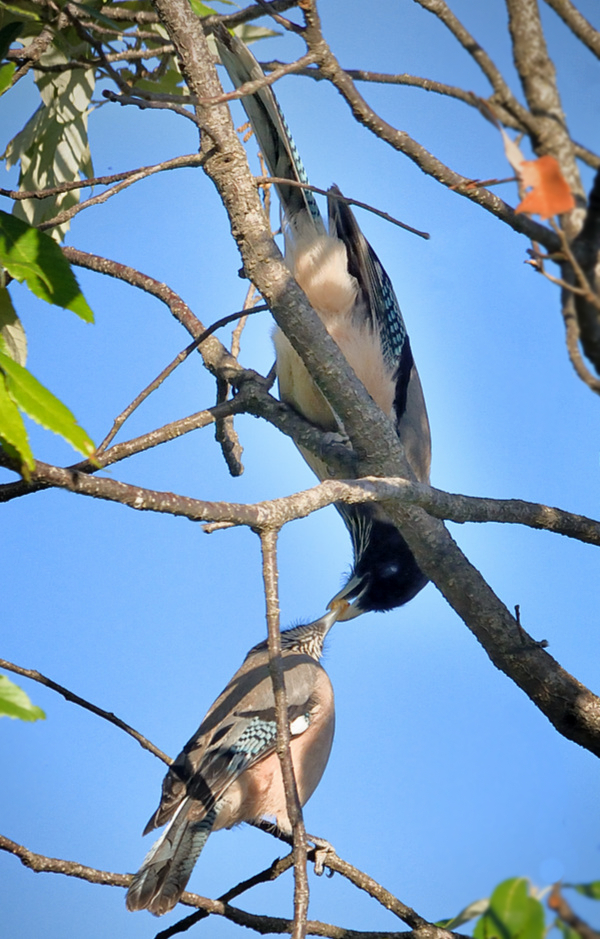
(Two Black-headed Jays – feeding each other?)
The sun was now shining brightly, but the wind still carried a cold bite. Sunlight barely pierced the forest, and whatever did was filtered through the tree canopies, casting a soft, dappled glow. It felt peaceful walking along the forest trails, surrounded by the sounds of nature.
One of my friends suddenly spotted a striking woodpecker. It landed on a pine and immediately began its rhythmic work—tap, tap, tap. The speed and precision with which it drilled into the tree was mesmerizing. I became so captivated by its skill that I forgot to capture a photo. Such is the magic of nature! By the time someone—perhaps it was the guide, I can’t quite remember—reminded me to take a shot, the woodpecker had already flown away. A beautiful photograph missed, but a much more precious memory made.
We continued on, spotting tree-climbers, bee-eaters, shrikes, and a few birds I’m still trying to identify. At one point, our nature guide signaled for us to stop and remain quiet. He had spotted a large deer deep within the forest, but it quickly darted away. He explained that the forest is home to a variety of animals—deer, foxes, martens, and rabbits are commonly seen. Wild boars frequent the area too, though rarely during the day on these trails. As for leopards? He assured us they don’t venture out in daylight when groups like ours are around.
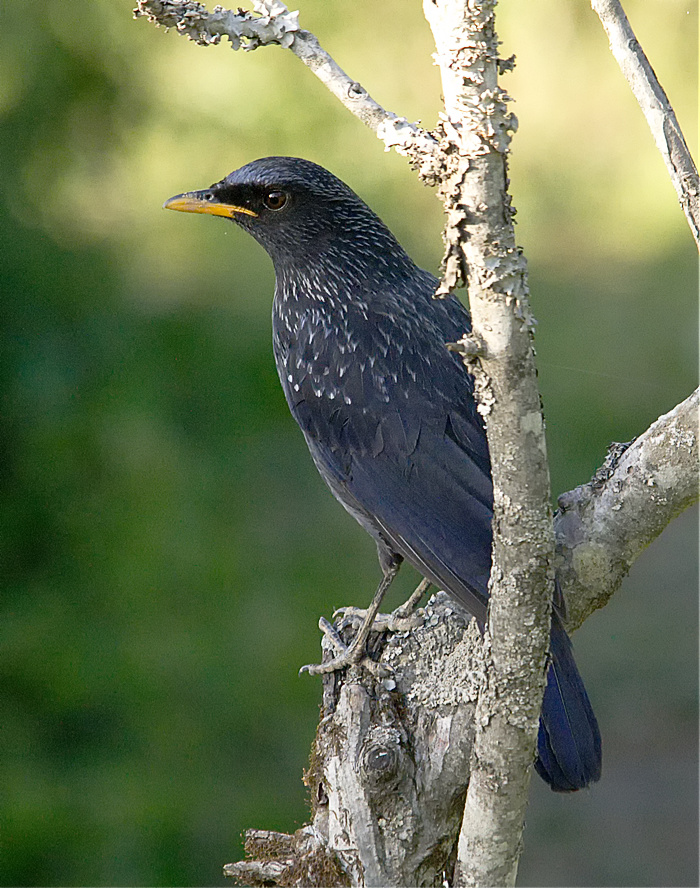
(A Blue Whistling Thrush. It sang a very melodious song, which I enjoyed a lot.)
There was a small white-and-grey bird hanging upside down on a tree, clutching its meal in its beak. The light wasn’t ideal for a photograph, but I snapped a shot anyway, just for the record. Sometimes, it’s worth capturing a moment for documentation, even if the conditions aren’t perfect.
Another bird caught my eye—a tiny one with a Dalmatian-like belly, speckled with spots. Birders probably have a specific term for it! It was curious yet cautious, staying just ahead of us for much of the trail. Though it led us along the path, it never let us get close enough to breach its comfort zone. Such a pretty little bird!
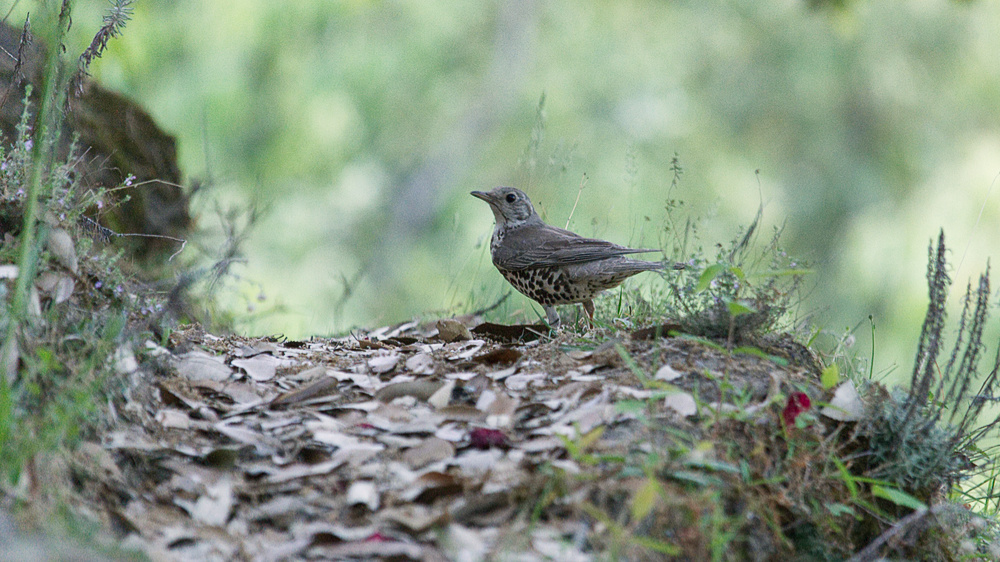
(The spotted bird, which was later identified as Mistle Thrush, that kept its distance but still kept on watching us with a very suspicious eye.)
A little further ahead, we spotted a Drongo resting in its nest. It soon flew away, only to return a moment later and settle back in. As this repeated, our nature guide explained that there were actually two Drongos—a pair—taking turns. There were newborns in the nest, and they were busy feeding them in shifts.
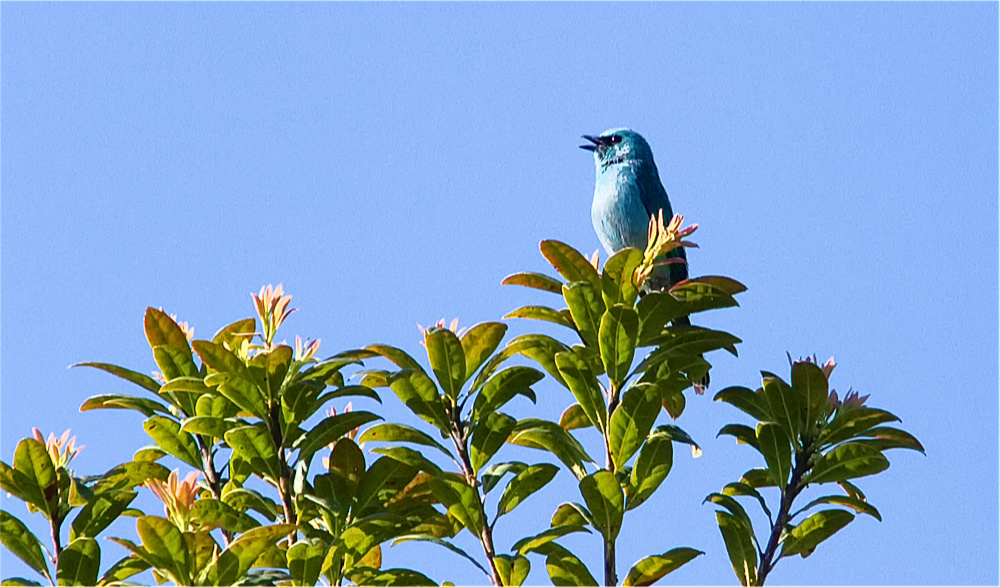
We heard a few more enchanting bird calls. While we could now identify some by their songs, most were simply beautiful melodies that delighted our ears. Perched atop a distant tall tree, a bright blue bird sang a high-pitched tune, its song cutting through the air. The Verditer Flycatcher, quite common in the region, was likely the one treating us to this musical performance.
More than two hours had passed since we started on out trek in Natadol. We began our way back toward the road, spotting more magpies and bulbuls along the way. This time, we followed a different forest trail, which led us to a roadside spot further from where we had originally entered the forest. This return route wasn’t planned, yet, interestingly, the two guard dogs were waiting for us there. Had they somehow known where we’d emerge, or was it just a coincidence?
The morning trek had been magical. The chorus of birds, the cool breeze that occasionally stirred with force, the crackling of dry leaves and twigs underfoot, the refreshing scent of moist earth, and the sight of wildflowers scattered along the trail—it was like walking through paradise.
As we returned to the cottages, we were greeted by a pleasant surprise: the bright sunlight had reached the garden as well. Magpies, swallows, sparrows, and bulbuls were chirping all around. A flock of swallows even settled on the railing near the deck, adding to the charm of the moment. In Natadol, it is considered a sign of good luck when they come and build nests in a house.
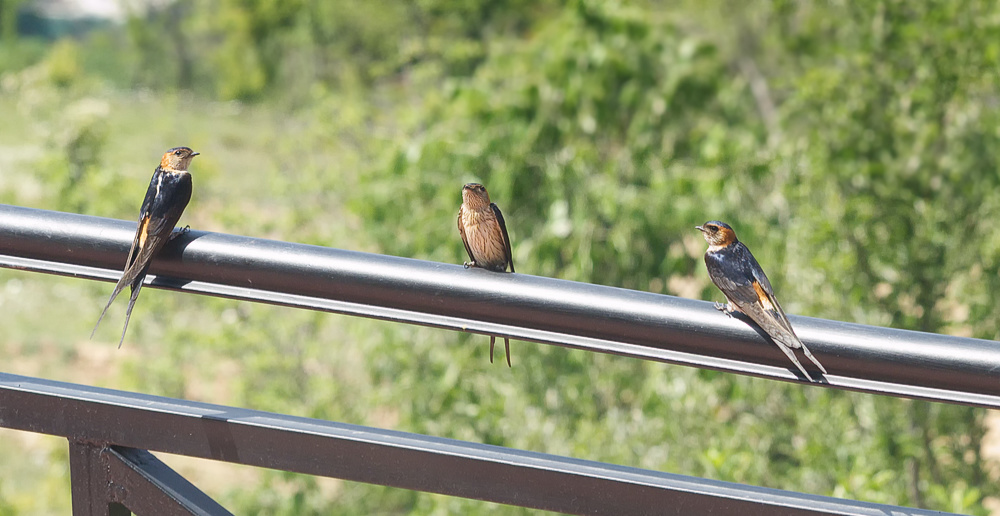
A beautiful morning indeed! The photographs are not upto the mark since this was more of a nature walk rather than dedicated bird-photography photo-walk.
To both my friends on the trek and the guide – I look forward to many more such nature treks in future. I hope we meet again sometime soon.
Further Reading:
Birds of Natadol
This article, originally published on my photography site, is now archived here; while some details may have lost their original context over time, it still offers an intriguing read.
Complete list of archived content – Photography Articles
Discover more from Maini's Hill Cottages
Subscribe to get the latest posts sent to your email.

Great post 😃
LikeLike
nice pictures
LikeLike
Whenever I “revise” this article – yep it makes me feel that good , I can picture myself wandering through the forest area of Natadol listening to the sounds of nature and going click click with my camera , keeping a sharp ear out for any sound by wild animals- a mountain bear or a tiger (don’t know if they exist or not) and my tummy yearning for the sumptuous breakfast awaiting me back at the Maini’s Hill cottages.Yes this article definitely makes me happy.Thanks Dr Shivam.
LikeLike