
One of the commonest questions that a lot of photography beginners ask – Which lens to buy next? In my opinion if a person is asking this, then the person is not yet ready to buy another lens. (More on this – Next lens to buy?) My first lens was a normal prime lens. Once I felt the need for a wider lens, after many years of use, I bought my second lens and so on. I have very few lenses in my collection and most of them were bought after facing limitations of the earlier lens for a long time. I do have a few lenses which were bought out of sheer desire rather than actual need but they are few in number.
Micro Nikkor 105mm f/2.8 AI-s
I do macro photography once in a while and have tried various lenses. One of my favorites is Micro Nikkor 105mm f/2.8 AI-s. Nikon calls its macro lenses as ‘micro’. Its specifications are easily available on internet. Nikon introduced this lens in 1983 and was based on their similar micro-Nikkors of varying speeds. It is a manual focus lens.
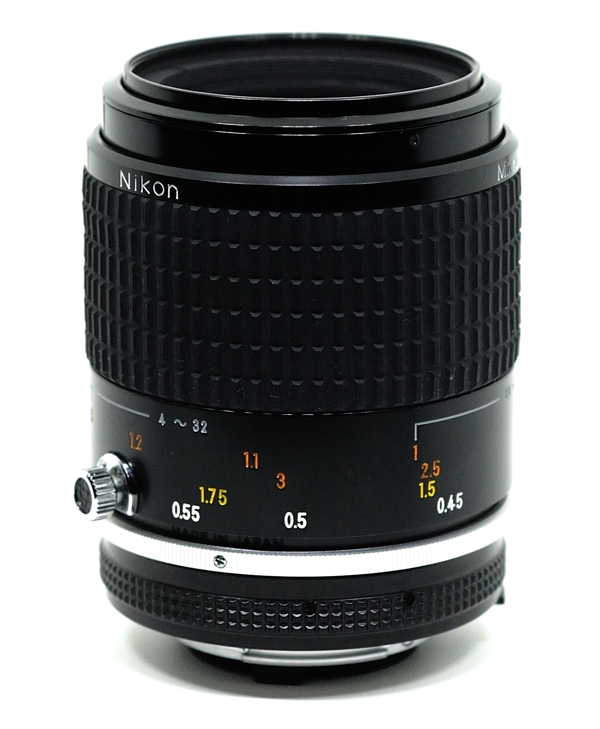
(Micro Nikkor 105mm f/2.8 AI-s)
Inside my camera bag
I usually carry a small shoulder bag or a messenger style bag for carrying my photography stuff. The bag usually has a camera with a lens mounted on it and sometimes a spare lens. Too many lenses tend to distract me. So I limit myself to just two prime lenses.
Religion and Photography
Cameras are now showing up everywhere. They are more prolific than mushrooms in rains. Everyone has them. Some use the cameras in mobile phones, others use compact cameras. Combine this with the cultural insensitivity of tourists and we have a big nuisance being faced by religious places. It is therefore natural that photography is prohibited in many such places.
I have a special attraction to religious places. Regardless of the religion, the peace, the atmosphere of faith combined with the mystery of religion which has trickled down the ages, makes these places intriguing for me. I have an urge to take my camera out and click everything that I see.
Dry Cabinet
I spent a good amount of my time living in coastal cities with my photography equipment. Coastal cities have high humidity and this leads to a common problem in optics – lens fungus.
In the earlier days of photography, people were not much bothered about the fungus. People owned and used a single lens most of the time which helped by exposing the optical elements to sun-light every once in a while. This prevented fungus. Even if the fungus grew, people did not notice it till it started causing excessive softening of the pictures.
Ansel Adams – His Influence
When I was a small kid, I found a book on photography in my grandfather’s library. I remember browsing through it and being amazed by the full-page photographs. The ones that attracted me most were that of a church and a photograph of a large rock with moon shining on top. When I could read the book, I understood that these were clicked by a photographer named Ansel Adams. There was no internet then and it was hard to find any information which was not easily available. A search in the school library gave me some more ideas about who Ansel Adams was.
Buying a used lens
Nikon gives me the advantage to use some really old glass. Most of the lens are compatible with even the newest of the DSLRs. User Manuals of all the cameras also list the lens that are compatible with a camera and which ones are not. Apart from old Nikkor glass, many used / old lenses from various other manufacturers are also available in the market. People keep upgrading and selling old lenses.
To use a clear filter or not?
One of the heated debates in photography is about the use of clear filters (UV/Haze/Clear) for protection.
The photographers discouraging use of the filters give arguments about the ineffectiveness in providing real protection to lens in case of fall, adding a piece of glass in front of an expensive lens bringing down the quality of the whole setup, increased flares and halos. Hoods provide better protection. There are incidents where the lens with a filter fell down and the filter failed to provide any protection and in a few instances ended up scratching the front element.
Zeiss 135 Apo Sonar or Nikon AF 135 DC
I was recently faced with a tough choice. I wanted to buy a 135mm lens for a full frame camera body. Purpose was for an all-rounder lens to carry around. I wanted a lens to do portraits, sometimes click pictures of butterflies, street photography as well as occasional family pictures from vacations. 105mm lenses were a little short for the kind of portraits I had in mind so I did not look at those options. 135mm is the ideal focal length for portraits according to me. The flattening is almost perfect and the angle of view ideal. I did a lot of research on 135mm lenses and tried out a few.
After searching around and trying various optics, I was left with two choices –
- Zeiss 135mm f/2 Apo Sonnar T* ZF.2
- Nikon AF 135mm f/2 DC
Caring for memory cards
Film era has ended and so have the lead lined cases for transporting films. The memory cards are the in thing now and they come with their own set of problems.
First of all, put your mind at ease. The memory cards are really really sturdy. Photographers tend to either loose them or upgrade to higher capacity cards. Very few of us have actually witnessed card failures.
A strong composition
What is a strong composition? Most of the advanced photographers who come to me end up asking this question.
In simple words – A strong composition is the one that puts your idea clearly. Ansel Adams has said, ‘There is nothing worse than a sharp image of a fuzzy concept.’
Continue reading A strong composition