Blueberries In Existing Orchard

Blueberries are among those plants that do not easily blend into a mixed orchard like ours. Their soil needs are quite different from most fruit trees. While apples plums pears and many others thrive in slightly acidic soil blueberries prefer a far more acidic environment. In some cases they perform best at a pH as low as 4.5 to 5. This difference alone makes them challenging companions in a diverse food forest.

Growing blueberries in containers is often suggested as a solution. In theory it works. In practice it demands large volumes of suitable growing medium. In my orchard fertile soil is limited. Much of the land is heavy clay and in places little more than rock. Filling large planters with purchased soil did not feel sensible or sustainable. Also, growing in containers requires a strict watering schedule which is hard to ensure in a place like ours.

Instead I chose to work with the land itself. I dug large planting pits in a sunny part of the orchard where the surrounding fruit trees are still young. Most of these trees are apples and plums planted about two years ago. To contain the contrasting soil of blueberries, I lined the sides of these pits with old untreated wooden boards. The result is a kind of buried ‘partial’ planter. The base is left open to allow natural drainage while the sides slow down soil mixing during the early years, while the boards hold up. Later these boards themselves will become part of the soil.

The blueberry plants that I bought, were in small pots. I reused the excavated soil from the planting hole and amended it lightly with pine needles and a small quantity of gypsum. To this I mixed the soil from the pots in which these plants had arrived. No fertilisers of any kind were added. Blueberries are sensitive plants and excessive feeding (especially chemical based) often does more harm than good, especially immediately after planting. Each cuboidal pit was roughly one foot deep and about two feet in length and breadth. The wooden planks were thin old boards with no chemical treatment so that they can slowly decompose without contaminating the soil.

Blueberries will remain much shorter than the surrounding fruit trees. I have often read that they make good neighbours but poor roommates. They can grow near other trees but struggle when forced to share the same soil conditions. These hidden in ground planters offer a degree of separation at least in the initial years. As the orchard matures the deeper roots of the apples and plums will draw minerals from wider and lower soil zones while the blueberries continue to feed closer to the surface within their acidic pocket.

Blueberries lack the commonly found root hairs as in various other plants, and so are quite finicky about the nutrients being available in close vicinity. I plan to focus on good mulch upto their drip lines, with occasional addition of sulphur and magnesium. (Though care will be required since sulphur can kill my precious fungal networks in the soil). Old folks who have been growing Blueberries for decades now also recommend tossing in a few rusted nails. The idea is to make iron available in case the soil is not acidic enough or iron is lacking.

To complete the system I plan to spread strawberries around the blueberry beds. Tomorrow, I have been invited to a lunch at one of my neighbours (Yes, I do visit people at times), so, day after tomorrow, I plan to transplant some strawberries from another patch to this area, and mulch a bit more with pine needles. Strawberries also enjoy slightly acidic soil and make an excellent living ground cover. They protect the soil reduce evaporation and add another productive layer to the food forest. Over time this small guild should settle into a balanced relationship each plant occupying its own niche without forcing compromise on the others.

Growing blueberries in an orchard like this is not the easiest path. But thoughtful design patience and a willingness to adapt make it possible to honour the needs of each plant while still moving towards a resilient and diverse landscape. I will write more about blueberries once I see how they turn out. Keeping my fingers crossed till then.

Click here for all related posts – Browse my blog on slow and sustainable living !

A Vote Against Humanity

Humans are a disease.

A slow one at first. Then hungry and progressing. Then proud of our hunger, and proud of the way we finish up the environment and everything else around us.

The word consumption once meant illness. A sickness that eats the body from the inside. People wasted away and finally disappeared. People were consumed by Tuberculosis, Leprosy, or even by Alcohol. Today the word has changed its meaning, but not its nature. Now we call ourselves consumers. We wear the word like a badge of honour. In truth, we are doing the same thing. We are consuming the planet. And like any disease, we are doing it without care for the host.

Some months back, I was reading a book on nature and a thought stayed with me. What if there was one council for all living beings. Not countries and borders, but species. A United Organisation of Organisms (UOO). In their first general body meeting, a simple vote is called. One species must be removes from the planet so the rest can survive. There is no debate. No anger. Just facts. Forests speak through what is left of them. Rivers show their poisoned waters. Birds arrive in fewer numbers. Insects barely show up at all. Still a vote is cast and the vote is crystal clear. Unanimous! Do I have to spell it out ? Yes, we are that bad a disease.

Look around for the signs. Air in Delhi NCR burns the lungs. Many Indian cities live under a grey sky. Children grow up knowing smog more than blue. Guests come to my homestay from pollution-choked cities, looking for a breath of fresh air, and then want to sit around a bonfire in summer clothes just for the sake of ambience. Does the smoke in the hills magically disappear?

Rivers carry foam and waste, instead of life. We burn coal and oil that took millions of years to form and finish it in decades. The climate shifts, seasons lose their rhythm, and we act surprised. We wonder that we are quite environment-conscious and have even a balcony full of plants growing in planters, how can we be the cause?

Oceans are filled with plastic. Fish eat it. Birds choke on it. Whales die with stomachs full of our rubbish. Forests are cut to build houses no one needs. Mountains are broken for minerals we throw away after a few years. We replace phones, clothes, cars, and other consumer electronics, while the land that feeds us grows tired and empty.

We are afraid of darkness, so we flood the night with light. Birds lose their way. Insects vanish. Silence disappears. We kill predators and then complain about imbalance. We poison soil and then ask why crops lack strength. We take and take, and when something breaks, we ask for more.

Maybe we are waiting for a big ending. A large meteor from the sky? Something that forces a pause. Something strong enough to stop us or wipe us out. The earth does not need saving. It will heal in time. The real question is simpler and harder. Can we stop behaving like a disease? Or will we keep consuming until there is nothing left but ourselves?

Click here for all related posts – Browse my blog on slow and sustainable living !

Towards Self-Sustaining Soil

As I hinted earlier, soil is a subject I can go on about for a long time. Here are some more thoughts on this. One of the major lessons I have learnt over the past decade is how the soil in natural forests remains self sustaining. Trees there grow tall and majestic. They feed countless forms of life and still they do not depend on any additional inputs. No one tills the land. No one turns the soil. No one carries fertilisers to them. No one performs labour intensive activities. Yet the system thrives.

The reason is simple. All the parts of a forest are complete and interdependent. Everything that is needed is already present within the system. The only major input comes from sunlight and to a smaller extent from rainfall. Everything else is part of a continuous cycle that feeds itself.

As I began moving my own orchard towards this balance, I read widely and experimented slowly. Over time a few realisations settled deep within me.

The first and most important realisation is that forest systems work because nothing is taken away from them. Plants produce food. Animals feed on this. They live their lives on the same land and return every bit of what they received back to the soil. Even their bodies at the end of life decompose in the same place. It is a closed loop. The place looks wild but it is an organised and a complete ‘closed-loop’ system.

In orchards this loop is broken. We take away fruits. We prune branches. We trim the orchard floor often. We even scare the birds away. All these actions remove nutrients that were meant to return to the soil. So one of the first changes I made was to stop this constant removal. Now I leave all clippings and cleared weeds on the orchard floor. Fallen leaves remain where they fall. Everything that grew on this land goes back to it. I still collect fruits but in return I add compost and manure. Even this need has reduced with time as the soil regains its natural rhythm.

A gentle word of caution is also needed. Excess of anything is bad and this applies to soil too. Adding too much organic matter is not always beneficial. Thick layers of mulch, especially when piled close to tree trunks, can trap heat and sometimes create harmful gases. During cold winters they may also shelter rodents that gnaw at the bark. I learnt this the hard way when one of my plum trees suffered damage. Overloading the soil with compost is equally unwise in an orchard that is slowly moving towards a self sustaining balance. Too much compost can disturb the microbial life rather than support it. Soil works best when its proportions remain in balance. Broadly speaking, a healthy soil contains about forty five percent mineral matter, twenty percent water, thirty percent air spaces, and only around five percent organic matter.

The second realisation is that soil should never remain exposed. In forests the soil is always hidden under leaves or under a natural layer of plants. Bare soil is a sign of disturbance usually caused by repeated trampling or rocky patches. So in my orchard I too keep the soil covered. Cover crops protect it. Mulch and compost protect it. Even when I plant new saplings I make sure that their base is covered, though taking care not to pile it too high. This biomass also breaks down steadily and returns nutrients back into the soil.

Another learning came from observing how plants breathe. They breathe not only through leaves but also through roots. Roots need air pockets. Good soil has around twenty to thirty percent of these air pockets. Two major enemies of these are compaction and flooding. Heavy machinery can compact the soil to such a depth that even the deepest roots struggle to push through. Clay soils also compact easily. Frequent tilling and turning the soil worsens this. So I stopped doing that altogether. I walk only on well defined paths and avoid stepping into growing areas.

Closely linked to this is the idea of not turning the soil. Each soil layer has its own purpose. Each layer is rich with its own form of life. Near the surface there are fungi, insects and worms that work on decomposition. Deeper layers host different worms and microorganisms that redistribute nutrients and allow water and air to move freely. Still deeper lie anaerobic organisms that thrive without oxygen. Turning the soil disrupts all of this. It mixes the layers and disturbs each group. It accelerates compaction. It reduces life in the soil over time. Many commercial farmers get caught in a cycle. They plough to break compacted soil but this ploughing again leads to compaction which pushes them to plough again. It becomes endless. Turning the soil also releases nutrients especially nitrogen into the air and exposes the land to erosion.

A self sustaining soil depends on life and not on force. My orchard is slowly moving in that direction. The soil has started breathing again. Earthworms have returned. Fungi are weaving through the mulch. Some days I feel the land is teaching me more than any book ever did.

And in these small and steady steps I am learning to trust the natural balance. My orchard is not a forest, yet when I follow the same principles of return and renewal the soil begins to find its own strength again. This quiet return of auto fertility shows itself in many subtle ways. The plants look healthier and become more resilient to environmental challenges. The fruits gain better flavour and size. Earthworms become more common. The mix of flora and fauna grows richer. New birds visit. More varieties of insects hover everywhere. Mushrooms appear on the orchard floor after a moist spell. These signs remind me that the journey is still unfolding, yet the rewards are already present and very real.

Click here for all related posts – Browse my blog on slow and sustainable living !

The Guests Who Add To My Zen

Most of the people who have stayed with me have added to my life in the most uplifting and unsuspecting ways. They arrived as guests and by some quiet magic departed as friends. Whenever I venture into the cities I try to look them up, though I confess I rarely escape my hillside fastness and my growing list of friends waits patiently like characters in a long forgotten novel.

The hills have a knack for sending me guests who lift the spirit like a sudden patch of sunlight on a cold morning. They appear at the gate with the sort of cheer that would make even a grumpy goat reconsider its life choices. Some carry a quiet wisdom that seeps into the place and settles gently between the apple trees. A few have inspired me to look at my orchard with fresh eyes and attempt improvements that I might otherwise have postponed until the next monsoon or the one after that.

These splendid souls wander about with genuine curiosity. They ask thoughtful questions and admire the soil as though it were a dear friend. They observe the terrain with lot of interest. They nudge me with gentle encouragement towards ideas that make the orchard healthier and more alive. After they leave I am often found examining neglected corners or plotting a new patch of herbs with the enthusiasm of a schoolboy who has just discovered a secret tree house. I am filled with new ideas that are actually practical and beneficial.

Only last week a family spotted a sombre corner of the orchard that receives very little sunshine. They suggested a set of sturdy little berries that brave the frost and though not likely to win any prizes in taste can produce a fine herbal tea full of antioxidants. Their suggestion was delivered with such warm conviction that I felt compelled to adopt the berries on the spot. The very next day I found them in a nursery located three hours away, and I managed to pick them up from there on that day itself. Most of my guests repeatedly visit me and when these do, I hope to serve them this herbal tea.

Then there are the rare birds who speak of minimalism and environmental matters with sincerity rather than fashionable zeal. They talk of living simply with such steady depth that one pauses mid stride and wonders whether one truly needs a new tool for every trivial task. Their insight is calm never preachy and somehow the trees seem to nod with approval whenever they speak. They remind me that the orchard is not just a place of labour but a responsibility and that the land responds generously when treated with respect rather than ownership.

I am reminded of the two young ladies who visited a few months ago. They spoke with such fire about the climate crisis that even the wind appeared to stop and hear them out. They spoke of forest fires, retreating glaciers, and above all the rising air pollution around Delhi, with a resolve that refused to look away. Their voices carried across the place like a clear call to arms and long after they left I found myself pondering what more I could do to further reduce my carbon footprint and make this homestead gentler on the world.

An elderly couple left behind a perspective that still feels like a small treasure. After a quiet walk and a simple meal they remarked that the greatest asset of this homestay was not just the cottage or the food but the experience as a whole. It was the peace the orchard the sense of space and the freedom from noise and rush that mattered most. Hearing this from people who had seen far more of life than I have felt like a gentle tap on the shoulder. It obviously boosted my ego, and it reminded me that the true worth of a place lies in the feeling it gives rather than in any single feature. Since then I have changed the way I speak to prospective guests. I ask them what they hope to experience instead of sounding the trumpet about delicious food or mesmerising views.

One of my repeat guests who is now very much a friend has given me a marvellous idea about striking a balance between the unkempt wild look and the tidier patches where one sits and contemplates life. His vision helped me create spaces that feel natural yet welcoming. Gardening tools resting in the greenhouse, wild grass edging the lawn, uneven steps made of local stone, and planter beds that seem casually neglected – all add to that cottage like charm. They also make my work smoother and many guests have admired this mix of order and wildness.

Some guests arrive with an interest in cooking and these are a delight. They share recipes as though handing over family secrets. Over the years I have learnt European salads and desserts, Arabic meats, Gujarati snacks, and a score of other delicacies. Last month a lady spent every second day in the kitchen during her stay here and cooked with such joy that the walls practically glowed. She taught us two delightful desserts that I have already made several times and each time I am reminded of her cheerful presence.

Then there are people who feel close enough to point out the small errors in my lifestyle including my tendency to gain weight. One of them tries to drag me out for long walks which, I admit, I secretly enjoy. Though he prefers walking in the evenings while I favour the daytime but somehow we still manage to meet halfway. From ideas on living happily and keeping healthy to conversations about finance and technology everything unfolds here and every now and then the focus lands on me and my life in these hills. It’s hard to justify to others why I don’t have financial freedom, but still feel happy doing what I do here.

Recommendations for books and films flow freely here. Many guests offer suggestions so perfectly suited to my taste that they often outshine the grand lists issued by respectable publications. I add them at once to my reading list and to my ever lengthening list of films to watch. These recommendations feel like small gifts left behind like bookmarks tucked gently between the chapters of daily life.

I sometimes think my place itself remembers these people. There is a warmth after they leave, a sense that something kind has passed through. Perhaps this is why guests return. Not only to rest in the quiet of the hills but to remind me once again that the world still sends good people to our door and that each of them leaves the place a little brighter than they found it.

Click here for all related posts – Browse my blog on slow and sustainable living !

Sanctity of Nights

The night is a sacred interval in the daily rhythm of the earth. It’s the time when soil cools, leaves rest, insects shift their quiet labours, humans sleep (or should sleep), and nocturnal creatures emerge to do the work that daylight does not allow. The onus is upon us humans to protect this darkness. As it so happens, we are the only species who are destroying it.

Light pollution is not merely a matter of wasted electricity or harsh city glare. It is a steady, invisible disturbance of ancient biological and ecological cycles. Wildlife suffers first. Birds migrate by the stars and become disoriented by bright skies. Nocturnal predators lose their advantage, while prey species live in a state of constant, unnatural alertness. Even insects, the smallest engineers of our ecosystems, spiral endlessly around bulbs rather than carrying out their quiet work of pollination and soil renewal. These are just a few examples out of thousands and thousands that are affected.

Human beings are also not spared from this disruption. Our bodies are attuned to darkness. Artificial light at night interferes with melatonin, the hormone that governs sleep and repair. When this rhythm is broken, the consequences accumulate slowly but surely. Sleep becomes shallow, mental health suffers, and long term risks rise, including metabolic disorders, depression, obesity and certain cancers. What seems like harmless brightness is, in truth, a subtle form of biological stress.

From a farmer’s point of view, even the land feels the weight of this constant illumination. Plants rely on night length to regulate flowering, dormancy, and seed setting. Soils cool and breathe under darkness. When artificial light blurs the boundary between day and night, even these silent processes begin to shift, and over time, the resilience of the land weakens. The harvest suffers.

In organic farming, we try to work with natural systems rather than overpower them. Protecting the sanctity of night is a continuation of the same philosophy. Light should be low and purposeful. It should fall only where it is needed and nowhere else. Fields, hedges, orchards and forest edges should be allowed their rightful darkness. The night is not a void to be conquered, but a living space that deserves respect. In my place, the lights are intentionally of low intensity that the nearby surface is visible, almost like under a full moon, but nothing more. No extra lights and nothing to light up the whole of the premises. That’s a waste.

There is also a quieter loss from light pollution, one that is harder to measure. When the stars disappear behind a veil of artificial glow, our view of the universe is obscured. For most of human history, the night sky was a shared inheritance. Constellations were calendars, stories and maps. Today, light pollution severs that connection, not only robbing ordinary people of wonder, but actively hindering astronomy and our ability to study the wider cosmos. We lose both knowledge and humility when we can no longer see beyond our own rooftops.

Then there is the simple matter of waste. Light pollution is energy thrown away, increasing the overall carbon footprint. It is money spent to illuminate empty roads and empty sites, vacant fields, and sleeping buildings. It is needless carbon in the air and needless strain on already stretched resources. In a world where so many still live with limited access to power, this excess is not just careless, it is unjust.

Now, people from cities who have bought pieces of land in this village are beginning to build their houses and projects here. Along with them, they have brought the city habit of flooding the night with unnecessary light, born more from discomfort with darkness than from any real need. Just today, I messaged three of them requesting that they switch off their bright outdoor lights. The most telling part was that one of those homes was empty, and another construction site had no work going on and not even a soul in sight. No one was there, yet the lights burned on through the night, illuminating nothing, protecting no one, and quietly erasing the natural darkness that this place has long lived by. The third person was actually present and seemed quite unaware of the harm such lighting causes. Thankfully, he switched off his outdoor lights after reading my message. I may come across as stern or even ill-mannered when I send these reminders, but it feels necessary. Someone has to speak for the night before its quiet beauty is lost.

When I stand in my orchard after sunset, with only a few small shaded low-intensity lamps at a distance, I can hear the land breathe. Crickets rise in their steady chorus. An owl passes in silence and lands on my roof. Nightjars care be heard. The trees feel taller, older, as though they remember a time when the world understood how to sleep. The sanctity of night is not a romantic idea. It is a practical truth. Darkness is as essential as sunlight. Without it, wildlife falters, human health weakens, energy is squandered and our gaze is trapped on the ground instead of lifted to the stars. To protect the night is not to move backwards. It is to live wisely, in rhythm with a world that still knows the value of rest, mystery and deep, healing dark.

I hope people reading this will start turning off the lights and maintain the sanctity of nights.

Click here for all related posts – Browse my blog on slow and sustainable living !

Non-Conformist Orchard

Few days back, I had some visitors from the other side of the globe. They wanted to explore my orchard. I walked down the narrow orchard pathway with them. However, I found myself listening less to my own explanations and more to the rhythm of their footsteps. A confused pause here. A hesitant stop there. It is a curious thing, this moment when two very different ideas of the same landscape quietly collide.

I was describing the regenerative systems that now guide my farming methods when I noticed the faint but unmistakable expression of disappointment on their faces. It did not come from arrogance, or so I hoped. It came from habit. From a deeply ingrained image of what a traditional orchard should look like. For them, order in the orchard was a proof of care. Uniform spacing of trees. Single species in long, straight lines, crossing each other at right angles. Exposed soil, regularly tilled, free of anything that could be called unruly or a weed. The popular thought that discipline of the land was interpreted as respect and care for it.

What they found instead was a living, layered system. I tried explaining the concepts and philosophy behind it. The orchard floor was not bare but deliberately covered. A mix of leguminous and non-leguminous cover crops fixed nitrogen, improved soil structure, and kept the microbial life active. Wildflowers occupied the edges of light and shade, inviting pollinators and beneficial insects. “Weeds”, as they are commonly labelled, were acting as dynamic accumulators, drawing trace minerals from deeper soil horizons and slowly returning them to the surface through leaf litter. Wild berries grew here and there.

Because the orchard lies on a steep slope, tree placement here has been guided less by geometry and more by the actual lay of the land. Each planting spot was chosen depending on each plant’s or each tree’s requirements of the soil depth and content of the soil, drainage, sun exposure, and wind patterns. Over time, the system has been moving steadily towards what one might call a semi-managed food forest. A loose canopy of taller trees, sub-canopy of mostly fruit trees, berry shrubs such as raspberries and blackberries, climbers like kiwi, and a functional ground layer that even includes edible species like wild strawberries, green peas, beans, and various herbs too.

In winter, the trees prepare for dormancy and shed their leaves. They fall, they gather, and they stay. I find this stage deeply reassuring. It is visible evidence of nutrient cycling in motion. The soil also starts to get richer. Earthworms pulling fragments of leaf matter down into the darker soil layers, and fungal networks developing further. To most people, however, this is often seen as neglect. My visitors could not understand why the orchard floor was not “cleaned”. Why I did not till and turn the soil. Why I allowed what they saw as waste to remain.

Their confusion amused me in a gentle way. Not mockingly, but with a kind of inward smile. I have stood in orchards like the ones they admire. I understand their sense of visual comfort. There is a strange satisfaction in straight lines and bare earth. Yet, I also know how biologically silent such places often become with passing years.

When I explained that mixed species planting increases resilience, they listened politely. Genetic diversity, I told them, spreads the risk. Different flowering times reduce the chance of complete crop loss. A varied root architecture improves soil stability and water infiltration. The harvest stretches naturally. Early spring fruits, mid-summer abundance, late-autumn heaviness, and then the quiet handover to preserves, jams, and dried fruit that store the memory of sunlight for colder months. Yes, they were polite, but quite disinterested too. Happens at times. I cut short the tour so as to get them back to the comfort of my manicured lawn, and to offer them a cup of hot herbal tea while enjoying the winter sun.

The question of profit emerged, as it often does. How can such a system be financially viable? Large orchards in their countries run like factories and produce fruits that in turn brings in lots of money. I explained that much of the produce is consumed fresh, turned into preserves, shared with friends, and extended to charitable groups. From their perspective, this seemed inefficient. From mine, it felt entirely logical. They measured value in terms of yield per acre and market price. I found myself measuring it in different units. Soil that improves rather than depletes. Water that infiltrates rather than runs off. Fruits that carry no chemical residues and are full of nutrition. A household that eats healthy, and in rhythm with seasons. Friends who taste something grown slowly, with attention rather than force. Their appreciation and wishes are my earnings.

As we walked further, I became aware of something quietly comic in the whole situation. They had been genuinely keen to see the orchard. I had been equally keen to show it. Yet, neither of us had paused to ask what an orchard meant to the other. They were expecting a controlled system. I was offering them a conversation with ecology.

It was a harmless mismatch, and in that harmlessness there was something almost comforting. It reminded me that the world still holds multiple visions of how land should look and behave. In the future, I think I will begin such walks with a small conversation. I will ask what they hope to understand. If their curiosity leans towards sustainable systems, we can spend long, unhurried hours watching soil, insects, leaves, and light. If they seek the neatness of industrial horticulture, I can gently guide them to the villagers nearby who still manage land that way. There is no judgement in this realisation, only a quiet clarity. Everyone is different and everyone’s understanding is shaped by the knowledge and exposure they have had.

I, for my part, am learning that not everyone who walks through a living orchard is ready to hear what such a landscape is softly saying. Trying to explain the deeper rhythms of this kind of farming in a short visit often feels hurried, incomplete, and quite frequently unwanted. Yet those who arrive with genuine curiosity are always welcome to learn more. With them, I am happy to linger, to answer their questions, and to gently share how and why this place grows the way it does.

Click here for all related posts – Browse my blog on slow and sustainable living !

A Quiet Start to the Day

My mornings begin with the blue-whistling thrush singing into the thinning dusk. Its notes are clear and melodious, like some early morning raga, and they slip gently into my sleep. I open my eyes slowly, wrapped in that familiar mountain laziness. Once, I could spend a little more time drifting in and out of dreams. Now, if I do not rise with the thrush, I will be greeted instead by the growl of excavators in the neighbouring plots. Their noise cuts into the hills like a saw. But the bird usually wins. Its song is an inspiring thing and it pulls me up before the machines can disturb me.

Still in bed, I check my phone. Not for the endless chatter of social media, which I dodge like a low branch on a mountain path, but for messages about bookings or the occasional small opportunities that help keep this place alive and my family well-fed. Sometimes I attempt the daily chess puzzle, just to wake my mind before the day begins to tug at me from all directions.

The first issue is usually the power. A strange quirk in our power supply system means that if the batteries drain at night or if the voltage from government supply jumps too high the whole supply collapses. Winter makes this worse because the solar panels do not gather enough light. I keep the main power line connected during winters but that comes with its own challenge: here we do not suffer from low voltage like much of India but from high voltage. It often touches 260 volts. When it rises too high the protective circuit steps in, refusing to supply power, and the batteries empty themselves trying to run the heaters. When I complained, I was told with great confidence that 260 volts is “normal”. It was almost funny. Almost.

Then I walk down to the water tank. The path is uneven and the orchard spreads around me in sleepy silence. This is to reset the power-supply system and to check the status of water. First I start the power-supply again. Then I move to the water tank. I lift the lid of the tank, peer inside, and judge how much of the day can be shaped around whatever water the mountain has seen fit to give. In summer this task stretches into an hour, kind of like a slow planning between me and a resource that refuses to be hurried.

After that comes my daily BSNL ritual. The internet, like a shy animal, disappears more often than it appears. The complaints are quietly closed without action, so I simply open new ones and carry on. It is an odd kind of patience that mountain life teaches: you learn to work with slow signals and slower systems. Even now, as I write this in the evening, there is no internet. I am tapping these words out through a weak hotspot that flickers like a firefly.

After that come the bills. There is always one waiting, like an uninvited guest who insists on turning up every morning. Yesterday it was the internet bill, impressive for a service that barely works. Today it was electricity. Tomorrow it may be school fees or groceries or gas. Some days the flow of expenses feels endless and I wonder how many tiny leaks one middle class financial life can endure.

By the time my morning rounds are done, I have already met a full range of distractions, annoyances, and small stresses. People imagine that I live a carefree life, untouched by the usual worries. If only they knew the effort it takes to keep this place running as simply as it appears. Yet, the odd thing is that I remain happy through it all. Not because the problems disappear but because I have learnt, in my own slow way, to let them pass through me like wind moving through tree branches.

The quirky 260-volt “normal” remark makes me smile now. My daily walk to check the power supply has become part of my exercise; a small gift disguised as a nuisance. Even logging a complaint to BSNL has become a kind of morning mantra. One clicks, one breathes, one lets go.

After breakfast, everything starts to shift. Once I step into the orchard after breakfast, the small irritations of the morning fall away like dried leaves. Nature is my reset. I look at the trees, many of them rising bravely out of difficult soil. I notice how they grow, inch by inch, even when conditions are far from perfect. There is a lesson there that I do not miss.

The birds hop in the branches, the breeze moves down from the higher ridges, carrying a chill that wakes me better than any coffee. The sun touches the frost and turns it into mist. The whole place breathes, slowly and patiently. And in that breathing I find my own peace again. I feel my mind loosen and settle. My world becomes simple again.

Life here is not effortless. But it is straightforward. And in its quiet way, I choose happiness every morning, no matter what the voltage says.

Click here for all related posts – Browse my blog on slow and sustainable living !

Overwatering Troubles and Fixes

In nature water is a giver of life but in pots it could just as quickly turn into a quiet agent of decay. Over the years I watched many people care for their potted plants with the warmest intentions yet unknowingly harm them. I had made the same mistakes myself in the early days. Over-watering was one of the easiest traps to fall into and also one of the deadliest. Now, when I see wilted plants in the pots of an over enthusiastic gardener I almost always assume the reason is too much water and not drought.

In open soil, the earth behaves like a giant sponge. Rain sinks down through many layers and moves slowly into the lower ground. This is why I prefer to leave as much bare earth (though covered with vegetation) as I can on my land. When it receives direct rain, and has good organic matter, trees and shrubs thrive. Even in days of heavy rain the ground keeps breathing. The roots stay in touch with air and remain healthy. Pots however do not offer this freedom. A pot is a closed little world where the natural flow of water has nowhere to go once the soil is full.

Overwatering affects not only root respiration but also the entire nutrient uptake pathway in potted plants. When the soil remains saturated the pore spaces that normally hold air become filled with water, creating anaerobic conditions. Under these low oxygen levels the fine root hairs, which are the primary sites for nutrient absorption, undergo rapid decay. This reduces the plant’s ability to take up essential ions such as nitrate, potassium, calcium, and magnesium. Prolonged saturation also leads to leaching of mobile nutrients, especially nitrogen in the form of nitrate, which moves easily through waterlogged media. In addition, anaerobic conditions promote the growth of harmful microbes that convert available nutrients into unusable or even toxic forms. As a result plants show chlorosis (yellowing), stunted growth, weak stems, and increased susceptibility to root diseases. Chronic overwatering disrupts both the physical and biochemical processes that allow a plant to feed itself. So, even if the plant is alive, it may not be as healthy as it should be due to overwatering.

When water collects at the bottom of a pot the roots sit in a dark airless pocket. In the past I often misunderstood these signs. I clearly and painfully remember a particular marjoram plant that looked tired so I watered it again thinking I was helping. Within days the small leaves turned yellow and soft. They fell at the slightest touch. Only when I pulled the plant out did I realise the roots were brown and mushy. By then the damage was done.

Things became even worse whenever the drainage holes clogged. I once had a large ceramic pot with a young hybrid raspberry plant. It grew beautifully for months then suddenly stopped. I watered it more and the poor thing collapsed within a week. When I checked the base I found that the hole had been blocked by crumbled stones packed with a mass of clay. In another case my lemon plant died because a single leaf had lodged itself over the hole and sealed it like a stopper. A fatal mistake that someone overlooked while planting the tree in that pot. Each watering had filled the pot like a bucket.

Some of my neglected pots created problems of their own. Over time the soil settled and compacted. In some older pots the soil became so tight that water simply sat on top or drained down the sides without touching the roots. Our soil here is heavy and clay rich even when mixed with compost. It used to turn into a sticky mass when wet and a hard cake when dry. Many plants could not push their roots through such resistance and slowly gave up. In those days I lost rosemary, thyme, basil, and lots of daisies through this mistake. Daisies in particular suffered as they dislike wet feet and die quickly in soggy soil.

To avoid repeating these errors I have now learnt to see when a pot is being overwatered and with timely intervention could save precious plants. I am now planning to buy a small battery operated moisture meter to check the pots more accurately. It should prove helpful because our eyes are not always reliable in judging moisture inside a deep pot and sometimes when me or my gardener are in a hurry, we tend to overlook the obvious tell-tale signs.

The long-term cure is however quite simple. I now use a light airy mix everywhere. I keep the holes at the bottom open. Sometimes I place multiple pebbles over the holes to prevent clogging. When my back permits, I lift the medium sized and small pots often to feel their weight. A waterlogged pot feels heavy and dull. Good soil feels crumbly and lightly moist. I water only when at least half the pot has dried out and the surface looks dry and loose. I also adjust watering with the seasons. In winter the plants need very little water.

Another interesting thing I learnt is that even in open ground a planting hole can behave like a pot. If the soil one digs out is heavy and rich in clay, the hole can hold water like a container with a closed bottom. When I am unsure I simply fill the hole with water and watch how fast it drains. This tells me what kind of tree will suit that spot. Pears for example can handle slightly heavier and more waterlogged soil. Peaches cannot tolerate it at all. When I backfill the hole I also make a small mound so that water does not collect around the base of the young tree. A little soil improvement helps as well and often makes the difference between a struggling plant and a healthy one.

Usually, in the wild plants have room to breathe and space for their roots to wander. In pots they rely entirely on us. A little patience and a little restraint with the watering can have saved many of my plants in recent years. Looking back I realise that most potted plants die not of thirst but of too much love in the form of water. A lesson that I am trying to pass on to my team and everyone who visits me.

Click here for all related posts – Browse my blog on slow and sustainable living !

Sunshine and Friends

There are friendships that arrive like sunlight through a window. They warm the room without asking permission. Some time back I was honoured by the company of two such friends. They had bought a small piece of land not far from the orchard and were now planning to plant trees there. A job after my own heart. Anyone who wishes to plant a tree becomes an ally of the hills at once.

But the real joy of their visit lay not in the plans for saplings. It was in the laughter and the strangely beautiful disorder that good company brings. The first evening set the tone. We settled down for dinner, and one of them suddenly declared a desire to listen to Bappi Lahiri. The way he enjoyed himself was delightful to watch. There he sat with the carefree cheer of someone who has temporarily mislaid all his worries. The beats played on, bold and bright, casting an odd yet cheerful glow over the old stone house.

Later we opened a bottle of vodka with some lemon juice. They made themselves a drink each while I stayed loyal to my lime juice (though I did enjoy a few beer here and there during the lovely time with them). The music wandered into conversations about old films. From there, the topics jumped about in a fashion of their own. Before long we found ourselves deep in an unexpectedly vigorous debate on Mother Teresa. Loud arguments filled with laughter rolled across the room. At one point I remarked that the vodka must be potent stuff. It was only later that I discovered neither of them had even finished a full drink. Perhaps the hills, not the vodka, are what loosen the knots in us.

What mattered most was that all three of us were entirely present in the moment. They are close friends and I am the late entry in their well-seasoned camaraderie. Yet I felt as though I belonged in their circle. That is the peculiar magic of good friendships. Stress and negativity dissolve like mist. What remains is warmth and the kind of laughter that lingers long after it has faded from the air.

The next day we visited an old temple hidden in a nearby village. To reach it one must walk through a pathway flanked by stinging nettles, as if the temple insists on a small toll before granting entry. We were lucky to walk past without touching them. The temple was serene and quiet. Though it had been renovated from time to time, it still carried its own gentle charm. The fresh paint and ceramic tiles had not entirely robbed it of its soul. It stood there with the calm dignity of a place that has seen generations pass, accepting each change without losing its essence. I wished I had packed a picnic basket. It was the kind of spot where one could spend a long afternoon doing nothing more than listening to the wind. Perhaps next time, with another friend or two who appreciate such secret corners of the world.

One of the days we took ourselves to a mountain stream for a small picnic. The sun was kinder there and the water sang its own leisurely tune. It was peaceful to sit on the bank, warming our backs in the sunshine and listening to the steady flow of the stream. The water was too cold for a dip. A couple of birds swept past us and disappeared into the pines. The only blemish was the litter left behind by careless visitors. It reminded me to carry a garbage bag next time and clean up the trail. One must, after all, protect the beauty that one enjoys.

On the way back we found ourselves discussing music again. Something about the sunlight on the road brought to mind “Ob-La-Di, Ob-La-Da” by The Beatles. This in turn led to a lively comparison with a line from “Meri Mehbooba” from the Hindi film ‘Pardes’. It is curious how songs drift through the mind like wandering birds, each perched on a memory.

Those days passed too quickly. They left behind echoes of laughter in the rooms and a pleasant lightness in the orchard air. Friendships have a way of doing that. They make a place feel richer for a while. And when my friends finally left, walking down the familiar path, I knew the sunshine would eagerly await their return. It is the company of good people that lends richness to the slow, quiet life I cherish here.

Click here for all related posts – Browse my blog on slow and sustainable living !

The Guests Who Test My Zen

Someone asked me about the signs or indicators that make me judge others in an instant. This was a difficult question for me. Sitting around a bonfire asked by a genuinely interested young couple I had to answer this. I am typing it out here too with the hope that someone may read it and understand my point of view. I try not to judge people and keep my prejudices locked away but at times in my mind I form an opinion of people quite early in conversations. To reassure myself I must add that such guests are exceedingly rare. Perhaps only a handful over all these years and I am quite certain none of them will ever read this. They all shared one remarkable trait: a heroic disinterest in reading of any kind. So if you are here reading these words you may safely stop searching for your reflection in any of the following descriptions. You are clearly not one of them.

Most guests are the sort that would warm even the stiffest upper lip. They arrive with a delight in the mountains a curiosity about the orchard and a gentle willingness to listen to birdsong without even taking out the ubiquitous Bluetooth speaker. Then there are others. Curious specimens who drift into one’s life like leaves blown in from a slightly confused tree.

At the bottom of my list remain the worshippers of film stars and youtubers. These enthusiasts sit about as if in expectation of divine revelation and recount instances from film stars’ private lives with a fervour usually reserved for mystics. (Does anyone remember the Lehren series of the 90s?) Some of my family members are also quite similar. Hot on their heels are the devotees of cricketers. Devotees of the game are fine considering that some even say that Indians have cricket flowing in their blood, but worshiping a cricketer is beyond me. I appreciate a well played game but the habit of elevating players to celestial heights makes me long for a quiet bench and a cup of tea.

Next come the high priests of the glowing phone screen. They enter a state of trance while swiping reels that flash by like confused lightning. The look on their faces is that of a person who has mislaid their soul but retains the hope of finding it somewhere between two poorly edited videos. I have been there and I know how difficult it is to keep down the screen. I still struggle at times and I have to consciously make an effort to avoid getting enslaved by this new age demon.

Then there is a category that deserves its own museum gallery. I speak of the self congratulators. These are the guests who begin every sentence with the word I. After ten minutes in their company one is convinced that they are the first humans ever to run a business, buy a car, take overseas vacations, or take a holiday in our humble hills. Their favourite sport is recounting their own achievements and they play it tirelessly. Thankfully, from what I have observed, someone in their group usually is the opposite and this person keeps the conversations more grounded.

Closely related are also the peacocks of prosperity. These individuals feel compelled to mention prices of things without provocation. They tilt their wrists in the sunlight so that the logo on the watch may shimmer for maximum effect. They speak of villas in cities I have never asked about and drop brand names as if scattering birdseed. Their attire shows more brands on them than even the number of stores in Almora’s only mall. The mountains remain unmoved in front of them though I sometimes find myself longing for a shovel simply to dig a small hideout. My finances are modest so their wealth and the financial freedom it brings are beyond my imagination, yet I still fail to see the point of such fierce attachment to objects when everything has to be left behind one day.

Then there is the tribe of name droppers. These are the guests who cannot complete a sentence without ushering in the name of some well known personality or an acquaintance who once shook hands with a politician. They speak of ministers and celebrities with the practised ease of someone reading out a grocery list. One moment we are discussing the trip to a temple or a nearby stream, and the next they are confiding tales of their close association with a certain politician who may or may not remember their existence. I listen politely though deep inside I suspect the mountains would be far more impressed by a person who knows the name of the bird singing in the oak than by someone who once attended a distant cousin’s dinner with a cabinet minister.

One must not forget the fashion adventurers. I have seen ladies attempt to walk through the orchard in high heels with a determination that would impress a mountain goat though not necessarily a doctor. The heels sink the ankles wobble and the entire enterprise becomes a dramatic performance of human optimism against the laws of physics. Some arrive dressed for a runway event rather than a hillside orchard and I watch with a mixture of horror and admiration as they attempt to navigate roots stones and occasional cow paths while clutching a designer handbag like a life raft. I felt that I was in a similar category last year when I visited a coastal town but dressed up in my summer clothes from here which were incidentally still too warm for that town.

There are also guests who arrive with a sort of brisk authority as if they have been appointed inspectors of rural life. They peer at the compost, ask suspicious questions about the vegetables, tap tree trunks, and then nod in a manner meant to suggest expertise, though it is clear they could not identify a plum tree if it introduced itself politely. My gardener with his serious demeanor has quite a hard time coping up with these experts. I pity his nerves at time.

And of course there are the ones who cannot stop giving advice. Before these instant experts have unpacked they suggest changes to the orchard the layout of the rooms the menu the weather patterns and occasionally the laws of nature. One tries to be gracious though inside something whimpers softly. From cemented tennis court on the lawn to a swimming pool, trust me, I have heard it all.

Still all of this is said with the affection of a man who has seen many types wander through these hills. I suppose what truly gets under my skin is not the people but the quiet disregard for the simple pleasures that the place offers. The wind in the leaves the scent of herbs the satisfaction of soil under one’s feet. When someone prefers celebrity tales brand labels or reels it always feels like a small missed opportunity.

Yet each guest brings their own story and the hills have a way of softening even the oddest ones. After all if the compost heap can turn chaos into nourishment then surely there is hope for all of us.

Interestingly I have begun to notice a rather heartening pattern. The guests who truly understand this place are the ones who return again and again as if the hills have quietly adopted them. They slip back into the orchard with the ease of old friends taking their favourite chair. What surprises me even more is when those who do not connect with the place at first still choose to return. With every visit they seem to shed a layer of noise and hurry and begin to match their rhythm to that of the mountains. They grow a little quieter a little more observant a little more content to sit under a tree and simply be. It is as if nature herself is conducting a slow gentle training programme turning even the most distracted visitor into someone who eventually belongs here.

Click here for all related posts – Browse my blog on slow and sustainable living !

Soil First

If I ever had to limit myself to only one activity here in the orchard, it would be building the soil. Everything else that we usually consider essential becomes secondary when soil is alive and balanced. Clearing the orchard floor or pruning or managing pests or correcting deficiencies all matter, yet none of them equals the impact of healthy soil. Even watering becomes far less critical. Soil that is rich in organic matter and well structured can absorb and hold water so efficiently that trees can thrive just on rain, snow, and dew.

Soil is not simply the ground beneath us. It is a living system. It is the base through which minerals flow, the habitat where microbes feed and multiply, the medium that holds water and air in a delicate balance, and the physical structure that anchors every plant. What I have now realized is that the health of an orchard is nothing more than the visible expression of the health of its soil.

My own journey began some years ago with trying to understand what I had. Initially, I collected soil samples from many parts of the orchard and sent them for an extensive analysis. The results were sobering. Most macro nutrients were grossly deficient. The pH had become too low after years of leaching on the mountain slope. The balance of minerals was disturbed in a way that affected both availability and uptake. Organic matter levels were quite low, which meant poor water holding and weak microbial life. Most parts of the orchard had heavy clay where water drained slowly and roots struggled to breathe. However, other sections had rocky and sandy patches with very little silt and clay, and water passed through too quickly. It was clear that this soil was not one uniform entity but a mosaic of conditions, each needing its own care. Though one thing was obvious it needed care everywhere.

Before doing anything else, and in disagreement to the prevalent consensus, I stopped all chemical use. No pesticides, no insecticides, no fungicides, no weedicides, in fact no ‘cides’ of any kind. No even any chemical fertilisers. This single decision changed the entire trajectory of the orchard. The land needed time to heal. I allowed old forest trees and fruit trees to grow naturally. This simple act of stepping back and letting the place become wilder worked like a reset switch for the ecosystem. Over the next seasons the trees grew taller and fuller. Their leaf fall layered the orchard floor with natural mulch. This set in motion the quiet work of decomposition. Leaves broke down. Fungi sent out their hyphae. Bacteria and protists returned. Soil organisms that had been suppressed by tilling and chemical fertilisers slowly regained their place. I could see the change happening. Each year the presence of mushrooms increased. Their fruiting bodies were a sign that the fungal networks underground were becoming strong again. As the soil revived, even the older fruit trees showed renewed vigour and the quality of the fruit improved.

Once the natural processes were underway, I began adding material to build structure and restore balance. I collected dry leaves from the orchard and nearby woodland. I used wood shavings, compost and occasionally old manure too. I broadcast white Dutch clover seeds to act as a cover crop, fix nitrogen and protect the soil surface. Wildflower seeds from the region added diversity and supported beneficial insects. I also used natural amendments like neem cake, sea kelp, fish meal, blood meal and bone meal at places where the initial soil testing report had given extremely concerning results. These natural sources are rich in trace minerals and organic compounds that nurture microbial activity.

With time and reading I realised that the true correction is not only about supplying nutrients but about restoring the ratios among them. Plants do not need huge amounts of every element. They need balance. In fact they do better in deficient soils but where the elements are in proper ratio, compared to soils rich in elements but with grossly altered ratios of these elements with respect to each other. Soil must also have the capacity to hold nutrients and release them through cation and anion exchange. (Let’s discuss CEC levels when we meet if it interests you). This depends on organic matter, clay content and the biological activity in the soil. A nutrient imbalance can cause deficiencies even when the nutrients are present. Correcting the internal chemistry of the soil was as important as adding any external input.

One of the most important insights that I have gained is the role of microbes in nutrient uptake. A major portion of what plants absorb does not enter directly through roots. Instead it is mediated by an extraordinary community of microbes. They convert minerals into plant available forms. They transport nutrients along fungal networks. They protect roots by competing with harmful organisms. They even help plants communicate stress and send defensive signals. By removing chemicals and reducing soil disturbance, I allowed this underground community to rebuild itself. The microbes did what they have evolved to do for millions of years, and the trees responded with greater health.

The work of building soil never truly ends. Every passing season I continue adding organic matter, encouraging ground cover, reducing compaction and letting natural processes unfold. I watch the soil becoming darker and crumbly. I watch it hold water through dry spells. I watch fungal threads weave through the leaf litter. I see more insects, more earthworms and more signs of life with each year.

Soil building is one topic I can spend hours discussing. If anyone is interested, join me in a discussion over a cup of coffee, while listening to the songs of the blue-whistling thrush and smelling the scent of the moist soil below our feet. I’ll be more than happy.

The orchard today stands on a foundation that is still quietly growing and improving. There is something humbling and beautiful in knowing that the most important work happens below the surface, hidden from the eye. It is said that a handful of healthy soil holds more organisms than there are people on our planet. These tiny creatures create resilience, flavour, vitality and longevity in every tree. Soil building is patient work. It invites us to observe, to understand, to cooperate with nature rather than control it. It is a practice that rewards not only this generation of trees but the ones yet to come.

Click here for all related posts – Browse my blog on slow and sustainable living !

Spirituality Begins Where Nature Is Respected

While walking around and tending to the orchard here, I feel the presence of nature in every breath I take. At this altitude the air carries the scent of pines and herbs, The place sings with the sound of dry leaves in the wind mixed with the bird songs. When I walk through the orchard in the early morning the frost still clings to the leaves during winter months and the sun rises slowly over the ridges. In those moments something within me becomes still. The nature speaks in its own gentle way and I feel held by the ground I walk on.

Living in sync with the orchard has become a source of deep spiritual nourishment for me. The rhythm of the seasons here is slow and yet persistently ongoing. Trees take their time to bloom. Soil responds with patience. Migratory birds return each year with familiar songs, while many of them stay back here all the time. When I tend to the new plants or mulch the beds or observe the way water moves across the slope I am reminded that nature has its own wisdom, and we are far from understanding it. Everyday is a new learning. This way of living has shaped my own inner life. I have become more grateful and more aware of the quiet lessons that the earth shares. The more time I spend in my orchard the more I respect the living world around me for it reveals the beauty and intelligence of creation and guides me towards a deeper spiritual understanding.

I often see people flocking to the hills in search of peace, spirituality, and natural beauty only to destroy the very essence of what they claim to seek. They build large concrete structures and clear every tree from a slope and somehow believe that this will bring them closer to nature. How does this work for them I fail to understand. A place without trees without soil that breathes and without birdsong cannot offer true calm. It becomes a hollow shell of the hills with a replica of cities they are trying to escape, rather than the living landscape they came to experience.

Over time I have come to believe that people who destroy nature cannot truly be spiritual. Anyone who is spiritually awake understands that every living thing has its own place. And this applies to most religions that I know of and even those people who call themselves atheists. They recognise that the land is not something to exploit for quick gain. It is a home that shelters us and feeds us and teaches us. When someone removes trees without thought or damages natural streams or exhausts soil it reveals a disconnection from life itself. True spirituality cannot grow where there is disrespect for the earth.

For me, every part of the orchard offers companionship. The apple trees and pear trees, the herbs that grow in sheltered spots, and the wildflowers that appear during spring or after the rains – all feel like members of a living community. When I work with them rather than against them I feel a sense of belonging. My spiritual energy feels lighter. It becomes easy to let go of unnecessary concerns and return to a simpler and more grounded way of being.

My orchard continues to guide me. The more time I spend among the trees and the soil the more I grow as a person. The more closely I observe the natural rhythms here the more balanced and peaceful I feel. Nature is not separate from my spiritual path. It is the heart of it and this orchard is my teacher or my guru every single day.

Click here for all related posts – Browse my blog on slow and sustainable living !

Wind Chimes and Prayer Flags

There is something very soothing about the sound of windchimes in the wind. When everything around is quiet and when the only other sound is the rustling of leaves on the trees, the chimes become gentle companions. With every soft gust, the last remaining leaves fall from the deciduous trees. A lone blue whistling thrush hops about in a small patch where the morning sun has already begun to warm the earth before the frost returns in the evening. In this simple scene the wind moves through the chimes and creates a tender music that feels like a whispered teaching and a message of happiness.

Yesterday I visited Nainital and from a busy tourist market I brought home a new set of windchimes and some Buddhist prayer flags. Buying from such places is often more expensive yet these families must also survive and flourish. I also did not mind spending time with the shopkeeper. His parents had migrated from Tibet in their youth. He showed me many beautiful things from colourful porcelain to small metal charms most of which were far beyond what my pocket could allow. I chose only a set of chimes and a string of flags. Over a cup of tea he spoke to me about their meaning and the conversation settled into my mind like a gentle blessing and also as food for further thought.

This morning, once the blue whistling thrush had warmed itself in the sun and flown away, I went to the clearing where my old chime was hanging. It is smaller than the new one and has weathered many years of harsh seasons. I removed it gently and placed the new larger chime in its place. The new chime has a deeper voice yet chimes less often because of its weight. The older chime has been like an old friend and it felt right to hang it on a peach tree further down in the orchard. Now when I’ll sit in the winter sun I will hear the deep meditative sound from the new chimes and while working near the peach I will be able to enjoy the playful notes from the old ones.

I then took out the prayer flags. They are small pieces of cloth on a string with prayers printed on each one. They have five colours that represent the five elements. The belief is simple. When the wind flows through the flags the prayers travel outward and spread harmony. A blessing is not meant to be held. It is meant to flow. Against the dark green oaks and the bare branches of apples and pears these colourful flags stand out and add a quiet touch of brightness and happiness.

Among the flags was another version similar to the prayer flags with the famous mantra Om Ma Ni Pad Me Hum. I hung it under the pergola I had built for grape vines. The soil may not favour grapes but the space is lovely in the second half of the day. The mantra has many interpretations. According to the Dalai Lama it means that through intention and wisdom we can move along the path of life and gradually cultivate a pure body speech and mind. Some explain each syllable as a reminder of generosity, ethics, patience, diligence, renunciation, and wisdom. All these meanings are beautiful. Sitting under the mantra I often feel a sense of awe at the clarity of the beings who shaped these teachings. In my own life I hope I can touch a small part of their peace.

There is no work to be done in the orchard today, so the day will be spent meeting a friend and mostly by catching up on some reading. I have been reading a thoughtful account on Tibet which ties in beautifully with my conversation with the shopkeeper yesterday.

Walking back to the sunny spot with the new chimes I notice that the thrush has not returned so I settle down without disturbing anyone. The breeze moves through the flags, spreading the prayers around, then reaches the chimes which respond with a thoughtful quiet sound. In that moment I feel the gentle rhythm of my life here. A slow life. A mindful life.

Click here for all related posts – Browse my blog on slow and sustainable living !

Choosing Text Over YouTube Clutter

There are people who read and people who watch. I have always belonged to the first group. Reading is how my mind blooms. Words arranged on a page help me understand life with a clarity that videos rarely offer. I do watch a quick tutorial now and then for a DIY task to see how a tool moves or how a brush cutter can be serviced at home. Beyond that brief moment of usefulness, videos do little for me. When I learn through text, something settles more deeply. I can return to a paragraph, breathe with it and allow its meaning to grow at my pace, not at the hurried rhythm of a video creator.

These days, when I look something up online, I am naturally drawn to text-rich websites. Pages filled with steady words, detailed explanations and thoughtful essays feel like a quiet room where my mind can sit down. Even simple blogs offer such charm. Many of them are written with a sincerity and lightness that make them both entertaining and informative. A good blog post can make me smile, teach me something new and ground me all in one gentle stretch of reading.

In comparison, much of YouTube feels like a marketplace where noise wins over meaning. Low-content videos dominate the space. The format encourages speed, constant posting and a strange pressure to stay visible. In that race for attention, depth is often the first casualty. I too have a mini channel for marketing cottages but that is there just for the sake of being present on the platform. One of my friends who started a YouTube channel is doing well and I genuinely wish him success. Yet even then I cannot watch more than a few minutes of his channel too. It is not him. It is the medium. Many so-called creators speak fast, start with the irritating ‘hello friends’, poor pronunciation and language, add dramatic thumbnails and offer very little substance. They may be financially successful, far richer than many authors, yet for me the true respect lies with those who write. A writer spends years shaping one idea into a steady form. That effort carries a weight and an integrity that quick videos rarely match. And this is not just youtube, the low quality content has infected almost all social media. Instagram which once featured beautiful photographs is now run with low class reels. Happening on Facebook and Twitter (X) too.

On the rare days when I watch something, I choose an ad free OTT platform. I avoid the low quality and often crass content on those platforms where many creators do not even know the difference between the sound of sh and the sound of s.

Mubi appeals to me because it feels curated, like walking through a well-kept library, though I find it expensive considering how rarely I watch films. Netflix works too because its navigation is simple and clean. Anything cluttered, noisy or filled with interruptions loses me within minutes. I do not even own a television any more and I do not miss it. It has been over 15 years now.

The written word has always been more rewarding for me. Even when a beloved book becomes a film or a series, I find the original text far more entertaining. The imagination stays alive longer that way. The joy lingers. There is a certain grounding that only the quiet companionship of words can provide. Though to be clear, these films are far ahead of the low class content I mentioned earlier. I have no intention of comparing there to them. These films are definitely a different class, even if I find books usually better.

Among my guests and friends, I am grateful that many prefer thoughtful reading over the endless scroll of low-grade videos. We often exchange book recommendations and good long-form articles. I once dreamt of a small neighbourhood book club but it faded before it began. Perhaps one day it will find its season.

So if ever you want to share something enriching with me, send me a link to a well-written blog, a text-heavy article or simply the title of a book. Do not send videos from Facebook, Instagram or YouTube. I have stepped out of that world and I am happier for it. Reading keeps my mind steady. It keeps me mindful in a world that constantly pushes distraction. And most of all, it gives me space to breathe.

Click here for all related posts – Browse my blog on slow and sustainable living !

Beyond Anger and Jealousy

Life in the hills has a way of slowing the mind and opening quiet spaces within. While living the slow life here, I get a chance to introspect and remember the various reactions and feelings that I have had over the last many years. The two most difficult feelings to get rid of have been anger and jealousy. Once they were taken care of, many things sort themselves out without much effort. A little greed may still linger from time to time, but it becomes far easier to handle when the other two no longer shake the mind.

People are generally good. Problems arise when people get into the traps of anger, greed and above all jealousy. From ancient Hindu texts and Buddhism to the teachings of Neem Karoli Baba from Kainchi Dham, everyone has been saying this. Saints and wise teachers across centuries have spoken of these shadows that cloud the mind. And yet people still get trapped in them to such an extent that they feel sad and even cause harm to others. Just yesterday I was watching the film Interstellar and I realised a profound dialogue that earlier had not fully reached my heart. There is nothing evil in nature. It may be scary and even harmful but not evil in the true sense. Evil happens when we humans allow ourselves to be affected by the traps of jealousy and anger.

For me, the first feeling to rise above was anger. It took me a long time to understand what it truly was. For years I believed that my angry outbursts were a healthy release, a way to empty frustration before it grew too heavy. People even advised me to let it out instead of holding it inside. But over time I realised that what I thought was an outlet was actually pouring more fat into a fire. The flames only grew brighter and hotter.

Slowly I taught myself a different way. Now I try to reason and see why things happened in the first place. When I pause and look at the situation calmly, I often discover that there was no real need for anger at all. Many times it is actually my mistake or my behaviour that was prone to misinterpretation by others regardless of my intentions. Whatever the cause may be, there is always a reason behind every reaction. Once I see that reason, the anger simply does not rise. It fades before it finds strength.

Though I have noticed there are some people who seem blessed with a rare talent. They can misinterpret anything. You offer them a cup of tea and somehow they hear a declaration of war. You compliment their new shirt and they take it as a philosophical insult. Such gifted individuals appear in life more often than one would wish. Then there are those who make me feel like a scientist studying my own anger levels. Every time I meet them, I can almost hear a voice in my head saying observe the rise in temperature and note the changes in behaviour. After a few such encounters I realised the simplest wisdom of all. Since I am not an ascetic, I find that from such people it is best to maintain a peaceful and respectful distance. For everyone’s wellbeing, especially mine.

Jealousy was harder to recognise because it hides in silence. It slips in quietly, wrapped in comparison and self doubt. It tells us that others have better lives, better opportunities or greater talent. It makes us forget the blessings that sit right in front of us. Jealousy narrows the heart until even good news from others feels heavy.

From feeling jealous of people who grew up with a strong financial cushion to grumbling about nepotism in different work environments including hospitality. From being treated as an outsider in my own country to worrying about saving enough for my family. I have felt jealousy rise within me many times. It comes quietly, sometimes as a complaint, sometimes as a sigh, sometimes as a sharp thought that why was I denied the things that many people seem to enjoy which are as simple as being born in the right geography.

Yet acknowledging it has been the first step towards loosening its hold. When I look at these feelings with honesty instead of shame, they soften. They stop hiding in dark corners. They become a part of my journey rather than a weight I carry. In that simple awareness, there is a sense of release and a reminder that the mind can always return to balance. Living close to nature helped me understand this better. In my orchard each plant grows at its own pace. Some ripen early, some ripen late, but everything has its season. No tree compares itself to the next. When I began seeing life in this way, I realised that jealousy only grows when we lose sight of our own path. Once I returned my focus to my work, my rhythm and my joys, the feeling slowly loosened its grip. I am thankful that I exist and in whatever way. I maybe called an outsider here but still I am surviving and doing that with purpose and happiness.

Greed remains in small traces, appearing as the desire for a little more comfort or recognition. Yet when anger and jealousy are handled, greed does not turn into such a big burden. It becomes something we can observe, understand and gently set aside. Gratitude and feeling thankful takes its place and the mind settles again. Minimalism, and realization of the difference between needs and wants has also helped.

These all feelings do not disappear overnight. It takes effort and honesty to face them, just as it took me years to recognise their patterns in my own life. But every step taken towards calmness brings a sense of freedom. When anger stops burning and jealousy stops whispering, the heart becomes lighter. It becomes easier to breathe, to forgive and to live with a sense of simple peace.

In the quiet of these mountains, I continue to learn. I still have to improve myself a lot. Every day teaches that the mind becomes clearer when we understand our own reactions. And as clarity grows, so does happiness. It all comes from within.

Click here for all related posts – Browse my blog on slow and sustainable living !

Little Projects that Shape My Days

Every week brings a small sense of purpose to my days in the orchard and at home. I have begun a little practice of taking up one project at a time, working on it with care, learning while working, finishing it, and then moving on to the next. It has become a rhythm that feels both grounding and joyful. There is something deeply satisfying about seeing an old object or an ignored corner come back to life through my own hands. There is a proud feeling whenever a project gets completed.

Last week was devoted to a simple project. I gathered a few old metal utensils that had been stored away for years and some that I had procured from a second hand shop. These were dull and stained. A bit of scrubbing and polishing, followed by a gentle cleaning, brought back their shine. It felt almost as if I had rediscovered forgotten companions. Now they are part of our dining experience. Traditional food items seem complete when served in something that carries history and warmth.

This week my attention has shifted outdoors. I am shaping a pathway through the orchard. It is nothing grand, just a clear and comfortable route that winds between the trees, allowing one to walk without disturbing the soil too much. I like the idea of creating a gentle flow that guides visitors and keeps the ground protected. Working out in the crisp mountain air with birds calling nearby makes even the smallest task feel meaningful. I often pause to watch a woodpecker pecking on an old pine or to admire how the slanting sunlight filters through the few remaining leaves in winters. The days are quite short now a days, but still I manage to make some progress every day with whatever few outdoor hours I get.

Before the utensils and the pathway, I had spent time on a bird bath. It now sits under an apple tree, catching morning light and offering visiting birds a safe place to drink and splash. Watching them enjoy it has been a reward far greater than the effort that went into building it. The first time when a pair of black-headed jays arrived and began dipping their beaks into the water, I felt that I had completed a much required addition to my garden.

When the children are free to join me, mostly during their winter vacations, I focus on more creative and larger projects. Their energy and enthusiasm turn work into adventure. Together we have polished the old mantlepiece in the sitting area and gave it a fresh look. The laughter that echoed through the room while we worked is now part of its grain. Another time we built a small pollinators hotel using bits of branches, bamboo and old plants. It stands in the center of the orchard and has already welcomed bees and other tiny visitors. The children proudly keep an eye on it, as if they are hosts running a little inn. We have also painted around the house, created miniature gardens, and even cared for fruit trees taking up pruning also as a project.

These projects have taught me the value of slow progress and patient effort. In a world that often rushes, it feels refreshing to take life one task at a time, to complete it well, and then let it rest. Each finished piece adds beauty and function to our space, but more importantly, it adds a quiet sense of achievement and joy.

I look forward to the coming weeks and to whatever small idea takes root next. I am planning on a succulents’ corner, a swing somewhere in the orchard, a small pond that has been on my mind for last many years. I have to create a tool shed, and also a small shelf to keep outdoor cushions protected from rain and snow when not in use. And as always, my increasing number of books always need yet another bookshelf. Then there is always something to mend, build or improve. Nature never stops creating, and perhaps I should follow her example. And the happiness that comes with it is of a different level that only the other DIY folks can understand.

Click here for all related posts – Browse my blog on slow and sustainable living !

Same Dish Different Ways

Today, some friends came over for lunch, and we put all our culinary eggs in one basket by serving only biryani. Not the stately Awadhi affair from Lucknow, nor the grand Mughlai production from Delhi, but a cheerful, fragrant creation of its own. Everyone enjoyed it with enthusiasm or did they tell me so out of their humbleness? Though, I myself had several generous helpings, each more satisfying than the last, so I guess it was delicious to others too. And now I find that the very thought of supper makes me feel like a python that has recently swallowed a goat. I will skip it tonight or maybe just a mug of warm milk will do.

Everyone has a set mind as to what tastes good and what does not. A lot depends on upbringing, culture, region, and religion. The same dish can be prepared in multiple ways, and each person will always vouch for the version they are most familiar with. What tastes divine to one may appear odd to another, and that is where the great charm of Indian food lies.

Take the above biryani, for instance. The one from Hyderabad is rich, layered, and full of spice, while the Lucknow version is more refined, gentle, and aromatic. Both are delicious in their own way, yet worlds apart in taste and temperament. Then there is the Delhi version, hearty and robust, and the one from Calcutta, mild and mellow with that famous addition of a potato and boiled egg. Each region claims its own as the most authentic, and perhaps, each is right.

I have often noticed a similar debate when it comes to the two popular stars loved by most Indian vegetarians – shahi paneer and malai kofta. I like them best with white gravy, a silken blend of cream and cashew that lets the spices speak softly. But lately, in Delhi and surrounding areas, they are served in red gravy, thicker, sharper, and more dramatic. To many, that is the proper way, and they look at my pale version as if it has lost its courage halfway through cooking.

Even a humble scrambled egg can take on a completely different personality. During my college days, I used to relish the evening scrambled eggs sold from the back of a mini van, served with a steaming bowl of mutton clear soup. That was on the days when I actually had a bit of money in my pocket. These days I am rather fond of the luxurious version with plenty of butter melting on top, served with soft buns and a cup of milky chai. A friend of mine swears by scrambled eggs paired with stuffed aaloo parathas, though I still suspect that his true devotion lies with the parathas rather than the eggs. My wife prefers hers plain and pure, made only with milk fats and now and then crowned with a little cheese. I, on the other hand, want mine bursting with red chillies and garlic. The kids love theirs with fresh oregano and thyme, straight from the garden. Different people have different tastes, and depending on what they have grown up with and what they have discovered along the way, the cooking changes too.

My guests from Gujarat often smile when I mention Poha. For them, it must be sweet and sour, an interesting combination that wakes you up better than any alarm clock. I prefer the Punjabi version, with a hint of green chillies and the crackle of mustard seeds, less of sweetness but full of warmth. Both are good, both are right, but each speaks a different culinary language. Jains don’t eat with potatoes but for me Poha is incomplete without potatoes, and a generous sprinkling of chopped onions.

Then there is Kumaoni cuisine, with its distinct, grounded charm. Based on lentils, local herbs, and ghee, the dishes here take on a character of their own. Bhatt ki daal, a favourite across the hills, is cooked with generous amounts of garlic and has a thick, earthy gravy that feels both rustic and comforting. Even meats are prepared differently, often slow-cooked with minimal spices to let the natural flavour shine through. Though villagers love the burnt mutton that is popular here, I find the smell a bit too strong for my liking. Millets, too, are part of everyday life, appearing in rotis, porridges, and even desserts. And thanks to social media, their prices seem to be rising faster than any investment one can think of.

Travel across India and you will see this endless variety everywhere. The same dish keeps changing its clothes as it moves from one state to another. The sambhar of Tamil Nadu will frown at the one in Karnataka for being too sweet, while the paratha of Punjab will find its cousin in Bihar a little too rustic. Yet, the joy of Indian food lies in these small quarrels of taste.

Our kitchens are shaped by climate, soil, and centuries of tradition. What grows in one region influences what cooks there. And so, every meal becomes a story of the land, the people, and the mood of the cook who stirred it. Perhaps that is why no two dishes ever taste the same, and thank goodness for that. Uniformity may be comforting, but it is the variety that keeps our plates and our hearts alive.

It has been quite an effort to pen down thoughts on food while sitting here with a stomach stretched to the limit. It is rather like trying to discuss thrift after being handed a suitcase full of cash. No wonder people advise going to the supermarket only after a meal, to avoid unnecessary purchases and sudden impulses involving exotic cheeses and expensive bites. Still, despite feeling as if a gentle nudge would send me rolling towards the bed, I have managed to type something, and that I believe, is an achievement worth a large celebratory burp.

Click here for all related posts – Browse my blog on slow and sustainable living !

The Friendly Recluse

That’s not my dog! That’s how I think people see me.

I have long believed that the world is divided into two kinds of people. There are those who rush towards parties with the energy of a terrier chasing a rabbit. And then there are the rest of us, who prefer to remain in a quiet corner with a cup of tea, hoping no one thinks of dragging us into a crowd. I fall quite happily into the second group.

It is not that I dislike people. I enjoy a proper one to one chat, the kind where thoughts and discussions move at their own pace and periods of silences are not uncomfortable. But put me in a room packed with cheerful chatter and my inner self begins to wave a small white flag. I find myself drifting towards the nearest window or corner table, searching for refuge. But, don’t be misguided into judging me.

I enjoy my own space and the time I spend in my own company. It gives me room to think and be mindful. I can catch up on my reading and try to improve myself, or at least make a brave attempt. Since I spend so much time here in the hills and often with guests at my homestay, there are moments when I have to create my own time and space. This means saying a polite no to parties and social gatherings. I prefer to meet people from my village over a cup of tea or coffee instead of spending the whole evening with drinks and dinner.

People label me an introvert, shut-in, high headed, snobbish, hermit, strange or even antisocial. Even though most of these are not the adjectives any sane person would feel happy about yet I find these remarks rather helpful. They prove that my message has gone through. I value my time and space and I am glad others have noticed it.

I do meet people but only when conversation can be real. I would much rather speak to one or two thoughtful humans than say hello to a dozen acquaintances and spend the night discussing the weather or hearing the usual complaints about the lack of city comforts. At the last party I attended almost a year ago the main topic was the joy of pressing a button on a phone and summoning a taxi or ordering groceries that appear before you can blink. Here in the village we do not have such things. Even couriers do not deliver. Speedpost brings letters and small packets but not parcels. What use was such a conversation to me? And I would never want this place to become crowded enough for those services to exist. That would be a sign of difficult times ahead for a region as fragile as ours.

I sometimes feel that people who have spent many years in cities find it hard to live without constant company. It is as if silence makes them uneasy or restless. One wonders if it is a sort of withdrawal syndrome, a tug that pushes them to socialise at every possible moment.

I follow my own small systems to avoid gatherings. The first is a polite no, sometimes supported by the timeless excuse of a cold and cough. After Covid people accept this excuse with great enthusiasm. Another method is to suggest a daytime meeting. Most city folks avoid drinking during the day, so the conversations stay clearer and kinder. The weather is also easier to handle and one can be outdoors in comfort, which is what I love about my village and the nature all around. And then there are the rare days when I spread the word that I am out of station and sit peacefully in my orchard with a book for company.

This balanced way of living keeps me focused. It gives me room to breathe. And in a world that forever hurries and lives in a fast lane, that feels like a small but splendid triumph.

Click here for all related posts – Browse my blog on slow and sustainable living !

Food Without the Fuss

Lately I have been watching a strange trend growing around us. It has to do with food the one thing that should be simple comforting and honest. But in many fancy places it has started turning into a sort of stage show and not a very pleasant one.

It began harmlessly. A kadhai paneer served in a tiny kadhai. A daal arriving in a little bucket. One smiled at the effort. But then the ideas became wilder. Kebabs carried in on toy bullock carts and wheelbarrows. And the other day I saw a video of a soup served in a ceramic bowl shaped like a toilet seat. I stared at it for a long moment wondering whether I should laugh or cry.

There is another group the very serious food lovers who visit restaurants with stars awarded by a company better known for making automobile tyres. Some say the star system began just to make people travel more and wear out more tyres. Perhaps it is true perhaps not but it does make a fellow think.

These restaurants serve portions so small that you finish them before your appetite even realises what happened. A single bite sits on the plate surrounded by decorations that look more impressive than the food. Then comes the show. Smoke trapped inside a soap bubble. Liquids poured over dishes for no reason at all. Fire rising from the sides like a cheap magician’s trick. Maybe it has to do with our primal attraction to fire. The chef walks by with a pair of forceps and places one little leaf of parsley as if he is completing a delicate surgery. And the way some sprinkle pepper from a great height makes me wonder if they hurt their elbow in childhood.

The trend to play with food has now travelled to street food too. Everything is drowned in el-cheapo butter or greasy mayonnaise. Or mixed with things that should never meet. Tandoori chai. Old monk chicken. Ketchup ice-cream. One wonders where we left our sense and our taste buds. Fusion dishes have also joined the parade. Gulab jamun pizza. Daal makhani sandwich. Noodle pizza. When I hear these names I feel a quiet sorrow somewhere deep inside.

And the new names people invent. Sewai is suddenly called Sweet Ramen Dessert. A simple pink drink is being falsely sold here as “rhododendron energy drink” only because of its colour. Delicately crisp fried wrap with savoury potato filling – is our dear old humble Samosa. I have never seen someone in India call a hamburger a “Pao with meat-vada” so why must we pretend Sewai is something it is not?

Good food does not demand all this noise. It does not need fire or bubble tricks or pouring techniques or even fancy names. Food made with care and eaten with peace has its own quiet charm much like a simple meal enjoyed on a winter afternoon in the hills. It warms you from the inside and leaves you content. And that is more than any theatrical dish can ever do.

Click here for all related posts – Browse my blog on slow and sustainable living !

Company of Books

Though I have been steadily reducing my material possessions and trying to live more simply, there is one thing I still keep adding to my life. Books. They remain one of my quiet indulgences.

Whenever I am in Almora or Haldwani, the two towns closest to me, I spend a long time wandering through the few surviving brick and mortar bookshops whenever I can. Yes, we still have a handful of them here. There is an old fashioned joy in browsing. The smell of books sometimes faintly musty sometimes sharp and new is a pleasure only fellow readers know. Even if the books are sometimes priced higher that online stores, I still buy. That’s instant gratification and the fact that I would also paying for the facility of being able to hold the book, get a feel of it, see if the fonts are readable by me. With advancing age and presbyopia setting it, I sometimes struggle with very small fonts.

In fact books have become important enough for me to realise that my favourite holiday is no longer a hill station or a beach visiting monuments or tourist attractions but a visit to the Delhi Book Fair. For me the best part of any holiday is to find a comfortable corner and read for as long as I like. It can be in a faraway beachside destination or a quiet corner at the nearby railway station. If someone brings me simple good food now and then and perhaps a coffee or a juice depending on the weather I feel perfectly content. These are my modest needs.

Books are woven so deeply into my life that whenever I give gifts they are almost always books. I choose them with care thinking of the person who will receive them. At times I suspect I spend far more effort than the occasion demands and far more time than the other person might even notice. But I enjoy the process and that is reason good enough for me. And while purchasing for them, I also sneak in a couple of books for myself.

My wife sometimes scolds me when I leave my books by the bedside. The fortunate thing is that when we go to the book fair she is as excited about buying new books as I am. I do use an e-reader but the printed page still feels more comforting. Someone needs to tell me which one has a greater carbon footprint. Do paper books burden the planet more or does an e-reader use up more energy and resources in its making. A friend once said the e reader is worse. Perhaps it is. In truth I use both. The kindle travels with me because it is light and can hold many books. Some titles are not available in print and the kindle is then the only choice.

All this means that books occupy every space they can find. In bookshelves and almirahs in old cartons by the side of the bed and even under it. Some lie on tables and a couple have even found their way into the greenhouse. Neighbours borrow them and I do not mind as long as they return them and keep them free of food stains. Yet there are gaps on my shelves where borrowed books never came back. Already been over three years now. It is a small thing for them to forget but it stings a little each time I notice the empty space. I often think of buying those copies again but then I wonder if it is needed. I have already read them. Still the thought of not having them a part of my life troubles me a little. They were old companions with whom I had spent some good time and I had hoped to revisit them some day. Should I buy them again?

Two questions that fellow readers often ask me are what genres I read and what I am reading at the moment. The truth is that I read across a wide range. Philosophy and religion. Fiction and murder mysteries. Self help and general non fiction. Even comics and graphic novels. I follow my curiosity and that list is long. As for what I am reading right now, I usually avoid answering. People can be rather quick to judge and I have no wish to explain or defend my choices. When I am travelling I often cover a book with brown paper (like school kids do) so that the details are not visible. It keeps the book clean and it keeps curious eyes away. Or I simply read on the kindle which is even easier.

Recently I had guests who asked how I spend my free time. My first response was – What free time? Later I realised what they meant. They were asking what I do without television films malls or evenings spent out. I told them that I have books. People have written so much of value that one lifetime feels too short to read even a small part of it. I am not sure if my next life will give me this same love for the written word or a chance to read as much as I want to.

My answer surprised them. One of them could not imagine anyone reading books in an age where the mobile phone rules and videos keep everyone busy. Her surprise amused me for the love of books has stayed with me for as long as I remember. It is an old friend and it will remain so for many years to come.

Click here for all related posts – Browse my blog on slow and sustainable living !

Resilience in Small Steps

Facing simple hardships one at a time is, I have come to believe, the most ordinary and yet the most profound way to build resilience. The more we cocoon ourselves in creature comforts, the softer our edges become. The body weakens first, and then the mind follows. It is a subtle erosion, almost polite in its pace, until one day, it becomes impossible to ignore.

Living here in the mountains has made this truth as clear as the winter sky. There is no end to comfort if one goes seeking it. And the more I allowed myself to indulge, the more fragile I became. It began innocently enough with a small room heater. At first, I used it on winter evenings when the air grew sharp. Then, without noticing, I reached a point where I could not work anywhere away from its warm circle. Every evening demanded fire or heat. It was pleasure, yes, but also a slow drifting into a padded cocoon.

One day, it struck me how much I had been pampering my body and how that softness had begun to seep into my thoughts and routines. That moment of clarity nudged me back towards simplicity. Two winters ago, I spent my first season without using heaters extensively for myself. I kept them only for family, friends, and guests. Now and then, I still switch on the infrared heater, but mostly to soothe my back rather than shield myself from the cold. I still tuck a hot-water bottle against my feet at night, but that feels more like an old-fashioned comfort than a dependency.

Even bathing has become a small practice of resilience. Some days, I use cold water. On others, I end the bath with a short, bracing splash. A friend jokingly calls it self-flagellation, though I am miles away from anything ascetic. This is not what Hindu monks do in the snow-laden Himalayas, nor what Wim Hof teaches, nor what our soldiers endure on the highest borders. This is simply me, taking small, deliberate steps to strengthen myself.

A small challenge that still lingers is typing in winter. My fingers turn ice-cold, slightly stiff and slower on the keyboard. It does not trouble me much, but if someone walks in, especially while I am sitting outdoors and typing, and expects a handshake, it can feel a little embarrassing. Since the Covid years, though, I have shifted almost entirely to a simple Namaste with folded hands instead of shaking hands. It feels warmer somehow, despite the cold.

The results revealed themselves in the most unexpected moment. Last summer in Delhi, the infamous hot loo winds were sweeping through the city. Heatwaves were sending people indoors. Yet I found myself walking under the harsh noon sun with nothing but a hat for shade and a steady rhythm in my stride, with no signs of exhaustion. No air-conditioned car, no icy drinks, no special cooling gadgets. Just my usual worn-out clothes, a calm mind, and a body that no longer panicked at discomfort. The heat was there, of course, but it did not trouble me. Even the rains have become more welcome; instead of hurrying for shelter, I now often stay outdoors and let the drizzle do what it does. I guess that my shaved head also saves me from a little bit of trouble that I used to face as teenager with a comb in my back-pocket.

Weather is only one teacher. Life offers thousands of small lessons, each disguised as a tiny inconvenience. For years, I carried a small foldable chair in my car because sitting on rocks felt uncomfortable. Later, I carried a towel to place between me and the cold stone. Now, I simply sit on rock, grass, or earth, without any second thoughts. Even the ground feels firmer and welcome when one stops fussing over it.

Recently, I considered buying a power bank for my phone. Then it occurred to me: walking a few steps to a charging point and waiting while the battery fills is hardly a hardship. Must I solve every small inconvenience with yet another device?

Even food has become a teacher. When someone cooks for me and the meal is not quite what I expected, I remind myself that nourishment is a blessing. Expectations are optional, gratitude is not. A small change in the way I think that turned my irritation to happiness.

The orchard, too, has its own curriculum of small hardships. In summer, the walks around in the orchard to check the water channels and how my plants are coping up feels tedious, especially when the sun is bright and the orchard floor dry underfoot. Earlier, I would postpone it or ask someone to go instead. Now, I see it as part of my own conditioning. Walking up and down with garden tools in a shoulder bag, feeling the heart pump and the breath deepen, is its own quiet training.

There are days when some weeds need removing (especially dodder when it starts to strangulate young plants) or some suckers/watersprouts need to be cut. The task is not always pleasant, and the work is slow, but it teaches patience. The earth does not hurry, and neither should I. Picking fallen branches after a storm, hauling vermicompost from the one spot to another, clearing weeds by hand instead of relying on chemicals, each task pulls me gently out of my comfort zone and reminds me how capable the body still is.

Even watering the saplings in biting cold, when fingers ache and breath fogs the air, has become a kind of meditation. The young trees depend on these small acts, and in some strange way, I depend on them too. Caring for something that cannot speak back strengthens a part of me that comfort tends to dull.

Walking has become another deliberate choice. Neighbours who visit me often drive short distances, even those that can be walked easily. Watching them made me pause. If I can comfortably walk the distance, why drive at all? Now, whenever I go to meet people nearby, I prefer to walk. The pace may be slow, the roads uneven, and the air thin at times. Yet something inside me feels steadier with every step. During late evenings, I still take the car for fear of wild animals, though in daylight hours, my feet feel enough.

Piecing all this together, I realise that resilience does not grow in heroic leaps. It arrives in quiet increments – cold water, a skipped comfort, a long walk, a rough stone seat, a bundle of branches lifted by hand. The mountains teach this gently: that we do not need to conquer nature, only to accompany it with a little more courage each day. I am now trying to find ways to inculcate this way of living into my kids and make them more resilient both physically and emotionally.

In embracing small hardships, I find that life becomes broader, not narrower. My mind steadies. My body remembers its strength. And somewhere between the winter pruning activities, the cold winds, and the uneven mountain paths, I rediscover a simpler, sturdier version of myself.

Click here for all related posts – Browse my blog on slow and sustainable living !

The Many Moods of Coffee

If there is one thing that divides humanity more sharply than pineapple on pizza or vegetables in maggi, it is coffee. The bean, that humble little brown nugget, has caused more debates, declarations, and disappointed sighs than any other beverage in the known universe (except perhaps tea, but that’s another battlefield altogether and I have already written about it earlier).

Now, coffee lovers come in a bewildering variety. There are the connoisseurs, the snobs, the purists, the innovators, and the ones who simply want caffeine in any shape or form. The bone of contention is never instant vs. filter coffee – that’s too obvious a duel. Instant coffee, poor dear, is universally looked down upon. Even those who secretly adore it put on a scholarly expression and murmur about “body,” “acidity,” “notes of chocolate,” and even “notions of fair trade,” before skulking back home to beat instant coffee with sugar and milk like guilty lovers.

Ah, instant coffee. The comfort drink of our college days! That brown liquid courage at late nights which helped us look convincingly studious before exams. It wasn’t just coffee; it was liquid drama. “Don’t disturb me, I’m revising,” one would say, while stirring that same old cup for the fourth time. Even the hostel canteen served it late at night as a specialty during exam days. Even today when I sip the so-called Espresso Coffee, essentially a distant cousin of that canteen brew, my heart experiences a nostalgic flutter. It still is quite popular at served at weddings or tourist joints around the lakes here. Call it what you may, but there’s still something endearingly homely about that hand-beaten instant coffee with hot milk, sweetened to the last molecule, or even this popular Indian version of Espresso Coffee which comes nowhere near to the Italian version.

But, alas, times have changed. Coffee lovers have gone international or as we say, have developed a more “overseas” palate. Beans are now roasted, ground, and discussed as if one were evaluating fine art. There are tasting notes, aromatic profiles, and equipment that look like they belong to a physics laboratory.

First, we have the Moka pot enthusiasts – a determined tribe who believe pressure and patience yield the perfect creamy brew. Then there are the French Press people, leisurely souls like most people around me who let their coffee steep while contemplating the meaning of life. The pour-over crowd insist theirs is the purest, most refined form of coffee, unpolluted by fines or filters. One such friend is my unofficial coffee instructor. And of course, our proud South Indian filter coffee with the upside-down magic that turns coffee-making into both ritual and performance.

Among a few high-end coffee elite, even using pre-ground coffee is considered a mild moral failing, while those who grind their own beans are treated with near-religious awe. I, for one, dare not trespass into that sacred territory.

Then we enter the dark forest of roasts, grind sizes, and brewing ratios. Medium roast, dark roast, coarse grind, fine grind – it’s all frightfully complicated to a simple person like me. I once tried to appear intelligent in a coffee discussion at a friend’s evening gathering by saying, “Ah yes, I prefer a medium roast with balanced acidity.” A dangerous move. Within moments, I was asked if I preferred washed or natural processing. Which method did I brew it? Where did I buy from? I nodded gravely and changed the subject to weather which it seems is always a safe subject to retreat to. Though I do remember a vague bit of information that one of the best coffees is processed from the poop of some civets, not that I fancy it or am even daring enough to try it.

And let’s not even talk about coffee pods. They make me feel like I’m committing a crime against the spirit of the bean. Too electronic for my taste. Coffee percolators? A good idea perhaps for an office, but they rob coffee of its romance. I tried it for a few months but always felt that I was playing with an over-complicated piece of machinery. Coffee should burble and gurgle, not blink and beep.

Everyone seems to have a favourite roaster these days. Some speak in hushed tones about small-batch, single-origin beans from estates with unpronounceable names. Others swear by their trusty omnipresent brand. The more expensive the package, the more convinced people seem that it must taste divine. Personally, I can’t tell the difference. Once I pour milk into it, all notes of “earthy caramel” and “smoky undertones” vanish without trace. Though, even before pouring the milk, I always struggle to find them.

For me, coffee falls into just two reliable categories: with milk or without. Simple. Honest. The milk might be frothed, steamed, or just obediently poured in. Sometimes, I take a shot of hot black coffee and pour it over a scoop of vanilla ice cream. Sometimes, it goes over a brownie. That’s about as experimental as I get, and that too for the sake of my guests.

A strong black coffee does have its merits, of course. It wakes me up faster than even the ruckus created by the birds on top of my roof in the mornings. But if we’re talking sheer pleasure, the creamy comfort of coffee with milk wins every time for me.

So while the rest of the world debates beans and brewing ratios, I sit by my orchard, under and old apple tree with morning sunlight filtering through, watching the hills stretch into a quiet yawn, and sip my cup of modest, honest coffee. No fancy names, no foreign beans, just warmth, aroma, and the hum of morning. After all, life in the hills teaches you one thing: whether it’s coffee or conversation, what matters is not the method, it’s the moment.

Click here for all related posts – Browse my blog on slow and sustainable living !

Tucking the Orchard In

Another autumn is drawing to a close. Winter has tiptoed in. Yesterday, I woke to find the orchard floor covered in frost, a silver shimmer over fallen leaves and sleeping roots. Today the frost was not there. Just a few more days and then, it will be there every morning.

For the past few days, I have been busy mulching the young fruit trees with compost. A couple of inches spread gently around each new plant is my way of tucking them in before winter deepens. The fruit trees like apples, pears, peaches, plums, apricots, nectarines, and many others – they may be hardy but when the plants are young, they are still tender and need some winter care.

There are many schools of thought on how best to apply compost. The usual advice is to spread it generously around the plant and then work it lightly into the upper layer of soil using a fork or spade. I prefer a simpler method: just spread it on top. This layer of compost serves as a mulch, keeping weeds from competing with the young plants and helping the soil retain moisture. More importantly, it allows the underground fungal networks to thrive undisturbed. Soil is an important resource and disturbing it again and again is not what I believe in.

The compost also guards the tender roots from sudden drops in temperature and dryness. Though the nutrients mostly stay near the surface, winter rains, frost, and melting snow gradually carry them down. The earthworms, those quiet little workers, do the rest.

So I have been going about the orchard, spreading compost, or to be precise, vermicompost, though I will spare myself the longer word, around all the new trees. The black gold around the plant somehow makes them stand out against the back drop of orchard floor and even looks beautiful. Maybe it is beautiful to me since I can see how important and useful it is to the new plants!

People often ask whether adding compost at this time might delay a tree’s winter rest or even coax it to put out new buds. In truth, a plant’s hibernation depends more on the length of days and nights and on the fall in ambient temperature. Chemical fertilisers rich in nitrogen can sometimes trick a tree into thinking spring has returned. But organic compost keeps the nutrients locked and releases them slowly and gently, never in a rush. It nourishes the soil, keeps the flow of nutrients steady, but does not wake what wishes to sleep.

Still, as a precaution, I begin with the evergreens, the citrus trees, and then move to those that have already gone to sleep. Apples and pears are bare and dreaming now, cherries and apricots too. The peaches are still halfway between wakefulness and slumber, so I shall wait a few more days for them, and then turn to the plums, some of which are still reluctant to call it a night. In fact, the lazy Green-Gage which was reluctant to wake up in the spring is now reluctant to go to sleep, almost like present day teenagers.

It takes several days to finish the round of mulching, but that suits me fine. By the time I reach the last of the trees, winter will have settled in fully, and the orchard will be fast asleep beneath its warm blanket of compost and frost. I will also be spreading some dry grass on the root zones of brambles and berries. My wife says that it works wonders for strawberries, I doubt it, but for the peace of my mind, I have learnt not to disagree.

Another thought that often crosses my mind is the time these trees take to grow up. Some were planted four or five years ago, others as recently as the last rainy season in July. Almost all are doing well, though their growth is slow and unhurried. They seem in no rush to reach the sky.

It is a quiet reminder of how different their rhythm is from ours. We look for change, for progress, for results, and we want them quickly. Trees, on the other hand, follow their own patient clock. They will bear fruit and nuts when the time is right. Some of the nut trees I planted will not yield their best harvest in my lifetime but will offer their bounty to another generation. They will grow tall and strong, casting shade for those yet to come.

Planting them filled me with quiet happiness. I often sit beneath an old oak tree and think of the one who planted it. I do not know who that person was, perhaps a gardener, perhaps a squirrel that buried an acorn and forgot about it. Whoever it was, they left behind something generous. In summer, I sit under the oak for its cool shade, and in winter, I still sit there, warmed by the sun that reaches me from the South while the tree shields me from the wind.

There is a quiet continuity in that thought. We plant, we nurture, we wait, and one day, someone else sits in the shade. So I go on spreading compost around the young plants, tending to them with care. Some will bear fruit for me, my family, and my friends to enjoy, and some will remain as a gift for those who come after.

Click here for all related posts – Browse my blog on slow and sustainable living !

My Screen – My Choices

There are days when the world feels as if it is spinning a little too fast. The chatter of updates, the flash of videos, the steady stream of reels that everyone seems to be watching and forwarding. I am bombarded by messages in the morning, from lots of well-meaning people. However, I often find myself stepping back from it all. Not entirely out of disinterest, but also out of a quiet need to breathe.

I have noticed that when I stay away from social media, a soft calm settles around me. It is almost like stepping out of a crowded noisy room into an open field with quiet. My own thoughts return. I enjoy this silence and break. It gives me space to look at the small things in my day, like the colour of the sky or the smell of the morning breeze. These moments do not demand my attention. They simply wait to be felt.

While living close to nature and growing away from time traps like social media reels, videos, forwards and tweets, there is an insight I have developed and found to be quite effective. I have stopped downloading pictures and videos shared by others wherever possible. I no longer open forwarded links, especially from people who are in the habit of sending them almost every second day or even more frequently. They mean well and want to share what they feel is worthwhile. Yet from my perspective it is not useful, and it often turns into a steady drain of time and leaves me exhausted. If I need information on anything, I will look for it when I actually need it. I would rather watch the videos I feel drawn to and read the thoughts I want to read, instead of what someone else enjoyed enough to forward it my way.

At times, to keep the apps a little misguided, I post thoughts from entirely different perspectives. A trick I learnt from a good friend of mine. It keeps them from surrounding me with similar views and topics. The same goes for likes and views. It creates a sort of confusion in their algorithms that keeps the suggestions at bay.

Do I see forwards at all? Yes, at times I do. When someone who rarely sends anything decides to share something. Usually such a forward has something worthwhile. Also, when the forward is accompanied by a short note written in their own words. Or when we have spoken on the phone and a link is shared in the context of that very conversation. These feel meaningful and personal, and I make an effort to check them.

Even on popular occasions like birthdays or festivals, I prefer to write a line or two conveying my thoughts rather than send pictures. A simple ‘Happy New Year’ sent directly by a person means more to me than a fancy image they might have forwarded to many others. Even if the text message has also gone to everyone on their list, it still feels more personal to receive a few words than a picture crafted for a crowd and downloaded from internet.

In my effort to move towards a slow and mindful way of living, I have uninstalled many social media apps. Some remain only because they help me with my homestay work and my livelihood. Friends now phone me more often. Messaging is minimal. And this feels nothing short of blissful.

Instead of moving with the stream, I move at my own pace. A chapter in a book, a quiet mindful walk, a small task done with care. These bring me closer to myself. In the simple choice to avoid the noise of endless content, I find a calm that feels like home. I am still not there. The social media and the forwards still distract me but with time I can feel the improvement in myself.

Click here for all related posts – Browse my blog on slow and sustainable living !

Rest on the Itinerary

From what I have observed, many people go on holidays only to return even more tired than before. A holiday to my mind, should be a time to relax and rejuvenate, to pause, breathe, feel the place and allow the body and mind to find their natural rhythm again. Yet so often, vacations turn into another kind of race. Travellers rush from one tourist spot to the next, ticking boxes as if peace could be earned through mileage or photographs.

Even at Kathgodam railway station, one can hear taxi drivers calling out a list of destinations, each promising more than the last. The higher the count, the more tempting it may sound to the weary visitor. Nainital, Bhimtal, etc are no different. Ask any local driver and you’ll be offered a tour of fifteen or so “must-see” spots, each with a viewpoint, a selfie corner, the popular roadside shack, and the perfect backdrop for social media.

Somehow, in the hurry to see everything, the essence of being somewhere is lost. The mountains, after all, do not reveal themselves to those in a rush. They open up slowly, to those willing to linger.

Somewhere along the way, the meaning of travel itself has become blurred. Words that once carried distinct shades of purpose like vacationer, holidaymaker, traveller, tourist, globetrotter are now used interchangeably. Yet they speak of very different intentions. A vacationer and a holidaymaker enjoys leisure. A traveller moves to experience. And a tourist often rushes to consume. Perhaps if we remembered these small differences, our journeys too might begin to feel gentler, slower, more meaningful, and become more enjoyable. There should be a clear distinction between those who take a vacation to truly unwind and those who travel to cram in sights, experiences, and photographs. The first kind returns lighter, rested, and perhaps even quietly transformed. The second comes back with crowded memories and a weary heart.

Here in the hills, I often see both kinds of travellers pass through. Some arrive at my place still moving to the rhythm of their cities with their phones buzzing, their minds running ahead of them. But after a day or two, the mountains begin their quiet work. The absence of crowds, the unhurried mornings, and the gentle routine of nature start to slow them down. The birds steal their attention, the breeze carries away their urgency, and the silence with the occasional music from the wind-chimes begins to do what no itinerary or checklist ever could.

They begin to enjoy the food even though very different from what they may have expected. They start to notice the small things – the fragrance of herbs drying in the sun, the rustle of wind through oak trees, the soft hum of bees near the rosemary beds, shapes in the cloud formations, and even tiny spiders hurrying around underneath the wild flowers. And in those simple moments, the holiday finally begins.

Most of our guests discuss with us about the various sightseeing options too. I recommend some places, mostly off the beat, and with nature all around. Out of the days they relax here, some plan an outing for a day or two and spend rest of the time just relaxing, doing nothing. Perhaps that is what travel was meant to do – not to tire us with too much movement, but to bring us closer to stillness. For rest is not in the number of places we visit, but in how deeply we inhabit the place we are in.

Click here for all related posts – Browse my blog on slow and sustainable living !

Melted Butter on Toast

There are free days and then there are freeeee days. Today was one of those long, gentle days that seem to stretch on quietly. The kind of an autumn day when the late morning sun still feels hot, yet the hills look friendly, and there is no hurry to do anything at all. The wind was cold but welcome under the bright sun.

A few days ago, a friend had shared a clever idea about how to make butter soft during these cold mountain days. He had seen it on social media. You heat a glass with boiling water, empty it, and then place it upside down over a small dish of butter. The warmth trapped inside the glass is supposed to soften the butter nicely.

Today, the idea came back to me just as some people staying with me mentioned toast with salted Amul butter and jam. Jam is never a problem here. Every summer we make jars of it using fruits from our orchard. The old way of cooking slowly, without any chemicals, keeps the taste of real fruit alive. However, butter, on cold winter days is not so friendly.

So I decided to test the butter trick. I poured some hot water into a glass and some into the French press for my coffee. After a minute, I emptied the glass and placed it over the butter. Then I waited. And waited a little more. Nothing happened. The butter sat there, cold and firm, refusing to change. Maybe the air was already too chilly for such an easy trick to work in our hills.

Not ready to give up, I tried two other methods. One bowl of butter went to rest in the sunny part of the greenhouse. Another went into a smaller bowl floating on hot water, as suggested by one another person here. The greenhouse butter after some minutes softened just enough to spread on hot toast. The one sitting over the hot water melted completely and turned into something that might one day call itself ghee. May be it could be dripped directly over the toast in the way people use honey, but this version of butter was also not for me. So I decided the greenhouse method was the best, at least for my use during this autumn weather.

Someone once told me that instead of spreading butter on toast, one should keep it on the plate and dip the toast into it, like cultured souls picking some chutney with samosas. A rather refined way of eating, I was told. I tried it, but my toast broke in the middle, and the butter won that round. I have never tried it since then. Even dipping a Parle-G in Chai to wet it perfectly is much easier than this method.

These days I try not to eat too much butter. For health reasons, I sometimes use olive oil instead. It took a little time to get used to, but now I quite like the taste. Still, nothing can quite replace the comfort of butter on a good piece of toast.

My favourite way to enjoy butter is with a fried egg. I toast a slice of bread till it turns deep brown, just a little short of burnt. Then I place a half-fried egg on it, and put a couple of small cubes of butter on top of the egg. The butter slowly melts and coats the egg, sometimes soaking parts of toast too, creating a simple yet rich flavour. When the yolk or butter drips on the plate, the corner of the toast is there of course, to scoop up every drop, in the polite manner of civilised people who are secretly trying to lick their plates clean.

Today was indeed a quiet, slow day. I sat back and enjoyed each bite of toast with butter and apple jam. No eggs though. The coffee was warm, the hills were calm, and the world felt at peace. It was a simple moment, yet full of contentment.

It reminded me that joy does not always come from grand moments. Sometimes it comes from something as small as soft delicious butter on crispy brown toast.

Click here for all related posts – Browse my blog on slow and sustainable living !

Learning Mindfulness

When the first light touches the tall trees of my orchard, the world seems to be waking up from slumber. The dew, like a thin blanket, covers the grass and the terraced slopes. In that stillness, I am reminded that mindfulness is not something to be achieved; it is something to be remembered.

While spending time here, I have come to see the orchard not merely as a place of work or abundance but as a living teacher. The trees, insects, birds, and soil all form a community where every being performs its role without haste or resistance. The rhythm of nature becomes a gentle guide, teaching lessons in the rustle of leaves and the hum of bees for those who want to listen and learn. I have been learning living with mindfulness. Being present and living in the present.

There are some basic techniques that I have come up with. One is when I walk around in the orchard, especially the slow stroll kind of walk when I check out how my trees are doing, I carefully and purposefully feel each breath. I appreciate the way the air goes in and how I exhale it out. Even the walk feels mindful. The rough steps and then the almost flat slate stones laid as a pathway, and then some more steps, then a small metallic bridge and a platform of some smooth stones. Each texture under my feet gives a different feeling. My eyes focus on the pathway so that I don’t trip, and then at times when I stand at a place, I look around enjoying the details around me. Instead of rushing down the path, I prefer to stroll and absorb as much as I can.

Sometimes, I spot a few ripe berries, ready to be plucked. I collect them and munch on them. Each bite filled with taste and sweetness, the texture, the juice. I feel happy and thankful that I am given an opportunity to enjoy it. I relish every bite and feel the moment when I enjoy it.

When I prune a branch, I know I am pruning. When I collect fallen fruits, I know I am collecting. The act itself becomes meditation. Instead of letting my thoughts wander around, I enjoy the task at hand. The orchard does not demand me to be calm; it invites me to notice, to see, to feel, to listen. Mindfulness then is not a technique but a friendship with the present moment.

I have found that even the most ordinary tasks hold deep lessons. While watering the saplings, I observe how the water seeks the lowest point, never arguing with gravity. In that, I see humility. When the leaves fall in the autumn and then the frost settles on the leaves, I see impermanence. And when spring arrives, soft and sudden filling the orchard with blossoms and new leaves, I see the truth of renewal.

Sometimes, I simply sit beneath an old apricot tree, next to an apple. The breeze moves through its branches like a quiet song. A wind chime sings. There is no need to analyse or label anything. I let the senses rest in their natural state, the eyes open to the play of light, the ears open to the chirping of the birds nearby, the mind open to whatever arises. And then on my thoughts, I can ponder and contemplate.

Mindfulness, I realise, is not about escaping thought but about returning home again and again to the world within and without. When one can listen to the sound of a leaf falling without judgement or desire, peace no longer feels like something distant. It is here, always, waiting quietly in the soil of awareness. When life feels unsettled and when I have some problems (who doesn’t have them?), I choose to pause and look within for clarity and solutions. After that, I turn to mindfulness, practising it consciously to find calm again. It usually helps.

Every day in the orchard is a practice. Some days are silent; some are busy. But whether I am turning compost, watching a butterfly, photographing the snow-peaks, or tasting the first fruit of the season, I try to walk as if the earth itself were sacred ground because to me it is.

When I bow, it isn’t only to the trees but to the simple gift of being able to see them, care for them, and learn from them. Gratitude itself becomes mindfulness, natural and effortless. When I retire to my bed at the end of the day, I mentally thank everything and everyone who made my day peaceful and fulfilling. And then I pick up a book, read a few words, and slowly slide into a restful sleep.

Click here for all related posts – Browse my blog on slow and sustainable living !

The Wrath of Wrappers

Cleanliness, they say, is next to godliness. But judging by the litter on the roads, fields, and that one mysterious spot behind the maggi point, I think we may be closer to chaos than to God.

One of the largest challenges I see around me is the menace of garbage. The most basic need for cleanliness is simply not taken care of. After years of observing, I’ve noticed an interesting pattern, almost like a cultural ritual we all silently participate in.

While driving on roads, I frequently see people in other vehicles open their window and toss out an empty plastic water bottle or a packet of chips. Out of sight and out of mind, I suppose. The intent to keep their vehicle clean is clearly there, but the intent goes out of the window along with that bit of garbage. I still fail to understand why people do this. It’s disgusting, and quite hard to explain to my family and myself. Maybe there’s a belief that the road has a magical self-cleaning mechanism we just haven’t scientifically documented yet.

Pedestrians aren’t far behind. Schoolchildren munching on chips throw their empty packets wherever gravity takes them. Juice boxes, candy wrappers – all go flying into the great outdoors. Don’t the schools still teach “cleanliness is next to godliness” or has it been replaced with “cleanliness is the someone else’s problem”?

The attitude continues well into adulthood. The juice gets replaced by liquor, chips by chakhana or snacks to accompany alcohol, and candy wrappers by tobacco pouches, but the littering remains perfectly consistent. If there’s one thing our nation is united in, it’s the art of flinging waste.

Once, I visited a home that had a huge pile of garbage hidden neatly behind it, out of sight of course. Their solution was simple and proudly shared with me: they burned it every once in a while. I suppose that’s one way to make problems disappear literally into smoke. Not something I am going to follow though.

Some years back, waste collection bins were placed at various spots around the village. Hope glimmered for a brief moment. People began using them, and I thought, “Finally, some progress.” But the bins were never emptied. The height of the dumps kept increasing until one day I noticed that they too were burning merrily away. The universal solution had been implemented again.

Burning seems to be the easiest way out. To my utter disappointment, I even see villagers collecting weeds and burning them to clear their land. I won’t even start on the perils of exposing the soil completely, but to burn organic matter that could have been composted to enrich the very same soil? That, to me, feels like a tragic waste of good resource.

I don’t see an easy way out. Maybe some large-scale change and strong policies will be required to make cleanliness a real priority. People need to understand one very basic truth – a place is not clean because it is regularly cleaned, it is clean because it is not dirtied in the first place.

Over the years, I’ve tried to lead by example. I pick up litter when I see it, carry reusable bags, and have slowly managed to convince friends and family to stop treating dustbins like decorative pieces. I wouldn’t be surprised if the homestay team has invented a nickname for me that includes the word cleanliness and possibly madness.

This change management is still a work in progress, but small victories matter. Some of the local shopkeepers now keep baskets for waste, and couple of children proudly show that they don’t litter. Some time back, a few local villagers, some schoolchildren, and I decided to clean up the area around the local temple and the pathways leading to it. It was a satisfying effort, and lasted for about twenty-four hours. By the next morning, someone had thoughtfully opened the garbage bags before they could be taken to the waste collection point and helpfully spread everything around again. Later I learnt that this noble act of sabotage was the result of a political disagreement between the people who had helped with the clean-up and others who were offended at not being included.

On a personal level, I’ve also adopted three basic habits. All biodegradable waste is composted. In my efforts to live more minimally my buying has reduced, which means less packaging and less waste. Most of the food I eat also doesn’t come in packets from supermarket shelves. That also reduces waste. And whatever plastic or non-biodegradable waste I do generate, I compress it and take it to the dump site. It’s not a perfect solution, but it’s better than burning it or letting it litter the hillsides.

Sometimes, when I see someone tossing a wrapper, I don’t shout. I simply hand it back with a smile and say, “You dropped something.” Once, I even cleaned an entire roadside patch myself in an attempt to clean the area. People started littering there on the very next morning. If litter has been found on the remotest places humans have been to, this was expected.

Right now, there are a few of us who still care enough to pick up litter whenever we see it. Maybe someday, for every hand that drops waste, another will reach out to pick it up, and eventually the hands that litter will stop altogether. That day will truly be worth celebrating.

Change begins in small pockets, and I’m trying to make sure my little corner of Uttarakhand stays clean enough for the next generation to enjoy without needing a hazmat suit. If I can convince even five people a month to think before they toss, that’s progress. And maybe one day we’ll reach the mythical land where using the dustbin isn’t just a concept but a routine, and minimalism is a way of life. Until then, I’ll keep my gloves and garbage bag ready, and my sarcasm sharp.

Click here for all related posts – Browse my blog on slow and sustainable living !

When Silence Sings

There is a special kind of peace I feel only when the man-made sounds go quiet. When I leave my phone behind, request my friends to turn off the bluetooth speaker, and allow the world to sound exactly as it is meant to. Out here in my orchard, in the woods, or in any natural place, I often wonder why anyone would want to fill this space with music however pleasant it may be.

The air already hums with its own rhythm. The leaves rustle softly as the wind moves through them, sometimes quite loud when the wind seems to run on them. Birds begin their morning conversations long before I wake, each with its own tone and intention. The song of the blue whistling thrush, the chatter of black-headed jays and magpies, the steady tapping of a woodpecker on an old pine. This is music in nature that is composed without instruments, performed without rehearsal, and felt most deeply when we stop trying to add ‘music’ to it.

Playing recorded music, however beautiful, often feels like putting up a wall between me and the living world. It turns the landscape into background scenery rather than something that speaks and responds. When a speaker plays from a pocket or a porch, the birds seem to grow quieter, the critters retreat, and even the wind seems to lose its voice. What remains is not companionship but intrusion.

There are, of course, a few exceptions. When the harsh sounds of machinery fill the air, a little music can offer relief. And during weddings or village celebrations, when ‘modern’ songs echo across the valley, I accept them as part of collective joy, even if not exactly welcome. One learns to live with those few days of festive noise. I cannot influence everyone, but perhaps I can guide my small circle, those who go for walks with me in the orchard or nearby woods or even to picnics away from other humans, to listen a little more and add their own a little less.

I do love music and often enjoy it on a decent system but that is when I want to actually indulge myself and do some serious listening. Occasionally, I do switch on the radio, which keeps me entertained while I do some mundane jobs on the computer. In my greenhouse, which also serves as a small conservatory, I keep a modest speaker that I occasionally use when friends or guests drop by. That’s as far as it goes, never for the open outdoors.

True listening in nature requires stillness. In that stillness, I begin to notice the finer details – the buzz of a bumblebee moving from flower to flower, the faint creak of an old branch swaying under its own weight, the distant call of a raptor circling high above. These are not random sounds. They are part of a vast and balanced orchestra that has existed long before us. When people who stay with me understand this, a whole new world opens up to them. Background music by the bonfire is fine, but song of crickets, occasional ”who-who” of our resident owlet, accompanied by crackle of fire is even better. Lately, people seem to enjoy music at very high volumes and so I always have to request them to keep it low.

There is something deeply healing about this quietness. Whenever I travel anywhere and then return back to my small sanctuary, my mind, so used to constant noise and stimulation, begins to settle. Thoughts stretch out instead of colliding. My senses grow sharper. Even my heart seems to slow down to match the rhythm of the surroundings. This is the gift of silence, a kind of awareness that no composed melody can imitate. People visiting me can also feel it and they have shared this sensation with awe with me.

Those who live close to the land know this instinctively. Old generation of farmers, shepherds, and naturalists often prefer to work in quiet, not out of discipline but out of respect. They know that when you listen closely enough, nature tells you what it needs – the soil crumbling beneath your feet, the wind that shifts before a storm, the change in bird calls that hints at rain, or the way crickets chirp in changing temperatures.

Every time I step outdoors, I let the wind be my melody and the forest my sound system. The music is already playing; I only need to listen.

And if you, my friend, still wish to hear your own tunes, use earphones and keep them to yourself. What sounds like music to one person may be just noise to another and silence, after all, is the one song that everyone can share.

Click here for all related posts – Browse my blog on slow and sustainable living !

The Contented Misfit

I sometimes feel that I am a misfit among the people around me. I try to maintain cordial relations with most, but there are places where our thoughts and perceptions differ. The pace of the modern world, its values, its endless noise, the social norms expected by most, all seem to move in a direction opposite to my own quiet rhythm and comfort zone.

Perhaps that is why I find my comfort among nature and books, instead of crowds and mindless chatter. The idea of being constantly online feels more like noise than company. I will prefer the hum of bees to the buzz of notifications, any day. Depending on how people see me, I have been labeled as a free spirit and nonconformist, to words that I would rather not write.

For starters, I like to learn as much as I can about nature – farming methods, horticulture, permaculture, organic farming, soil, and whatever else I can lay my hands on. Now a days, I am reading a book on forest gardens. I already know most of it but it still quite interesting. Similarly, flipping through coffee table books showing beautiful gardens delights me. I recently found an old book on urban gardening with lots of photographs. When I am doing nothing, I love to flip through it and imagine how and what I can do in my orchard. Yet people around me are blissfully unaware of this quiet fascination of mine. Those who do take an interest in flowers are content with growing annuals in planters, and that’s more than enough for most. But when I wish to talk about soil structure, or the intricacies of fungal networks in the orchard, I find myself at a loss. There’s no one nearby, who is so deeply interested or hungry for knowledge.

When it comes to learning, I collect information through books and long-form articles. Videos, on the other hand, distract me. My friends often share video links, especially from social media, and I simply smile. No doubt they are interesting, but a good book or a thoughtful blog teaches me far more. Perhaps I am what people call a bookworm, I’d much rather read a book than watch its film adaptation. Schindler’s Ark book moved me more than the film, even though Schindler’s list is one of the most artistically recreated version.

And since I love books and blogs so much, I occasionally write here as well. When I want to share my thoughts, there are only a handful of people who genuinely enjoy reading them. Some do so out of old friendship, wanting to know what I have been up to. Interestingly, even though I live in a remote village in India, most of my regular readers are from Europe. Sometimes I wonder if I was born in the wrong country, or perhaps in the wrong time.

Another space where I feel out of step is when people from the city talk about land and property prices. For them, land is an investment, a figure to watch and speculate upon. For me, land is where my trees grow, where nature speaks to me in whispers and seasons, where I can enjoy my homegrown fruits. When asked about the local land rates, I usually confess that I have no idea since I am no property broker. As for my finances, I still find myself juggling between running the homestay, tending to the fruit orchard, and occasionally taking up professional assignments of varying scale. Land, to me, is not an asset to be traded but a sacred living space that breathes and nurtures.

Then there’s the idea of fun. Most people I know love to drink. Alcohol forms the centre of most gatherings, and the more of it there is, the better the evening is considered. I on the other hand, am almost a teetotaller now. Almost, because I still enjoy a mug of chilled beer or a glass of wine once in a while, perhaps once a month but never so much that I lose my words. Thankfully, I now know a few others who share this sense of moderation and even a few who completely avoid alcohol, and that has been a pleasant development over the years. As for parties, I prefer to stay away. I find more joy in meeting a person individually, talking about something meaningful, than in the noise of a crowded gathering where talk drifts from weather to politics and back again.

Social media, too, feels distant to me. It has its own strange ecosystem that feeds on constant visibility and comparison. I once tried to keep up, but it felt like watching life through glass. The more time I spent online, the more I drifted away from the living world – the smell of wet soil after rain, the call of a thrush at dusk, the softness of loamy soil in my palm, or the moist grass under my feet. These moments exist without the need for applause or social validation. They are complete in themselves, and in their company, I too feel complete. I have slowly and slowly almost abandoned social media. Whatever little exists, it is there to market my services.

Sometimes people find my choices odd. They ask why I live so quietly, why I avoid the crowd, why I keep my world small when the world itself is so large. I do not have a clear answer. Perhaps it is because I believe depth matters more than width. I would rather know one place deeply, than skim over thousands without understanding any. I would rather have a couple of very good friends rather than a large group of acquaintances. Even for my vacations, relaxing and enjoying good food while staying put in one place is more important than having a list of popular destinations to visit.

The orchard has taught me that stillness is not emptiness. Beneath the surface, roots are always seeking out, worms are always working, seeds are always dreaming. Life does not need to shout to be alive. In that stillness, I find meaning that the modern world often overlooks. I feel that by trying to know more and more, by introspecting and contemplating on various thoughts, by trying to understand things that are usually taken for granted, I am improving myself by being still and quiet.

Am I a misfit? Yes, maybe. But there are many more like me, souls who like to live gently, who listen more than they speak, who seek harmony instead of excitement. I am happy in their company. In the company of my neighbours, friends, and the visitors who find their way here, even if their thoughts and ways differ, I find happiness. Also the birds in the orchard, the wild animals that wander through, and the trees that sway around me are companions of a kind. My tastes and preferences may not match others’, but we still manage to find common ground and share good moments together.

So yes, I may be a misfit in the present social structure but I am a contented one.

Click here for all related posts – Browse my blog on slow and sustainable living !

Quest for Perfect Sapling – Continues

There is a quiet disappointment for people like us that only those who work with the soil can truly understand. It begins with the vision of planting a new tree, of filling an empty corner of the orchard with something that will one day bear fruit and shade. But that excitement fades quickly when I start looking for good-quality cultivars.

Most nurseries are simply shops that sell whatever they can. Labels are vague, sometimes misleading, and often no one can tell me the exact rootstock used. For a naturalist who believes in diversity, resilience, and the quiet art of matching the right tree to the right soil, this lack of precision feels disheartening.

Recently, I was informed by a friend who heard from another of his friends, that a nursery about two hours away by car had some good variety of blackberry plants. I had been searching for healthy brambles for a long time and thought they would make a fine addition to my orchard. Acting as a lower layer in my food forest, they would provide delicious berries for breakfast and for preserves. I called up the owner of the nursery, who confirmed that they had some large-fruited, air-layered blackberry saplings in good health. My confidence rose at the prospect of growing juicy berries in the years to come. While imagining them, I could picture a bowl of fresh blackberries for breakfast, or canned into a preserve to be enjoyed under winter sun with toast and butter.

After a couple of wrong turns, and with help from some kind children, I reached the small village where the nursery was located. In the hills, popular map apps don’t always work well, but the journey itself felt promising. Excited and happy to see the size of the saplings in the nursery, I asked for the blackberries. To my astonishment, the owner pointed out a group of saplings that did not resemble blackberries in any way. They were Jamun, the Java plum (Syzygium cumini). When I questioned him, he insisted that these were indeed “black berries”, spelled with a space in between, fruits that were black in colour. I had to explain, somewhat wearily, that just because a fruit is black doesn’t make it a black berry and this one was not even a berry in a true sense.

Disheartened, I still ended up buying a few other fruit trees as consolation, feeling that the long trip, time, and fuel needed some justification. On the drive back, I couldn’t help thinking about how common this confusion has become.

There seems to be a vast misunderstanding when it comes to fruits in India. Mandarins and Tangerines are called oranges, oranges themselves are called malta, and clementines – few seem to know them at all. Raspberries are confused with cape gooseberries, which are called rasbhari in Hindi, meaning “filled with juice”. Blackcurrants are passed off as everything from falsa (Grewia asiatica) to black mulberries, and even the black mulberries themselves are frequently sold as blackberries. Lime is sold as lemon, and lemons are advertised as “big lemons”. Gooseberries are mostly unheard of, and some knowledgeable chaps mention amla, the Indian Gooseberry instead.

The nursery owners usually have no idea about the rootstocks or scions used. Ask them which cultivar of apple it is, and you’ll get a blank stare, followed by a confident answer by some nursery manager or owner naming a popular apple variety that looks nothing like the plant in front of you.

Online nurseries are an even bigger pain. Most of them cater to city dwellers who are content growing anything green on their balconies. The nurseries earn well from them. It doesn’t matter which variety is sent, as long as the plant looks good. Out of my desperation for good verities, I sometimes end up ordering online too, only to be reminded not to do it again. Recently, I ordered a pomelo and some kumquats. Instead of pomelo, a plumeria arrived, and instead of sweet kumquats, I received narangi plants, the sour chinese ornamental mandarins often sold as decorative plants.

Another incident comes to mind. I had been searching for sour cherry trees for my orchard and finally found a nursery that claimed to have them. After several days of messages and photo exchanges, I travelled there only to find that the owner, a businessman from NCR who ran the nursery as a side business, was not present. His gardener, more of a watchman, showed me the trees. Thankfully, they looked healthy and well-grafted. I asked if they were the sour variety. He replied that they were sour when raw and sweet when ripe, which, in a literal sense, was true, though it missed the point entirely. I wanted the true sour cherries for preserves, the Prunus cerasus, not sweet cherries picked early for eating raw. A horticulturist or a nature fellow would know the difference.

No one seems to know about pollination requirements either. It is always better to do one’s own research or take along someone who truly understands the plants. Not every fruit tree is self-fertile and many need cross-pollination, And to top it not all varieties are compatible. A Japanese plum cannot pollinate a European one. An oriental citrus fruit cannot pollinate a European citrus. These small details make all the difference between success and failure in an orchard. Blossoming times of various fruits also matter when it comes to cross-pollination.

When I walk through my own orchard, I realise how much patience this search demands. Each tree here has its own story. Some were grafted by local hands and have adapted beautifully to the mountain climate. Others were bought with hope but failed to thrive. The older varieties – pears with a pink blush, apples scented faintly of wildflowers (like hara pichola and rhymer), apricots with a taste of honey, green small plums that tasted like mini sugar filled truffles are vanishing fast. Perhaps the true cultivars worth preserving are not the ones displayed in glossy nursery catalogues but the ones that have survived neglect, storms, and time. Those that continue to bear fruit quietly in old courtyards and forgotten terraces. An orchard with a mix of modern cultivars and old heirloom varieties is a dream that I have been chasing.

Lack of good-quality saplings continues to be one of the biggest challenges I face year after year. It has been almost a decade since I have been searching for good brambles like gooseberries, currants, and some delicious cold hardy fruits.

Despite the challenges, every time I manage to graft a cutting from an old, hardy tree, it feels like reclaiming a bit of what’s being lost. A small act of hope, rooted in the belief that the orchard, like nature itself, rewards patience and care far more than convenience.

Click here for all related posts – Browse my blog on slow and sustainable living !

Simply Being, Not Doing

Today was a lazy day, the kind when everything seems to move slowly, like a leaf caught in a slow breeze. I spent the first half of it wandering through the orchard, not to work or plan but simply to see how everything was shaping up. I made a conscious decision to leave my secateurs behind, so that I would not be tempted to prune when the trees are preparing for their winter rest. This was to be a leisurely, watchful stroll, a gentle conversation with the land.

As I moved between rows of trees, I could almost sense their faint awareness. The apples, the pears, the plums, all felt like murmuring a gentle greeting, with their leaves still carrying traces of autumn’s warmth. The sunlight, filtering through the canopy, fell in soft golden patches on the ground. I found a quiet spot where the sun touched my back and stood there for a while, soaking in its mellow warmth. The air had a nip to it now, the season was tilting towards winter, and the sun felt like a familiar friend returning for a short visit.

Soon, my solitude was shared by the birds. The black throated tits were the liveliest, darting, chattering, and jumping from one branch to another with an energy that made the whole orchard feel awake. A nuthatch, unconcerned by the commotion, was busy checking out the bark of an oak, hopping upside down with perfect balance. Its quiet persistence was a delight to watch. Then came the greater yellownape, announcing its arrival with a sharp call before settling on a young pine. It began to tap and probe the bark as if conducting a careful inspection. What a striking yellow nape it has !

For a while, I stood still, listening. The orchard had turned into a natural aviary. The soundscape was rich with calls, chirps, rustles, and the occasional breeze moving through the pine needles. It was easy to lose track of time in that world. When I finally decided to go back, more than two hours had passed.

On the narrow pathway, a wildcat was stretched out lazily, relaxing in a patch of sun. It looked up briefly when I approached, blinked once in mild irritation, and shifted a little, just enough to make space but not enough to suggest it cared much about my presence. There was something amusing about its quiet confidence and laziness. It too was having a slow, easy day, much like the rest of us.

Back near the cottage, I picked up a book and settled under a tree. The hours that followed passed gently, with the rustle of leaves and the occasional song of a bird breaking the silence. The windchimes swayed in the breeze, adding their delicate notes to the afternoon. The book I was reading did not say anything particularly new, yet it carried familiar wisdom, things I already knew but still needed to hear in another’s words. Sometimes, that is the kind of reading one needs, not for discovery but for quiet affirmation.

Later, I found a forgotten packet of biscuits in the cottage and made myself a cup of hot milk tea. The combination was simple, but deeply satisfying. I was not hungry enough for lunch, the tea and biscuits were more than enough.

As I sat outside, sipping slowly, two voices drifted in from a distance. One man was speaking about the many sacrifices he had made to get something done. The other gently reminded him that his wife too was making sacrifices in her own way, quietly, steadfastly, holding the family together. Their exchange lingered with me. It made me think how often life works like that, everyone doing their part, often unseen, yet essential to the whole.

By evening, the air turned colder, and I moved back indoors. The wind had picked up, carrying a chill that hinted at the nights to come. I sat for a while by the window, watching the last light fade behind the hills and the distant snow-peaks change colour, from pastel pinks to deep orange.

It had been a slow day, yes, but full of quiet companionship. The orchard, the birds, the cat, the sun, and the soft murmurs of human life, all had played their part. I smiled to myself. Not every day needs to be full of doing. Some are meant for simply being, listening, watching, and remembering that everything around us, in its own way, is alive and trying its best to thrive.

Click here for all related posts – Browse my blog on slow and sustainable living !

Learning to Live with Less

Living a slow life and shifting to a village meant curbing my expenses. Since opportunities for earnings are very limited here, and I do not have any royalty income or passive income sources, running a homestay and somehow making my ends meet is what I do now. The orchard gives me some income, but not enough to financially sustain me. Still, I live. I work. I eat well. I breathe clean air. And most days, that feels like enough.

The first step was the realisation that I had to make do with less. My family supported me with that and continue to do so. I began to understand the difference between my needs and my wants. Having food is a need. Buying a Bluetooth speaker is a want. Then came the next step, which was to examine my needs more closely. Having food is a need, but what to have matters. Coffee from a big chain or fine dining in opulent restaurants may fill the need for food, but they also fall under wants. I began eating more often at home, which meant healthy, nourishing meals cooked with love.

For many years, I believed I needed more. More comfort, more possessions, more security. The world has a way of convincing you that survival alone is not enough, that happiness must be built through accumulation. A dream job and a career path, endless material possessions, overseas holidays with photos for social media, club memberships, being the life of a party, keeping a large circle of acquaintances, following the latest in technology and owning the newest gadgets. The list goes on. These were the things I was conditioned to believe I needed. It came from school, from family, from friends, from workplace conversations.

But out here, the noise fades. I see how little one truly needs to live well. A warm meal. A dry roof. A place to work with your hands. Someone to talk to now and then. The rest is decoration.

Instead of spending money on buying more and more things, I began to think in terms of experiences. Taking my family out for picnics remains a favourite pastime, when they are free and willing to go. We sit by the stream, enjoy simple food, and click photographs. Sometimes we walk through the orchard, plant saplings, or collect seeds for the next season. On quiet evenings, we read together, or tell jokes and stories. I have found that time spent in shared laughter or quiet conversation gives more joy than any purchase ever could. I also try to build their resilience and emotional intelligence, though that is still a work in progress. I involve them in the daily rhythm of the orchard, encourage them to care for the plants and animals, to understand patience, and to face small discomforts without complaint. We talk about gratitude, kindness, and self-reliance. These things cannot be bought, yet they add more value to life than anything money can offer.

Maybe for my children, apart from other things, I will leave a legacy of books, a steady character, knowledge, and a green space to relax and breathe freely.

There is honesty in a pared-down life, the kind that comes when you stop chasing and start noticing. When I prune a tree, I think about how every branch takes energy. The tree knows this. It sheds what it cannot feed. We too carry too much – objects, opinions, fears of falling behind. I was conditioned to believe that I must grow endlessly, but trees do not grow to the sky. They stop. They rest. They bear fruit.

I began to look at my wardrobe and realised what I actually wore most often. I focused only on that. No fast fashion for me. When I attend a party, I prefer to wear my clean set of everyday clothes. I hope that when I am invited, it is to meet me and not my clothes. As a mark of respect, I make sure not to wear anything dirty. For me, being clean, well-shaved, and fully present in the moment without distraction is important. I do spend good money on comfortable shoes, since I walk a lot and often on rough ground. That makes sense to me. Yet I do not buy shoes that seem overpriced or too flashy. I do not use strong perfumes either, as they mask the natural scent of flowers, soil, and leaves. Good hygiene is enough for me. My winter clothes have been with me for so many years that my neighbours can often recognise me more easily by my jacket than by my face.

In the city, success had a clear shape. A bigger house. A newer car. A steady rise in income. A new job title. More contacts on LinkedIn. More social validation. Here, success feels different. It is watching a seed sprout or a graft union strengthen. It is serving fruits grown on this land. It is finding peace in the sound of rain on the metal roof. These things do not appear on balance sheets. They do not impress anyone. But they are real.

I still get distracted by online sales sometimes. When that happens, I try my best to resist the urge to splurge. At times, I end up buying books, more than I can read at the moment. I tell myself it is an investment for the future. Maybe one day I will catch up. I have grown to dislike complicated electronics. They drive me restless. Most of my recent purchases have been for the homestay or the orchard. With time I hope to reduce those too. I have to reduce my expenses to be able to afford the slow life I intend to carry on living, and this in turn comes with the satisfaction of reducing my carbon footprint as well.

I have come to see that the things I was told I needed were mostly distractions. They filled the emptiness that comes from disconnection. Out here, I have no mall, no constant stream of entertainment, no rush. I have a hillside, a small orchard, many good books, and time. That is the definition of wealth for me.

What I need is not more, but less. Fewer things. Fewer social validations. Fewer fears. Just enough to live with purpose and without pretence. The rest can fall away like old leaves in winter.

In the end, it comes down to learning the difference between living well and living more. The world sells us the latter. But here, among trees and silence, I have begun to understand that a meaningful life does not demand much. Only attention, gratitude, and the courage to say, “this is enough.”

Click here for all related posts – Browse my blog on slow and sustainable living !

Memory of Soil & Movement of Life

There is a quiet memory hidden beneath the soil. It is not the kind I can see or touch, but one that trees, roots and microbes share. It is a memory that shapes the fate of new life planted where old life once stood.

Sometimes, when an old fruit tree dies, I have to replace it with a new one. There is always a small ache in doing so, as if I am saying goodbye to an old friend, however it has to be done. One village elder once told me never to plant the same type of tree in the same spot. “If an apple tree dies,” he said, “it is better to plant a peach, a plum, or an apricot, but not another apple.” He did not know why, but his advice carried the quiet wisdom of generations who had watched and learned from the land.

When I began to look into it and spoke with others, I started to understand. The tree that once stood there had grown strong and deep-rooted. Its mature roots were thick and widespread, capable of resisting the pathogens that live in the soil. But a young sapling, with tender and fragile roots, faces the same earth without the same strength. It cannot fight those invisible enemies in quite the same way.

There is another reason too. Each species of tree feeds differently. One might draw more of certain minerals or nutrients than another. The difference may be small, but after years of growth it becomes important. So planting a different kind of fruit tree gives the soil a chance to rest and renew itself. It allows balance to return.

I have seen this in my own orchard. The soil remembers. Over time, the roots of a tree create their own world beneath the surface. Bacteria, fungi and countless tiny creatures adapt to that tree’s way of life. Some become partners, helping it grow, while others turn into quiet adversaries, feeding on its remains. When I plant the same kind of tree again in the same spot, it finds a world already shaped against it. The soil feels reluctant, almost weary. In the early days of my orchard, I replaced a few old apple trees with new ones. Very few of them survived, and those that did still struggle after many years, their growth hesitant and slow.

But when I plant something different, the story changes completely. A cherry where an apple once stood, or a chestnut where a plum once grew, seems to find the ground more welcoming. The places where I replaced apples with plums are now a joy to see in summer—strong, leafy trees laden with dark, juicy fruit. The soil organisms do not yet know what to make of the newcomer. Gradually, new relationships form. The soil learns to recognise and accept its new resident, and the young roots spread with quiet confidence. It feels like watching renewal take shape in silence, a reminder that variety and change breathe life back into tired ground.

I have also noticed that trees seem to follow their own kind, almost like families with shared habits and needs. Apples and pears, for instance, behave in similar ways, so replacing an old apple with a pear or even a plum does not help much. They belong to the same group of fruits known as pomes. Likewise, plums, cherries, peaches and apricots all fall under the group of stone fruits, and planting one after another from this family often brings the same problems, though to a lesser extent than planting the exact same type. It helps to think in terms of these natural groupings when deciding what to plant next. Choosing a tree from a different group gives the soil a better chance to recover and start afresh.

I often think about how closely this idea of replant disease and requirement of a change mirrors the lives of people and the way we adapt. Migration, which we see all around us, seems to follow the same pattern. Hill folk who have lived here for generations face the same struggles year after year. The absence of good healthcare, the lack of steady income, the constant raids of monkeys, wild boars and other pests on their crops. Children of hill folk find it difficult to flourish here. Many leave for the cities, hoping for a better life. And at the same time, people from cities, weary of noise, pollution and crowds, come here seeking peace.

It is much like planting a new kind of tree in the place of an old one. The hill people take their endurance and patience to a new landscape and slowly adapt to that city life. The city people come to the hills with a desire for quiet and space, and sometimes they too grow roots here. They learn to live by the seasons and measure time by the play of sunlight and shadow.

But there are others who come with their own sealed worlds, carrying the city with them. They build homes that look out on forests but never touch the soil. They live in comfort, but never truly belong. They remind me of saplings planted in their pots, roots confined to their own soil even when placed in new ground.

For me, replant disease is more than a horticultural challenge. It is a lesson in regeneration. Life thrives when it moves, when it dares to begin again, when it meets the unfamiliar and learns from it. The soil, like people, needs rest and renewal. It must open itself to difference to stay fertile.

When I walk through my orchard and see an old stump beside a young sapling, I often think of this. The older trees lean with memory, their roots tracing the stories of what once was. The new sapling reaches towards the same sky, yet lives a different life. In its own quiet way, it is nature’s way of teaching me about change, about migration, and about how all living things find new life when they let go of the old.

Click here for all related posts – Browse my blog on slow and sustainable living !

My Corner of Hope

The hills were never meant to fall silent. They once sang with the soft beat of wings and the morning chatter of birds. The wind carried the scent of deodars and forest floor, and the sound of the leaves. Now those sounds are fading, replaced by the growl of engines and the echo of restless work. The mountains are weary. Their slopes are being cut open in the name of development, and the calm that once lived here is slipping away.

In the middle of this change, I have been trying to keep a small part of the old world filled with nature, alive. When I began, it was only a patch of land. Over the years I have planted a mix of trees close together so their branches could meet and form a green ceiling. I let herbs, grasses and flowers grow freely below, while doing away with tilling. I wanted the land to decide its own shape. Slowly the orchard began to turn into a living refuge. Some of the planted trees are now tall enough to provide me shade whereas the new ones still need some nurturing now and then.

Now the space feels alive in every nook and corner. Butterflies flutter around in the morning light. Ladybirds hide under tender leaves. Magpies screech from the tall branches. Owls come at night and watch quietly from the trees and at times jump around on the roof of my house. Blue Whistling Thrush wakes me up with its early morning melody. Small tits and finches arrive each day and fill the air with their soft songs. Many of them have nowhere else to go. They have been pushed away by deforestation, dust and noise. Here they find a sanctuary, a little peace, a place to belong and flourish again.

Each season paints its own picture. Spring hums with colour and motion, with flowers and blossoms all around. Summer deepens the shade and slows the air, the fruits add colour. Autumn lets the leaves fall gently to feed the soil. Even winter, cold and silent, carries a calm breath beneath the frost.

Yet beyond this small sanctuary, I see how much has changed. There is a growing disregard for the world around us. People seem careless even with their own surroundings. Piles of construction material lie scattered on the roads, blocking drains and turning the surface into broken tracks once the rains arrive. Vehicles are parked without thought, narrowing the way for everyone else. At night, blinding headlights shine into the eyes of oncoming travellers, as if no one remembers that the beam can be lowered to let the other pass safely.

The noise too has become constant. Construction carries on at hours when silence should belong to all. Heavy vehicles move around at late hours. Loud music and shouting spill into the open air. Garbage is thrown without care. Even words have grown rough. Many people come here from crowded cities to escape the dust and pollution, yet they end up creating small versions of the very places they wished to leave behind. The gentleness that once defined these hills is slowly slipping away.

While the hills deteriorate, I am trying to create a space that stays green and kind. Here the nights are dim so that the owls and insects can see. The trees grow thick to shelter birds and butterflies. Flowers bloom to feed the bees. I keep the air quiet and the rhythm slow so that life can breathe freely again.

Sometimes it feels like a losing battle. The noise and neglect beyond the orchard never cease. Yet every time I see a butterfly rise from a leaf or hear a bird sing before dawn, I am reminded that nature still endures. Each tree I plant is a small act of faith. Each flower that blooms is a quiet promise that not everything is lost. I sometimes think of this orchard as a small prayer for balance. Every tree planted is a note in that prayer. Every bird that returns is an answer. Even in moments of doubt, I believe that these acts of care matter.

I may not be able to change what happens outside my orchard, but I can keep this one corner alive. Hopefully one day, when all this restless construction comes to an end, the peace that once filled these hills so completely will return. It may come slowly, like the first light of morning, but I believe it will come. The hills will find their calm again, and life will sing here as it once did.

Click here for all related posts – Browse my blog on slow and sustainable living !

Morning with the Living Soil

The mornings are changing again. The light arrives a little later now, filtering softly through the mist that rests like a thin shawl over the orchard. I stepped out early today, before the sun had fully decided to wake, and found the air already carrying a hint of winter, that quiet chill which brushes the skin like a memory of snow. There was also a moist winter smell which is hard to describe.

The plum and peach trees stood still, dignified, and drowsy, their leaves beginning to show flecks of yellow. Apples and apricots have already shed their leaves, and are already fast asleep. A gentle breeze wandered down from the hills, stirring the branches and carrying with it the faint fragrance of damp earth. Somewhere behind the apple trees, I heard the soft tuk-tuk of a woodpecker, followed by the lazy Tea-for-Two call of a yellow vented bulbul. They seemed in no hurry, as if the morning were meant entirely for unhurried music.

Closer to the ground, the world was awake in its own quiet way. A spider had built a fine web between two low branches of a plum tree, a perfect piece of art strung with dew drops that glistened like tiny beads. A ladybird inched across a dutch clover leaf, bright and deliberate, while a pair of dragonflies darted in and out of a shaft of sunlight that had found its way through the mist. I bent to watch a black ant struggling with a crumb twice its size, determined, unstoppable, and perhaps wiser than most of us. My kid pointed out a bumblebee visiting a fuchsia flower.

After a while, I fetched my pruning shears and trimmed a few branches that had been covered with dodder, that curious golden vine that wraps itself around anything green and thriving. I had cleared some young trees just a few days back but missed this one. It looked almost beautiful in the morning light, though it is a silent thief of life. Once that was done, I planted a few cuttings of crabapple branches in pots, hoping to propagate them. Crabapples are wonderful companions in an orchard, good pollinators and sturdy stock for grafting other cultivars. There is something quietly satisfying about giving life a new chance, even in the smallest of ways. Simple things like propagating plants or grafting makes me very happy.

Later in the morning, while sitting and working in the orchard, I received a call from a friend who wanted to know which organic fertiliser he should buy: compost, vermicompost, or manure. I smiled, for such questions always remind me how simple and fascinating soil life really is. Compost is decomposed organic matter, usually a mix of garden waste, dry leaves, and kitchen scraps. Vermicompost is compost broken down with the help of earthworms, a process that I personally think deserves to be called Wormicompost, though I was not the one to have spelt it first. Manure, on the other hand, is decomposed cow dung or similar animal waste.

For me, the difference lies not only in the process but also in what each brings to the soil. Compost, when properly made, reaches high temperatures that kill most unwanted seeds. Vermicompost helps increase the earthworm population and is rich in plant nutrients, though it stays cooler during decomposition. Manure remains the coolest of the three and carries a wealth of fungal spores, including those that help establish mycelial networks around plant roots. I use all three, depending on where they are needed. Over time, however, I hope to make the orchard self-sustaining, so that such additions become unnecessary and the land nurtures itself through its own cycles of life and decay.

As I explained these differences to my friend, I noticed a plump partridge walking up and down between some old apple trees, inspecting the ground with great seriousness. Birds, too, add their own offerings (poop) to the soil as they wander about. Having wildlife in the orchard always feels like a blessing, a sign that the land is alive and balanced. I hope to see more animals here someday, perhaps even more hares and many more birds. Maybe, in future, I will have my own domesticated animals like sheep and hens too.

Up in the trees, a flock of white-throated thrushes burst into view, their loud, cheerful chatter echoing through the valley. They moved in one great wave of sound and wings before settling in another patch of trees. I stood for a while, watching them, feeling the wind turn cooler against my face.

Winter will come soon. The trees will rest, the ground will sleep, and the hills will wear their silver mornings once more. Yet for now, the orchard still hums with quiet life and gentle work, waiting for the frost to arrive.

Autumn and the early days of winter are also a good time to feed the soil with organic fertilisers, once the trees have settled fully into their hibernation. The nutrients then sink gradually into the earth, carried down by snow and soft winter drizzles. The layer of compost or manure also serves as a mulch, keeping the roots of young trees moist and shielding them from the bite of frost.

As I walked back, the first rays of the sun touched the dewdrops on the grass, and the whole orchard seemed to sparkle.

Click here for all related posts – Browse my blog on slow and sustainable living !

The Great Food Confusion

Allow me to begin with a confession. The kitchen, that hallowed ground where garlic meets glory and onions bring both tears and triumph, is also a battlefield of misinformation and superstitions. If I had a rupee for every time someone told me that microwaves destroy nutrients, I would have enough money to buy a lifetime supply of butter and possibly have a cardiologist on retainer.

As a hobbyist cook who loves both science and sarcasm, I feel it is my duty to clear the air before it fills with the aroma of something burning. I meet a lot of new people, and then there are my neighbours and friends in the region. Each has their own fundamentals and theories related to food. Many of them are built on misconceptions or false beliefs or even on (mis)interpretations of various ancient texts. These are often spread through social media or dressed up as traditional wisdom or lifestyle advice.

The most common one I encounter concerns jaggery (In Hindi – Gud, Khand, or some even calling it Brown Sugar). Surprisingly, even diabetics do not seem to mind having it. They see it as a healthy alternative to sugar, but it is still sugar. True, it may have a bit of iron and minerals, yet it remains a calorie-rich sweetener that spikes blood sugar levels as easily as refined sugar does. I like jaggery for its distinct flavour in certain dishes, but I feel sad and often hard pressed to keep my thoughts to myself when I see people using it lavishly in sweets, convinced that it is somehow better. And the habit of mixing it with milk makes things worse. As far as I know, the calcium from milk binds with the iron from jaggery, cancelling out any of its supposed benefits and leaving you with something worse than plain sugar. Sugar is the new alcohol, and at times just as bad, whether it comes from white sugar, jaggery, dates or anjeer.

Speaking of alcohol, that is another misunderstood topic. People often justify their drink with all sorts of creative health theories. Let me be clear. Alcohol is bad. Beer, rum, whisky, vodka, scotch, bourbon and even the much-celebrated wine are all bad for health. Wine does not lower cholesterol; it merely troubles the liver. Beer does not make kidneys happy; it grows the belly. Rum is as bad as the rest. If you love your drink, please enjoy it, but do not preach about its goodness. I too enjoy an occasional beer or a drink, but I know it is not good for me and I do not encourage others to join me. If you want to gift me a bottle of wine, you are more than welcome. I will appreciate it.

Another everyday confusion is about milk and milk products. Some people refuse to have curd in the morning or evening but will happily drink milk, even if it is chilled. I find curd far gentler on the stomach, but if others think differently, I do not argue. Everyone has the right to their own preferences but I still remind them at times about the probiotic effects of curd.

Then there is the matter of imbalance in our daily diets. Many people in India consume far too many carbohydrates and too little protein. It is an uneven way of eating, made worse by social media influencers glorifying thalis that overflow with fried foods and sweets, and frequently prepared in not so clean surroundings. I do not support or oppose any specific diet, but I do feel sad when food loses balance.

I also dislike the growing trend of exotic foods flown in from distant places. No matter how nutritious or fashionable they seem, food that travels halfway across the world cannot compete with something fresh and local.

The order in which we eat seems to puzzle people endlessly. Some begin with salads, others prefer them alongside the main course, and a few avoid them altogether. Then comes the eternal question of tea – should it follow a meal or be avoided entirely? And what about drinking water while eating? Opinions on that could fill a book. As for diet trends, I would rather not begin, for they change faster than the seasons and make even the simplest meal feel like a moral decision.

Different religions and cultures have always influenced food choices. The Gita praises fresh food, the Bible speaks of bread and wine, the Quran and Avesta mention meats, and Jain and Buddhist texts highlight vegetarian living. People naturally follow what they are exposed to. I do not comment on anyone’s beliefs, but I do find it fascinating how our traditions shape our tastes.

Coming back to modern myths, the idea that fat is bad for you is another one that refuses to die. People hear the word “fat” and imagine disaster. Yet butter, mustard oil, and coconuts are not plotting against you in the dark. They are friends when used wisely. The real culprits are those sugar-heavy, fat-free snacks that pretend to be healthy while quietly plotting your downfall.

And since we are on the subject, oils too are misunderstood. There is nothing good in excess, and some oils are genuinely harmful when overheated or laden with additives. For me, oil is a medium that enhances flavour and provides energy. Ghee works beautifully for parathas. Olive oil brings out the best in pastas and pizzas. Mustard oil gives Indian dishes their character. Coconut oil suits southern food perfectly. Vegetable seed oils with neutral flavours are fine for cutlets and rolls. Toast and buns come alive only with butter.

Another thing that never fails to unsettle me is how some of the people I know, devoted pet lovers all, allow their furry companions to roam freely through the house, kitchen included. That, however, is where I draw the line. Their presence certainly spreads love, but also a fair share of germs, often in proportions that do not quite balance each other. It is best to keep your beloved cat or dog out of the kitchen. The belief that a well-vaccinated pet makes a kitchen safe is another common misconception.

Microwaves too have been wrongly accused of making food radioactive. If that were true, your leftover curry would glow in the dark. In reality, microwaves simply heat food by energising water molecules. They do not alter its structure unless you forget it inside for half an hour, in which case anything is possible. I do not use a microwave very often myself, as I live in a place where those ready-to-eat meals are not available, and every bit of electricity matters since we rely on solar power.

Salt too has been painted as the villain of modern diets. Yet salt is what gives food its life. Without it, every meal would taste like a polite conversation about nothing. Moderation is important, of course, but salt-free soup is little more than warm disappointment.

When it comes to choosing the kind of salt, things get even more complicated. Some people (especially while fasting) avoid sea salt because its production is said to harm marine life, while others prefer rock salt, which is often imported from a country that does not exactly send us friendly greetings. It becomes quite the moral dilemma – salt that may harm sea creatures, or salt that comes from a place with a history of hostility. I find it difficult to take sides, so I simply use my salt with gratitude and restraint.

Vegetarian food often gets dismissed as dull, which is simply unfair. A perfectly spiced potatoes and tomato curry or a well-made mushroom risotto can be nothing short of a revelation. The secret lies in treating vegetables with the same care and respect one reserves for meat. Season them thoughtfully, saute them with attention, and serve them with pride, and they will never disappoint. Similarly, non-vegetarian food often gets labelled as overly fatty or excessively spicy, which is equally unfair. A perfectly grilled fish fillet with a hint of garlic or a smoked chunk of meat can be exquisite and a true game changer.

Also, the notion of ‘pure’ vegetarianism always irks me. I fail to see the appeal of drawing such rigid lines, especially when some of them seem to stem from a subtle sense of superiority.

Finally, people tend to think that cooking is complicated. It is not. It is controlled chaos that ends well. Start with good ingredients, do not panic when things sizzle, and remember that even great cooks have burnt toast.

So there it is, my take on culinary confusions and kitchen myths. Food is meant to be enjoyed, not feared or over-analysed. Eat sensibly, cook joyfully, and for heaven’s sake, stop overeating jaggery. Eat well and adopt an active life-style.

Now if you will excuse me, I have a pot of soup plotting to stick to the bottom while I write this, and I must foil its plans before it wins.

Click here for all related posts – Browse my blog on slow and sustainable living !

Reducing Food Miles

Every meal has a story. But few of us pause to wonder how far that story has travelled before reaching our plates. The tomatoes in a salad, the rice on a steaming platter, the coffee in a morning cup, each may have journeyed thousands of kilometres across states or even continents. That journey, while invisible to the eye, leaves behind a trail of carbon, a footprint that tells the tale of how our choices connect with the climate.

When food travels long distances, often called food miles, the transportation process burns fossil fuels. Planes, ships, lorries, and trains together form a vast global web of movement that makes modern diets possible. While it feels convenient to have kiwis in summer or apples in monsoon, the energy cost of refrigeration, packaging, and shipping is immense. A single air-freighted mango from another hemisphere can carry more carbon weight than the fruit itself. And, I am not talking about agricultural practices here that further use up fossil fuels.

It is said that on an average for every single calorie of food energy that appears on our plate, about ten calories of fossil fuel energy are spent to grow, process, package, and transport it. This imbalance is striking. The energy we consume in a meal is only a fraction of what has already been burned to make that meal possible. And that figure is a global average. If we add the fashionable foods that travel great distances, the situation becomes far worse..

The irony is that much of what we import can often be grown closer to home. Local produce, especially when cultivated through sustainable or organic means, arrives fresher and carries a far lighter environmental burden. Supporting local farmers not only preserves traditional crops and livelihoods but also reduces greenhouse gas emissions that result from long-distance logistics. The local vegetables and fruits may not look very beautiful always (since it is not grown to be exported) but usually it is much more nutritious. For my family and friends, I prefer to grow or buy from local markets whatever is available in our region. Locally grown fruits such as apples, pears, peaches, guavas, and papayas make far more sense than avocados, bananas, imported apples, or pineapples. Nuts like walnuts and chestnuts from nearby farms are much more sustainable than cashews or Californian pecans. The same applies to vegetables, lentils, grains, and meats. Freshwater fish from local rivers and lakes are better choices than seafood that has travelled thousands of kilometres.

When guests at my place ask for South Indian dishes or seafood, I smile and gently explain that we are located in the northern part of India, far from the sea. In fact, as the crow flies, China is closer to us than the nearest Indian shoreline.

It is easy to underestimate how far the web stretches. A restaurant salad might contain lettuce from the hills, olives from Spain, and cheese from Italy. Each ingredient carries its own hidden emissions from the fields where it was grown to the factories where it was processed and the warehouses where it was stored. By the time it reaches your fork, it may have emitted more carbon than an entire day’s electricity use at home.

Choosing local food is not about isolation; it is about balance. It is about rethinking what “fresh” means, not something wrapped tightly in plastic and flown overnight, but something that has grown in the same air you breathe. When we align our diets with the rhythm of our land and its seasons, we not only lower our carbon footprint but also rediscover the rich diversity of our own region. Few years back, I used to enjoy mangoes and watermelons in the peak of summers, now even in winters I see watermelons that have flown all the way from equator. Bananas, green or ripe, are now available round the year, but at what cost to the environment?

The same holds true for water. Drinking from local mountain streams carries no carbon guilt, while bottled water has its own carbon miles attached to it. To make matters worse, microplastics in bottled water and the disposal of empty bottles add further environmental cost.

Our food here may taste different, but it is delicious, nutritious, and perfectly suited to this region. Lentils like Bhatt and Gehat, combined with locally grown rice and millets, and cooked in traditional ways are flavourful. Local meats make wholesome and mouth-watering dishes. One simply needs to be open to experiencing the cuisine that belongs to this land.

Next time you sit down to eat, ask quietly, how far has my food travelled? The answer might surprise you. In that awareness lies the first step toward a more sustainable and more rooted way of eating, one where nourishment extends beyond the body to include the earth itself.

Click here for all related posts – Browse my blog on slow and sustainable living !
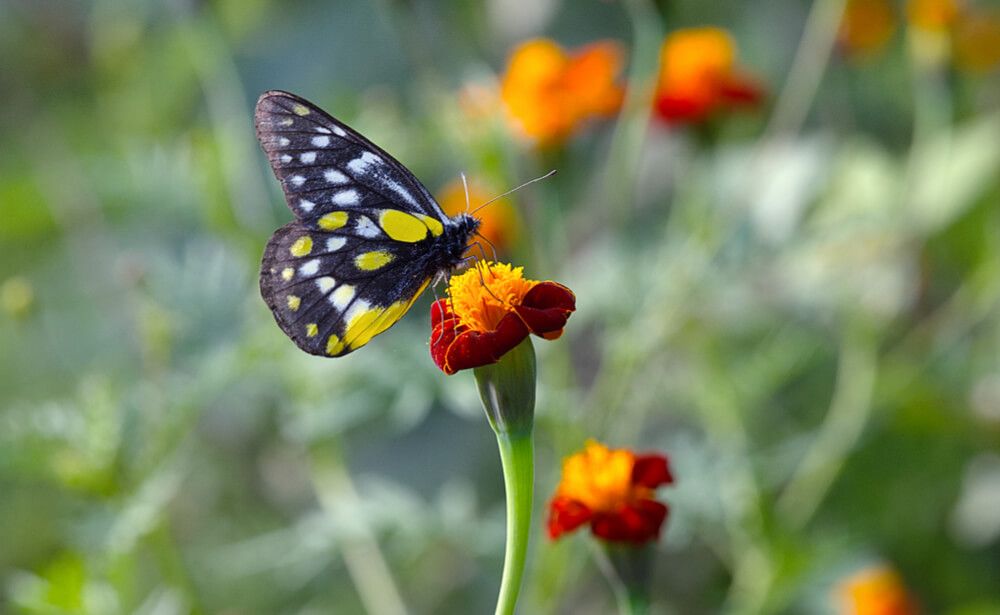
Slow Stroll Through the Orchard

Every once in a while, I take a slow and unhurried stroll through the orchard. It is not the usual kind of walk meant for exercise or leisure. This one is slower and quieter, an observational walk to see how everything is doing, and to lend a helping hand here and there. I carry a small sling bag with a few essentials: a pair of secateurs, some alcohol swabs, a small trowel, a piece of cloth, and gardening gloves.

Reviving an orchard that lay neglected for decades and turning it into a self-sustaining food forest takes both time and patience. The trees I planted over the years are finally beginning to show their strength. For the first couple of years, they simply stood still, waiting perhaps to make sure they belonged. Once the fungal networks took hold in the soil and the roots grew confident, the trees began to flourish.

With no tilling, other plants too find their way into the mix, some helpful, some harmful. One persistent troublemaker is dodder, a thin, leafless vine that winds itself around stems and feeds on the sap of young trees. Left unchecked, it can kill a plant. The best remedy is constant vigilance and removing it the moment it appears. Keeping the undergrowth trimmed helps, though cutting weeds too close to the soil can make it easier for fungal spores to reach the trees. A light, thick carpet of weeds under the canopy often traps these spores, protecting the young trunks, especially through spring and early summer.

As I walk, I stop by each tree, a few hundred companions I have come to know by sight. If I notice the orange threads of dodder starting to climb, I crouch down and pull them out carefully. Sometimes a branch has to go too if it has been infected. I look for suckers and water sprouts, the greedy shoots that drain a tree’s strength. Those are trimmed as well.

I also have to resist a familiar temptation, pruning. I am not fond of shaping trees into tidy forms. I prefer to let them grow as they wish, to find their natural rhythm. But most of my fruit trees are grafted cultivars, and a little guidance is sometimes necessary. However, this is not the right season for pruning though. It is autumn, and a cut now might push them to sprout tender new leaves that will not survive the coming frost. So, I hold back the urge.

Now and then, I come across a young tree that did not make it. I note its place, and as I walk further, new spaces for planting begin to reveal themselves. Curiously, when I buy new saplings, I often cannot think of where to put them, but on these walks, the land itself seems to suggest the right spots. Digging a few planting holes in advance always helps. It scatters the effort over multiple days instead of one big task at a stretch, and also makes the planting locations very obvious.

Today, I also spotted a small bird’s nest tucked inside a pear tree. A few chicks were still there, late arrivals to the season. I made a mental note to keep everyone away from that tree for a few weeks. They will need some peace before the nights grow colder.

A few cement planters that had been lying unused caught my eye. I decided to clean them and give them to the neighbours. I have realised that my heart lies more in growing food than flowers, though my family occasionally scolds me for neglecting the latter. Fewer planters will mean fewer wilted flowers to explain. Am I smart? ;-)

I sat for a while on the bench overlooking part of the orchard and the valley beyond. The late afternoon sun had warmed it nicely. Around it, I had planted grapevines years ago hoping they would climb the trellis and lend a Mediterranean touch. The soil there is poor and the vines have struggled, but perhaps they have toughened up now. With a little vermicompost this winter, they might reward me next summer. I am keeping my fingers crossed.

The orchard is still a work in progress, not yet the self-sufficient haven I dream of, but every season takes it a step closer.

Farther ahead stand the young plum trees planted last winter. All of them are doing well, their leaves dense and healthy, the short internodes telling me they enjoyed good sunlight. Soon the leaves will dry and fall. The soil here is heavy clay, and I will have to lighten it with organic matter and a touch of gypsum. Another note added to my growing list.

Beyond the plums lies the spot marked for the new greenhouse. I have been waiting for months, though waiting has its own pace in the hills. Here, things move slowly, almost lazily, as if time itself has no hurry. At first, I found myself growing impatient, muttering under my breath at each delay. But over time, the mountains taught me a quieter lesson. You cannot rush anything here. Not the rain, not the ripening of fruit, not even the delivery of a greenhouse. What once felt like a delay of weeks now stretches into years, and somehow, that feels perfectly natural. I hope my greenhouse will arrive this year.

Below that lie my Hügelkultur beds, built from old logs and wooden planks. The rains have left their mark on them, softening the wood and causing small damages here and there. They have held up well, considering their age, but a little care will set them right again. Another quiet task added to my list, and perhaps a pleasant one for a cool afternoon.

On the way back, I noticed an old apple tree covered in thick lichens. I had not seen them before. Tomorrow, I will photograph and catalogue them. Thankfully, the air remains pure, and the avoidance of chemicals is slowly restoring balance to this small ecosystem.

The path is made of uneven stone slabs, placed just far enough apart to keep my shoes clean. I sometimes wish for a smoother path, but for now this simple one serves me well. A smoother and more polished path may look lovely and will cost money, but will also have a higher carbon footprint. Sticking with these old stones is simpler and more environment friendly.

I stood for a while, looking at the trees I had tended through the years, each one carrying a small story of patience, hope, and quiet labour. There is still much to do and much to learn, but that no longer feels daunting. By the time I returned to my room, the sun had dipped low. I had spotted dodder on three trees, all cleared now, removed many suckers and water-sprouts, made a list of things to be done and also made notes for a dozen new plantings. Perhaps this winter I will add some sour cherries and a few more brambles. Each small act, each rescued tree, feels like a quiet victory. Quite a productive stroll it was.

The orchard keeps growing, in its own rhythm, and in caring for it, I find myself changing too. Slowly, quietly, almost without realising, I am growing along with it.

Click here for all related posts – Browse my blog on slow and sustainable living !

Only What They Do – Comfort of Basic Tools

There are days when I find myself yearning for the basics, for a simplicity that seems almost forgotten in our world of constant hurry. Complicated things rarely bring me peace. What I long for are objects and experiences that carry honesty, that speak clearly of their purpose. Nothing more, nothing less !

Take the telephone for example. I would rather have a simple line phone with a rotary dialer, where each turn of the dial made a small clicking sound, than the sleek glass screen of today’s smartphones. There was something steady about waiting for the dial to spin back, as if time itself moved a little slower and more patiently. Each call was for a purpose. Today, messages race past, impersonal and fleeting, lost in a flood of forwards and nonsense. I use a smartphone out of necessity, for work and connection, but I must be one of those rare breeds that keep my landline too, for the small and steady joy it brings.

I would pick a traditional radio over a bluetooth speaker any day. A radio isn’t perfect, it crackles, it drifts, sometimes I have to adjust the antenna, but that is exactly the charm. It connects me not just to music but to voices, to the warmth of someone speaking across invisible waves. As I write this, I am enjoying some nice old Kumaoni music on 100.8 Mhz.

The same goes for books. A paperback has weight, smell, and the joy of turning a page. A Kindle may hold a thousand titles and even a dictionary, but it can never replace the comfort of holding a single book. Some say that a Kindle suits someone like me since it saves paper, yet that deserves a deeper thought when one considers the carbon footprint of the device and the ebooks themselves. I seem to be digressing here (a word my friend favours and one I have grown fond of myself). There is something quietly grounding about holding a simple paper book, feeling its weight, turning its pages, and breathing in that earthy, relaxed comfort.

I prefer an alarm clock that is simply a clock, with hands that glow faintly in the dark. It wakes me when needed without dragging me into a maze of notifications. No apps, no settings, just a simple instrument doing what it has always done. Sometimes the gentle ticking lulls me to sleep, and at other times it distracts me. On those rare nights, I simply hide it under a thick pillow.

Today I went to the nearby market in search of a torchlight. I wanted the kind I have always used, a steel body, battery-powered, reliable. The shop offered flashlights with Bluetooth speakers, solar chargers, radios, and even one with a remote control. After much searching, I found a simple battery-powered torch, though in plastic. It may not shine like the new gadgets, but it does exactly what it should.

And lights. How much more human it feels to walk up and flick a switch, to feel the click under my finger, than to ask Alexa to brighten or dim the world for me. The act itself is grounding, immediate, personal.

No Internet of Things for me for everyday stuff. No voice assistants or apps trying to govern every small detail of life. Give me the basics, tools that do their work and then step aside. A fridge or microwave with a Wi-Fi connection is beyond my understanding. Why does my weighing machine need to remind me to drink water? IoT may make sense for applications in security services or healthcare, but not in everything at home. I do not need a kettle that sends me a notification when the water boils.

I like canvas bags with a couple of pockets that last a lifetime, sturdy and dependable, instead of polyester bags with countless zips and compartments, and even absurd little slots to attach USB devices. Give me a plain, honest bag that wears with age and gathers stories, rather than a flashy one that falls apart in a season. And then there are the inventions that try too hard. Smart toilet seat covers? Are you joking? Definitely not for me. A chair should be a chair, not a massage parlour with a control panel. Even spectacles come now with Bluetooth and cameras. I would rather keep my reading glasses simple, the way they are meant to be.

Somehow, I never could come to like a mini Swiss knife. I never found it useful. I would rather have a proper set of knives in the kitchen and a proper set of screwdrivers in the toolbox. And when it comes to opening a bottle, nothing beats the solid iron openers that vendors once used in cinema theatres and circuses. They would make music on the glass cold-drink bottles with them, a playful prelude before opening the cap. That kind of bottle opener has just one purpose – to open bottles, and it does it with quiet dignity.

Simple things with a purpose work better than tools that seem to give lots of additional facilities. Simplicity is not about being old-fashioned. It is about breathing easier, about letting life go on without an extra layer of fuss. Simplicity brings about a feeling of being grounded, of peace, and also of relaxed happiness. In choosing less, I feel I choose more – more presence, more calm, more of what matters.

Click here for all related posts – Browse my blog on slow and sustainable living !

Home Shaped by Simplicity

When I began to build my house I learnt quickly that there is no end to expenses. Everything imaginable and even much that is not can be bought nowadays. It is peak consumerism, an endless parade of comforts that people chase as though enslaved to them. My thought was simpler. I wanted a modest and cheerful dwelling where only a few essentials found their place. A shelter that would guard me from the elements yet not cut me off from the living world outside.

So my house rose from stone, wood, and cement, plain in its making but sturdy enough to stand against the extremes of weather of the region. It does not gleam with marble nor boast expensive fixtures. Its beauty lies elsewhere, in sunlight falling through unadorned windows, in the scent of spices drifting from the kitchen, in the company of books whose pages carry the mustiness of time. It is neither spartan nor palatial.

The roof above me is all I need. It shields against snow and rain and offers shade from the harsh summer sun. Yet the house never seals me away from the seasons. In winter I wear woollens indoors, unlike in centrally heated rooms where the air feels curiously untouched by weather. That small choice, layering oneself rather than warming the entire house, feels truer to the rhythm of nature and lighter on the earth’s carbon footprint.

My home itself is furnished sparingly. There is little more than what is required yet nothing feels wanting. It is functional, comfortable and cosy, never a place to flaunt but always a place to return to. Perhaps it suits me because I spend much of my time outdoors beneath the trees, listening to the birds’ scattered notes, or wandering through my orchard on the narrow paths I have laid, stopping at places to sit and reflect, or caring for the flowers growing in the planters placed here and there. I spent my money on planters, a greenhouse, and garden furniture. On my to-buy list are some more items like a couple of hammocks, some more chairs, and maybe a swing too.

Inside, comfort comes not from show but from placement. A rocking chair that soaks in the afternoon sun during winters. A lamp that spreads its soft light across evenings. Windows framing the orchard where bulbuls and thrushes pause on their way through. Most of the bedrooms in my house face south, welcoming the low sun in the cold months. Unlike the guesthouses that turn rooms to the north for the spectacle of snow peaks, I have placed my desk there instead. While working I can look up at the valley and the distant summits, allowing the mind to breathe a little between tasks.

Even in upkeep I follow the quiet philosophy of Wabi Sabi. A patch of peeled paint need not be hidden at once, it can rest there as an honest part of the house’s story. The house breathes through its imperfections. The light filtering through the smallest cracks in the door, curtains stirring with the mountain breeze, the tapping of birds on the roof above. Sometimes when the rain falls hard, I love the sound of it drumming on the roof. It lulls me into a kind of gentle trance and often carries me into sleep. The younger generation even has a name for such things now, something they call ASMR, though I simply know it as the old and timeless comfort of rain.

And perhaps the greatest comfort lies not in what the house contains but in what it teaches. I enjoy life without depending on any particular thing. When I travel I do not miss my own material comforts, the lack of them never troubles me. What unsettles me instead is the opposite, the weight of excess, the overstuffed rooms of hotels, the polished consumerism in homes of friends. It is there amidst too much that I feel least at ease.

This house is no showpiece. It is lived in, warmed by laughter and by the steady passing of days. In a world that measures worth by what is new and shiny, my home stands quietly apart. It reminds me that comfort can be shaped from small things and happiness can be found in the simplest of moments. The glow of a lamp on a winter evening, the scent of coffee rising from the kitchen, the hush of wind moving through the trees outside, all weave together into a life that is both humble and abundant.

Click here for all related posts – Browse my blog on slow and sustainable living !

Between Trees and Peaks

At the edge of my orchard, where the land slopes towards the valley and the view in front seems wider than elsewhere, I find myself facing a question that is less about choice and more about feelings. In the distance during clear winter days, which are quite frequent here, I can enjoy a panoramic view of snow covered Himalayan peaks. It is a sight that feels both timeless and majestic. On some days, they seem to lean in a lot closer and that keeps me mesmerized. The question I keep asking myself – should I thicken the northern area of my orchard and garden with more trees (the area with a view of the snow-peaks), filling the space with fruit and shade, or should I leave it open so that each winter the snow peaks stand clear against the horizon? These are decisions in life that are not about right or wrong but about what kind of beauty we wish to live with.

Within the orchard itself I have already planted generously. Fruit trees are intermingled with forest trees, and among them rise tall oaks, hollies, alders, rhododendrons, and conifers. These trees are more than companions. They act as wind barriers. In summer strong gusts sweep through the valley with enough force to topple heavy metal chairs or tear roofs from homes. The trees that stand tall in front absorb that force and shelter the orchard and house alike but at the cost of the open view before me.

It is not only my own dilemma. I once asked my followers on social media whether they would choose trees or an unobstructed view. Most voted for trees, which I take as a hopeful sign. People are slowly waking up to the fact that we need more and more trees. Yet I also sense that this conviction wavers when personal comfort is at stake. Guests who visit often remark on the tall trees that rise into the sightline. Some gently advise me to lop or coppice them in order to restore what they call the beautiful panoramic view. On asking my neighbours, most advice on having tall trees, yet everyone seems to be longing for an open view in front when it comes to their own personal properties.

But my own heart leans towards the trees. A dense canopy shields against wind, filters the air and creates a retreat that feels hidden away from the world. The south side of my place is managed differently. There I keep fewer trees and most are deciduous, so that when they shed their leaves the low winter sun can spill warmth onto the house and the lawn. Between these two aspects, dense northern canopy and lighter southern edge, I find balance. And within the trees themselves I prefer natural windows, gaps in the canopy that let the snow peaks show through, framed rather than lost.

Perhaps the real choice is not between trees and view but between two ways of seeing. Trees pull the gaze inward into leaf and fruit and the bird resting on the branch. Peaks pull the gaze outward into immensity and distance. Both are necessary. One roots me, the other humbles me. Sometimes, while clicking photographs of the snow-peaks, I frequently end up framing them inside a natural ‘window’ or at times with an interesting foreground.

So for now I lean towards restraint. I plant enough to shelter the orchard but not so much that I lose the winter mountains. Some trees I allow to rise tall, their crowns holding back the winds. Others I keep lightly lopped at the lower branches, shaping small windows through which the peaks can quietly appear. Still, I know that tall trees in front can change the sense of vastness and openness that some people so deeply cherish. From my office window I can always enjoy an open view of the peaks, since it sits at a greater height. There are a few other spots on the property that offer the same gift, so the view will never truly be lost.

When thought of more deeply, an orchard is never only about what grows within it. It is also about the openings between, the pauses, the silences, the lines of sky and mountain that appear between trunks. On a philosophical note, our lives are much the same, shaped not only by what we build and achieve but also by the spaces in between – the balance of solitude and community, of labour and rest.

As winter approaches, I will plant a few more trees, both nut and fruit. They will offer shelter and food to the birds, and provide my family and friends with a harvest to enjoy and remember.

Click here for all related posts – Browse my blog on slow and sustainable living !

Urban Nature Enthusiasts

Every few weeks, the hills are visited by a peculiar species: the Urban Nature Enthusiasts. You can spot them easily. They step out of their shiny SUVs wearing shoes that cost more than a local villager’s monthly salary, and announce with a dramatic sigh, “Ah, the pure air, the untouched beauty… so pristine!” At this point, the hills themselves tremble slightly, because they know what’s coming next.

The Enthusiast has not come merely to admire the landscape. Oh no. They have come with plans. The first plan usually involves buying a chunk of land “to preserve nature.” How? By chopping down half the trees for a three-storey glass villa that looks suspiciously like a shopping mall, complete maybe with heated infinity pool, indoor gym, and, why not, a helipad maybe?. After all, what’s the point of escaping city life if you can’t bring the city with you?

The second plan is even better. They want to “live like the locals.” Which translates to: importing a Delhi-style cafe, a Mumbai-style gym, Internet faster than CERN, and occasionally, a city-style neighbour who will help them complain about the “lack of parking space” in a mountain hamlet where goats outnumber people. These people adore the idea of unspoilt nature, but what they really mean is: unspoilt until I spoil it. They don’t want the real hills with their quiet rhythm, homely kitchens, extremes of temperatures, and unpredictable weather. They want a curated version: nature with 24-hour hot water, nature with home delivery, nature with temperature controlled villas, nature with a personal driver who can reverse their SUV on a goat track.

A lot of people who visit us also want to buy a second home here. For many, it feels like an easy money option: buy a place, turn it into a bed and breakfast, keep earning while they continue working in the city, and visit once in a while for the thrill. Over the years, I’ve watched this cycle repeat itself: first the excitement of buying, then the disappointment of “no guests,” then the revenue-sharing contracts with companies, then leasing it out, and eventually, the “For Sale” sign. Then another unsuspecting buyer comes from the city, and the cycle starts again.

The grass is greener on the other side—that’s exactly what happens when people with money decide to buy a house in the hills. They see the greenery, breathe the clean air, and enjoy a few peaceful days, then begin to imagine that owning a house here would be like living in a permanent vacation. The reality, of course, is very different. Maintenance challenges, unreliable water and power supply, limited healthcare, patchy connectivity, and the simple unavailability of many everyday goods soon begin to test their romantic notions. What once seemed like paradise starts to feel like hard work, and the dream of an easy life in the hills fades quietly into frustration.

If the buyers have deep pockets, the house just sits there, locked and forgotten, while the caretaker enjoys a better lifestyle than the owner ever will. A popular local joke sums it up neatly: “City people are so rich, they spend a fortune to build a house where their caretaker lives comfortably.”

Of course, there are the sensible second-home owners too. They keep their houses locked, visit only for holidays, and then leave quietly. For them, the house is a sanctuary from the daily grind of the city. They don’t arrive with grand schemes or restless ambitions; they come seeking silence, rest, and a few unhurried days. These people are a joy to host. They spend their time soaking in the calm, carry away memories instead of blueprints, and return to their city lives refreshed. Their thoughts drift not towards where the concrete mixers will work next, but towards which trees they might plant, an instinct that adds to the landscape rather than takes away from it.

Many of our guests even spend their entire trip looking at properties for sale, weighing the realities carefully, and then making the wisest choice of all: not buying anything. For them, returning here whenever they wish to unwind feels far more sensible than taking on the burden of ownership. Some prefer it this way because it leaves them free to enjoy holidays in different places, without being tied down to one house or one set of responsibilities.

Then there are the visitors who arrive bubbling with ideas about “improving the place.” They speak earnestly of educating children, providing livelihoods, and “developing” the region. The villagers, however, usually smile knowingly and laugh about it later in the evenings. Their logic is simple: if these city geniuses are so capable, why not begin by fixing their own neighbourhoods – by planting trees in their smog-choked lanes or helping children in their crowded slums? The laughter, of course, grows louder after a couple of drinks.

Some of these enthusiastic planners eventually come to grips with the ground realities and learn to enjoy the hills without trying to reshape them. A rare few do make a meaningful contribution: like a couple I know, with whom I will be enjoying dinner tonight, who quietly run a small centre to further support the education of local school-going children. But they are exceptions rather than the rule.

Quite a few can’t resist their urge to “upgrade” the mountains, mansions twice the size of what they need, trees axed for more and more buildings, floodlights that turn quiet night skies into stage shows, and heaps of waste hidden behind houses. One gentleman I know proudly burns his mountain of plastic waste as a “solution,” sending clouds of toxic smoke into the very air he came here to breathe.

And then there are the moments of pure irony. City folks gather around the fireplace and discuss, with great indignation, the “merciless way” village women lop trees for fuel and fodder. All this, mind you, while they themselves are enjoying a decorative bonfire that serves no purpose beyond ambience, having arrived in SUVs after travelling long distances and that drink fuel like parched camels. Talk about carbon footprints ! The villagers, with their branches and cattle, might just be the lightest steppers on this mountain path.

Thankfully, most of the people who come to stay at our place are somehow of the type that actually understand nature. I feel happy and proud when I see them carrying bits and pieces of their waste back with them when we go out for picnics. In the evenings we discuss the climate crisis and what we can do. The person who bought a land while staying at my place is planning to plant lots and lots of trees this winter.

In the end, the hills don’t really need saving by anyone who doesn’t understand, nor do they ask for grand visions or concrete promises. What they offer, quietly and without fuss, is a chance to slow down, to breathe, and to remember that life can be lived more simply. Those who come here and leave with lighter hearts rather than heavier footprints are the ones who truly understand. The mountains will outlast the fashions of second homes and the fever of quick returns; they have their own rhythm, patient and enduring, waiting only for us to listen.

Click here for all related posts – Browse my blog on slow and sustainable living !

Time Slips, Memories Stay

My parents developed white hair many decades ago. Their age has long been visible to me, not just in appearance but in the depth of their experience. I chose to stay with them, even when it meant some financial compromises and many quiet sacrifices. It meant adjusting my food habits to theirs, though at times I still rebel. It meant accepting their religious ways even when my thoughts wandered differently. It meant patience with money matters and with the slower pace of their days.

Yet through these compromises I discovered something greater. Parents hold a vast reservoir of experience. They have faced storms that I cannot imagine. Their guidance comes not as commands but as gentle reminders shaped by long endurance. When they speak, I hear the weight of lessons learned through hardship. Their way of seeing the world gives me strength. Their resilience becomes a mirror that steadies me when I falter.

And while they age, I also watch my children grow. They grow too fast. The years of small hands, innocent questions, and sleepy hugs feel as if they will soon belong to another life. Time is flying. I often feel as if I am trying to hold on to dry sand in my hand. It slips away no matter how tightly I close my fingers.

Parents and children move in opposite directions. One drifts toward dusk. The other toward dawn. Both slip away from my grasp in their own way. I stand in the middle, pulled by memory and by hope, holding what cannot be held.

When families come to spend time at our homestay and I sit with them, I often sense the same feelings stirring in their hearts. Parents speak of how quickly their children are growing, of how precious years seem to slip by unnoticed until they are gone. The young too share their own quiet worries about parents who are ageing, and the fear of not having enough time together.

Just last week a small child asked me a question that stayed with me. She wanted to know how long I expected to be with my own children. Her mother was not doing very well health-wise, and the weight of that worry showed in her innocent eyes. It was a painful question for one so young, and I found myself pondering it for many days after. My wish is simple. I want to be there for my children for as long as they need me, until they become strong and self-sufficient. And even after that, I want to be present so that I can savour whatever time remains, not as a duty but as a joy. To ensure this, I have further understood that I have to focus on my health too, something that I had long neglected. Neglected, while earning my livelihood and spending some of my free time with friends.

Sometimes, when I am away from my family, what comforts me most is not even their physical presence. It is the quiet knowledge that they are there, living their lives, existing in the same world as me. That awareness alone is enough to steady the heart.

What fills me with joy is the simple truth that I am here, sharing life with my parents and my children. Each meal together, each story told, each laugh that echoes in the room is a reminder that time is not only slipping away, it is also giving itself to us in the present. There is beauty in knowing that love stretches across generations, that guidance flows down and innocence flows up, and I am standing in the middle, receiving both. Even with its fleeting nature, this dance of time is a gift, and I feel grateful to be part of it.

Simple things like having meals together, discussing ideas and what’s happening around with parents, buying groceries together, fun-filled fighting with kids for the prime space to lie down, or even at times just lounging around when everyone is home is quality time. These moments will not be there forever.

It is in this way of life that I learn the meaning of presence. Compromise then becomes more than sacrifice. It becomes a wisdom. It teaches that control is an illusion. We cannot freeze time. We cannot shape others to our image. We can only walk beside them. We can only give ourselves fully to the moment before it passes. This is not loss. This is life. To be alive is to hold sand, knowing it will slip away, yet still to hold it gently. To sit with parents as they age. To listen to children as they grow. To remember that the value of time lies not in its length but in our presence within it.

Perhaps this is the true gift. I see it everywhere, from Buddhist Mandalas to Hindus’ Ganesh Visarjan. Not permanence but the trace left behind. The warmth of a hand once held. The echo of laughter shared. The calm strength of parents who endured. The fleeting innocence of children who ran ahead. To live well is to live in the moment, and be thankful for the family and friends we have around us. To let love flow across generations. And to trust that even as time slips away, what remains is the imprint of how deeply we chose to be here.

Living a slow life, while contemplating on these lines, makes me feel thankful for what I have. Even though time cannot be stopped, it can be savoured. And when I choose to see joy in the fleeting, I find myself lighter. The smiles of loved ones stay with me. The kindness shared lingers. The bonds of family endure far longer than the minutes on a clock.

Click here for all related posts – Browse my blog on slow and sustainable living !

Operation Vermicompost

Since yesterday, I have been on a quest for something that sounds deceptively humble – vermicompost. Pantnagar’s agricultural university sells it, and I thought it would be a simple errand. Drive down, buy some bags of worm magic, and return triumphant. But no. This little adventure has turned into a full-scale logistical opera, complete with phone calls, negotiations, last-minute changes, and the occasional dramatic sigh.

We make our own compost and vermicompost, of course. But our orchard is largish and the soil is still in that hungry teenage phase where it eats everything you give it and asks for more. One day, when the soil matures and the orchard becomes self-sufficient, I hope to simply watch the worms and homemade compost do the work while sipping coffee in peace. For now, I am still the desperate middleman between hungry trees and reluctant trucks.

The university sells vermicompost in 40-kilo bags. Great for economies of scale, terrible for the back. I can squeeze a maximum of six bags into my car before the suspension starts to weep. This year, I estimate we need another 50 to 60 bags on top of what we produce ourselves. Buying the stuff is not the problem. Getting it from Pantnagar to our hilltop orchard, however, is starting to feel like organising a small military campaign.

My idea was to combine orders. A large project near us wanted 100 bags (40 quintals). A neighbour fancied 25 bags (10 quintals). I bravely volunteered for 75 bags (30 quintals). What a treasure that would be – mountains of rich black vermicompost, all quietly wriggling with life. We finalised a collective order of 80 quintals. Then came the truck problem.

Small pick-up sized trucks can’t carry that much. Mid-sized trucks can, but they quote prices that make you wonder if they plan to sprinkle gold dust on each bag. I started making calls like a stockbroker in a market crash. One contact promised to arrange a truck but quoted a rate so high that the neighbour with the modest 25-bag order threatened to retreat. Meanwhile, the university sales counter, blissfully unaware of our growing drama, had already started packing the bags and putting workers on overtime. Backing out was no longer an option.

The neighbour with the smallest order suggested reducing the order to 50 bags and hiring a smaller truck. That would have been easier, if slightly disappointing. But before I could agree, the big project people called in a panic. “Don’t go ahead without us!” they said, as if I was about to elope with the worms.

Enter the fourth player. A friend-of-a-friend offered to arrange a truck—if we added another 20 quintals for his personal use. Suddenly our modest 200-bag mission ballooned to 250 bags (a whopping 100 quintals). By then the word was out, and a fifth person called. He wanted to know if I could manage another 10 bags for him. At this point, the compost was practically multiplying faster than the worms themselves.

I even found a small trucker willing to take on the job at what sounded like a bargain until he revealed the catch. He proposed making multiple trips over the next month, ferrying just five to ten bags at a time. To sweeten the deal, he offered me a “special rate” of one bottle of alcohol after every trip. Technically quite affordable in rupees but completely against my principles and definitely a recipe for logistical chaos. I politely declined.

After endless calls, counter offers, and quiet calculations about who would pay for what, a truck was finally secured. The person with the largest order graciously agreed to cover the cost difference for the smallest buyer. Not the tidiest ending, but if all goes well the bags should start their journey tomorrow. The final order tally as of now stands at one hundred bags from the big buyer who will also shoulder the extra transport cost, seventy five bags of mine, and twenty five bags from the neighbour who gets a slightly gentler shipping bill. And to top it all off, I will also have to make a trip to Pantnagar to pay in cash, then chase down the others to collect their share. Truly, the worms are easier to deal with than humans.

All this drama just to move a few tonnes of worm poop from Point A to Point B. Farming, once again, proves that it is never only about soil and plants. It is about the delightful chaos that sneaks in when humans and their opinions enter the picture. The quiet lesson for the future is simple but sharp: never assume that a clever plan to share costs or create mutual benefit will automatically win hearts. Most people are not quite ready for the act of cooperation for mutual benefit, yet. Getting a seed to sprout in a drought sometimes feels easier than getting a group of grown adults to agree on a truck. I will get my vermicompost tomorrow, and I am not losing hope in cooperation. Perhaps in the future these joint efforts will fall into place more easily.

ADDENDUM: Day 2: The vermicompost reached me. Yet to settle the amounts.

Click here for all related posts – Browse my blog on slow and sustainable living !

Instant Experts, and their Suggestions

Running a homestay is a bit like hosting an endless dinner party. Most guests arrive with warm smiles, eager curiosity, and a genuine love for the hills. Some come to learn about the place and share stories. And then there are those who arrive carrying invisible blueprints and an unshakable belief that they know exactly how the homestay should evolve. Opinions and suggestions don’t just arrive, they pour in like an unexpected monsoon.

Over the years, I’ve collected a delightful range of ‘improvement’ plans. One enthusiastic planner suggested tearing out the lawn to build extra cottages and a cement tennis court, as if the plants were secretly yearning to become a suburban sports complex. Another went further, proposing that we cut down every tree near the cottage because the birds were ‘too noisy’ and left a ‘mess’ beneath their branches. According to him, the ‘view’ would also improve. No trees, no birds, no heartbeat of our homestay either!

These visions are delivered with the brisk confidence of a search engine that forgot to fact-check itself. Mention a kettle and you might receive a lecture on metallurgy. Wonder aloud about the weather and you’ll be treated to a ten-minute forecast on El Nino, La Nina, western disturbances and how they will either dry out the winter or flood the valley, sometimes both. Around the evening tea table or the bonfire, conversations bloom on their own. Someone laments climate change and rising temperatures, another predicts record snowfall using the same data. Politics slips in too, quite frequently. I prefer to keep my political views to myself. The most distressing are the infrastructure development suggestions involving extensive construction work. Though thankfully most of these discussions never turn into actual construction (destruction) at my place.

There is, however, a certain charm in all this unsolicited expertise. A world full of polite nods and timid ‘I don’t knows’ would be dreadfully dull. These self-appointed sages keep the dinner table lively, the group chat scrolling, and the fire crackling with debate. Just the other night, a tipsy gentleman delivered a passionate speech about the dangers of alcohol in the hills, between sips of his fourth glass of whisky.

Children too contribute in their own way. A young boy once asked why I keep my head shaved. I explained that it saves me from the tyranny of shampoo and comb. He then requested I convince his mother of the virtues of going bald. When his parents and I later settled into a chat, the conversation drifted from hair to the persistent moisture in the walls and how ceramic tiles should cover every inch, inside and out. I filed that suggestion in the Not-To-Do list, right next to ‘cemented tennis court on the lawn’. The parents thankfully didn’t discuss the tiles in the coming days, and the kid also didn’t discuss his need for a new hairstyle.

Some guests, when discussing topics they think they’ve mastered, provide perfect opportunities for gentle mischief. I listen carefully, nod thoughtfully, and ask for dates, figures, or concrete details. That’s when confident eyebrows twitch and imagination does the heavy lifting. A warm smile welcomes the inevitable guesswork. It happens often enough to keep my evenings pleasantly entertaining.

Last week, one guest started discussing on how nice it would be to have bright lights all around. Another suggestion gracefully ignored by me. I am surprised at how few people understand the seriousness of light pollution.

Not every suggestion is outrageous. Some are quietly wonderful. Recently someone suggested enjoying morning tea under a tree. Now I often sit with a cup in that shaded spot, a small table by my side. It’s now one of my favourite places to hang around. Sometimes I set up a picnic table there for guests too, and it never fails to delight.

Of course, a few proposals leave me blinking in confusion. A regular visitor once urged me to open a souvenir kiosk near the parking area. At least with her, I’m guaranteed one loyal customer if I ever cave in. Another gentleman raved about the food but thought the presentation needed ‘professional’ touches, perhaps I should get a pair of forceps to position a single leaf of parsley on each cutlet. I thanked him.

There are some suggestions that are there in my mind. Some day, when I have the resources, I will implement them. A small pond, a garden swing, an open gym, some outdoor games, even a sauna !

Suggestions come with every batch of guests, and the steady flow is oddly reassuring. It means people care. A few ideas inspire small upgrades, many land in the ‘interesting but impossible’ folder, and some simply make great stories to share under the stars. Meanwhile, the orchard stays true to itself. Birds still sing at dawn, trees stretch skyward, and the hills remain blissfully uninterested in tennis courts.

My job is not to chase every bright idea but to guard the quiet, living beauty that brought me here in the first place. Some guests may arrive armed with grand plans, but nature keeps the final say and what a comforting truth that is.

Click here for all related posts – Browse my blog on slow and sustainable living !

Gentle Discipline of a List

Morning comes early. Light spills over the hills and the air smells of pine and damp earth. A bird calls from the orchard. I sit with a cup of coffee and a to-do list from yesterday night. I check the list. Not a long one. Only what must be done today. Water the new plants. Fix the gate. Answer the email. Call the bank. Write. Paint the repaired steps. These small things shape the hours. They give the day a spine.

A to-do list is a small thing, but it keeps the day honest. It shows me the work. It does not care if I am tired. It does not forgive. Cross a task and the weight lifts. Leave a task unfinished and it stays, quiet and patient, asking only for the next hand that will meet it.

Making such lists steadies the mind. Each line catches a thought before it drifts away. By writing it down, I am delegating my thoughts to the page. The list carries them so my mind can be free, open, and calm. In a world that asks us to do many things at once, a list promises a single place where my scattered pieces can come to rest. It gives the comfort of order in a life that otherwise scatters easily.

Tomorrow’s list that I made before starting on this article looks like this – Wooden blocks. Sort the pots. Webpage. Agatha Christie. Lemon. Humic acid. Call Himanshu ji. These random words will not make sense to anyone else, perhaps not even to me a month from now. For tomorrow it is enough for me. Just these handful of words will keep me on track. With every tick of the pen I anchor another small victory.

Even the most critical professions trust the power of a list. Surgeons and pilots follow checklists; lives depend on their precision. Their lists are exact. Mine is simple. It guides a single day. But the principle is the same: write it down, do it right.

Keep the list plain. Short words. No grand plans. Chop wood. Pay bill. Call friend. Sharpen knife. Order coffee. Each line is a promise. Each tick a quiet triumph. The pen scratches and the mind clears. Outside, the world is wide and distracting. Inside, the list keeps the day steady. The list teaches discipline. It reminds me that life is built on small acts done well. Clean the carpet. Arrange the books. Answer the letter. From such plain work comes quiet satisfaction. Each crossed line is proof of progress.

By capturing tasks I free my thoughts. I can read books without the nagging sense of something forgotten. I can walk in the orchard and not be pulled back by a dozen small urgencies. I can visit a neighbour and enjoy a chat. I do not list the things that belong to life itself: walking, the slow cup of tea, a talk with my mother. Why? because they are as regular as breakfast and happen on their own.

There is a method now. I write only what I will truly do. I will not note “polish the deck” when I know I will ask the painter to do it. At most I may write “tell painter about deck”. A list is a tool, not a dream. Better a few true tasks than a crowd of wishes. When there is much to be done I may make a list for the week, but even then I keep it lean.

Some lists nest within others. A to-do list for the day might include a visit to another town. That visit carries a shopping list and a list of small jobs to do while there. Little branches of order grow from a single page.

At night I look at the page. See what was done. See what waits. Some things will always wait. That is life. The list is not the day. The day is the sun on my face, the smell of fresh bread, the rustle of leaves, the laughter of family. The list keeps me steady while the world moves. Before retiring to my bed, I make a list for the next day, sometimes just a list of things to be done but with no particular timeline. Having a free mind before going to bed is also quite helpful.

A list should be a servant, never a taskmaster. It is easy for a good habit to harden into something rigid, to make us obsess over what is written instead of living. I limit my items for the day. Six to eight meaningful tasks are usually enough. I choose three priorities. If only those three are done the day is still a success. I give myself a few minutes each evening to make the list and then close the book. Some items belong to next week. Unfinished things are not failure, merely unfinished. I use a someday list for wishes and projects that belong to the heart, keeping them separate from what I will touch today. One notepad holds everything now. Scattered notes at various places only breed anxiety. I let the list remain practical, writing actions not judgements, and I notice if checking or rewriting it becomes restless or compulsive. The list is a tool, not a measure of my worth. It should bring calm, not burden.

A friend of mine uses a planner built in a spreadsheet, organised into priorities and colour coded. It serves both as a to-do list and a daily planner. I have seen how remarkably organised he is, all thanks to this simple habit.

A list is lean and sharp. It is the bare bones of a day. A diary holds feelings. A planner parcels out hours. The list needs only to be a small, honest ledger of things you will touch and finish. I write it. I do it. I cross it. I delegate my thoughts to the page and free my mind. And when I remember that I am supposed to do something more, I add it to the list, gentle and patient, letting it help me live, not cage me.

Sometimes I pause after making a list and just sit. The mind feels lighter, as if the thoughts I carried have stepped off my shoulders and settled on the paper. There is space again for noticing the quiet: the wind in the trees, the distant barking of a dog, the slow calm coming over the world. The list does not contain the next day, but it allows the day to arrive, uncluttered and full. And in that simple release, I find a small kind of joy that lingers long after the pen is put down.

Click here for all related posts – Browse my blog on slow and sustainable living !

Living Soil

Walking through my orchard I often feel that the true magic lies beneath the surface. The soil is alive with a quiet community of fungi and microorganisms that work tirelessly to keep the trees healthy and the harvest abundant. Over the years I have learnt to observe and nurture these unseen allies and they have rewarded me with stronger plants and richer flavours.

The foundation of all this life is a living soil. It is not an inert mass of dirt but a breathing community of earthworms, fungi, bacteria, and tiny insects that create a balanced ecosystem. Earthworms tunnel through the soil drawing in air and moisture while leaving behind castings and poop that are rich in plant available nutrients. Their gentle movement keeps the soil loose and well drained which allows roots to grow deeper and stronger. Interwoven with their tunnels are vast mycelial networks that connect trees and plants in a silent exchange of minerals water and even chemical signals. I often imagine these filaments as connections from the popular ‘Avatar’ film.

Protozoa, nematodes, springtails, and other tiny creatures graze on microbes recycle nutrients and keep populations in balance. Layers of organic matter from leaf litter and compost feed this community while stable soil aggregates create pockets of air and moisture.

One of the most remarkable companions in the soil is mycorrhizal fungi. These delicate networks of filaments attach themselves to the roots of fruit trees and extend far into the earth. They bring water and nutrients such as phosphorus and trace minerals to the trees in exchange for simple sugars. This partnership helps the roots reach places they could never explore on their own. I have noticed that trees with a thriving mycorrhizal network are more resilient during dry spells and flourish better when the conditions are more conducive. Now I use their commercially available spores to coat the roots while planting new fruit trees.

Talking of fungi, Trichoderma is another beneficial fungus that plays the role of a gentle guardian. It colonises the root zone and competes with harmful pathogens. By simply being present it keeps many soil borne diseases in check. I often apply a compost tea rich in Trichoderma to give the young saplings a strong start. It works well along with mycorrhizal fungi. Another ally that deserves special mention is Metarhizium anisopliae. This remarkable fungus acts as a natural insect control by infecting and suppressing harmful pests that live in the soil. It targets pests such as beetle larvae and other root dwelling insects while leaving beneficial organisms unharmed. I introduce Metarhizium into my orchard through well prepared compost or bio formulations and it quietly builds a protective layer beneath the trees. Its presence allows the orchard to stay vibrant without relying on chemical insecticides.

Among the microscopic workers there are countless bacteria that quietly enrich the soil. Nitrogen fixing bacteria such as Azotobacter capture nitrogen from the air and convert it into a form that plants can use while phosphate solubilising bacteria unlock minerals bound in soil particles and make them available to the trees. These helpers reduce the need for outside fertilisers and help keep the orchard and lawn self sustaining. Over time I have observed an interesting shift. As an orchard matures and the soil is left largely undisturbed the balance of nitrogen fixation gradually moves from bacteria to fungi. In old forests and long established orchards with stable living soil it is the fungal networks that carry most of the responsibility for bringing atmospheric nitrogen into the ecosystem.

Another valuable friend in the root zone is Azospirillum, a soil bacterium that forms close associations with plant roots and stimulates the growth of fine roots and lateral branches. It produces natural growth hormones that improve nutrient absorption and moisture uptake and can also fix small amounts of atmospheric nitrogen, though its main strength lies in enhancing root vitality rather than supplying nitrogen. Some strains help prime the plant’s immune system and subtly alter the plant’s scent profile, making it less attractive to pests and more appealing to beneficial insects. By supporting stronger roots and triggering natural defences Azospirillum quietly strengthens the orchard’s resilience and adds a gentle insecticidal layer without disturbing the balance of the living soil.

Pseudomonas fluorescens is yet another beneficial soil bacterium that protects plant roots by suppressing harmful fungi and bacteria through the production of natural antibiotics and enzymes. It also promotes root growth and enhances nutrient uptake, helping plants stay healthy and resilient without chemical treatments.

The microorganisms present in ready to use commercial waste decomposer concentrates bring yet another layer of vitality. This culture contains a blend of fast acting decomposers that break down organic matter with impressive speed. I use these to make a liquid fertilizer by adding to a mix of water, jaggery, and stinging nettle. When applied to compost heaps or directly to mulch layers this liquid fertilizer accelerates the transformation of plant residues into rich humus. The resulting compost teems with beneficial bacteria and fungi that invigorate the soil and feed the trees with a steady release of nutrients. On spraying the soil, it helps make the soil loamy and even seems to increase the earthworm population. Another interesting biological product that I use is Bokashi, commercially available as spores mixed with barn. Bokashi fermentation offers a different but equally valuable contribution. The Bokashi process uses a special mix of lactic acid bacteria yeasts and phototrophic microbes to ferment kitchen scraps and garden waste. Instead of rotting the material ferments and preserves more of its nutrients. When buried in the orchard soil the fermented matter decomposes quickly and enriches the microbial life in the root zone.

Do I use any chemicals in my orchard? Yes, I do. However these are ones that are not considered harmful to the soil. Commercially available formulations of garlic oil, humic acid, seaweed extracts (kelp) are some such examples. Sometimes, I also add various ‘meals’ prepared using different organic components like bone, fish, blood. With time, as the soil in my garden and orchard develops a stable, self-sustaining structure, I hope to reduce these additions even further. I do have to use neem oil at times, but I prefer to avoid it since it harms the beneficial insects as well.

To support the hidden network under the surface of soil, I follow practices that keep the soil undisturbed and rich in organic matter. Mulching with fallen leaves and compost provides food for fungi and bacteria. Avoiding harsh chemicals allows these organisms to thrive and maintain a natural balance. My orchard’s soil still has a long way to go but I feel that we are fast progressing towards the soil that it should have. Soil that is softer and more fragrant, with a dark crumbly loamy texture.

Every time I see a new flush of blossoms or taste a fruit with unexpected sweetness or flavour, I am reminded that the credit belongs as much to these silent hidden partners as to the sun and rain. Caring for them is not just good horticulture. It is a way of honouring the sacred web of life that sustains us all.

Note for my readers: Use this post as a guide for your garden/orchard. I will be happy to discuss if you need any more information.

Click here for all related posts – Browse my blog on slow and sustainable living !

Letting Go

The trees in an orchard do not hold on to their fruit forever. When the apple ripens it falls. The tree does not cry. It does not chase the fruit once it has dropped to the earth. It stands still and gathers its strength for the next season. This is the way of life.

Letting go of the past is one of the hardest tasks for any human being. Our minds wander back to old talks and sharp words, especially when there is free time and silence. Many people try to escape by keeping busy. I did the same. But life here in the hills gave me long hours of quiet. The mind, left free, would drift to old scenes and old hurts.

One day I began to see how this was harming me. The first step was to understand that the past is already gone. No thought can pull it back. What matters is the present and the work that shapes the days ahead.

There were moments when someone had spoken ill of me. I longed to confront them, to defend my name. As I reached for a higher state of mind, the picture changed. I forgave the person. There was no use brooding over words already spoken. Yet, as a human with self-respect, I let him know that his remarks had hurt me. It was not anger. It was a simple, clear feedback, and then I moved on.

One of the companies I once worked with let me go without giving any clear reason. To this day I still do not know why. Perhaps it was personal, perhaps my work did not meet their expectations. Whatever the cause, I chose to forgive them. I gave the top management, whether involved or not, the benefit of the doubt and allowed the matter to pass. I remain on friendly terms with most of them even now.

I am at peace with myself. Government policies, poor infrastructure, unnecessary jealousy and even moments of discrimination, shoddy work by contractors that I had to redo at considerable cost, fruit trees first damaged by harsh weather and later raided by monkeys, the shortage of water in the dry months – many things have tried their best to disturb me. Yet I now view these challenges with distance and keep them apart from my inner calm. Overthinking and living in the past bring far more harm than good.

There was a time when I spent a large sum on a music system that I rarely use nowadays. From simple things like cooking pots to expensive electronics, I made choices that felt right at the moment. They brought me joy then, and some still do now. Looking back, I could see them as mistakes. I could have saved the money. But I no longer dwell on that. I am grateful for the happiness they gave me, for the small pleasures they added to life. Just as with people, these things came into my life for a reason. If they no longer serve me as I once hoped, there is no harm done. I simply let the thought pass and move on.

Self-loathing is a slow poison. It clouds thought and drains the present of its light. We cannot change an old act, rewrite a conversation, undo a loss, or turn a decision inside out. We can only learn, and fine-tune the choices of tomorrow.

The orchard shows this truth in many ways. After a heavy storm, broken branches lie scattered on the ground. I gather them, not with sorrow but with the knowledge that pruning clears the way for new growth. When a tree stops bearing fruit, we cut it back and wait for fresh shoots. The cycle continues. The tree does not mourn its old branches.

I have spent mornings watching the frost melt from the grass. At first the ground seems locked and lifeless. Then the sun rises, the ice softens, and the soil drinks the water. Nothing lasts. Not even the hard things you fear will stay forever.

There is heavy construction nearby these days. Earth-moving machines growl through the mornings, power tools shriek late into the night, and dumpers rattle in at dawn with stones and sand. At first the noise unsettled me. Even in the rare moments of silence, I would recall the sounds of the day before and feel the same tension return. That too was living in the past. Now I let it pass. I no longer carry yesterday’s noise in my mind. I choose to stay calm and content within myself, knowing that every disturbance is temporary. The work will finish, the dust will settle, and quiet will return in its own time. My peace does not depend on the noise ending. It is already here, steady and untouched.

Sometimes I walk through the orchard and see last year’s leaves turning to soil under my feet. They were once bright and full of life. Now they feed the roots of new saplings. Our past mistakes and pains can serve the same purpose if we let them settle and nourish the present instead of clutching them in our hands.

Do not keep turning the same patch of earth in the orchard. Digging it over and over only dries it out. Leave yesterday’s ground to rest. Today’s care is enough. Water the young sapling that stands before you. Pull the weeds you can see now. Live in the present.

Just, let the past go !

Click here for all related posts – Browse my blog on slow and sustainable living !

Traces of Their Stay

Over the years, I have had the privilege of welcoming many kinds of guests. Each one brings a story, a way of being, a rhythm of life. When I look back, I see that hosting is not just about rooms and meals. It is about moments shared, the laughter that lingers in the air, the quiet conversations under the trees, and the small connections that remain long after people have left.

Some guests come for silence. They arrive from cities full of pollution, noise, rush, and restless nights. Here, they sit beneath apple trees, breathe in the cool mountain air, and let their shoulders finally rest. After a day or two, I see the change in them. Their expressions soften, their movements slow, they smile more, and they look lighter, as if they’ve laid down a burden they didn’t know they were carrying.

Others arrive with restless energy, eager to explore. They want to walk every trail, climb every ridge, taste every herb growing wild along the fence. Through their excitement, I see my own land with fresh eyes. Their questions about plants, birds, and farming practices remind me of how much beauty is hidden in plain sight. Many brim with ideas about what I could add to the orchard or how I might expand its possibilities. While not every suggestion takes root, the exchange itself is energising, and the land feels new again through their wonder and questions.

Families bring their own warmth. Children race across the lawn, their laughter echoing against the hills, while parents discover a rare stillness. I’ve seen kids pull their mothers and fathers into games of uno, tambola, or ludo, keeping them away from their phones and into the present moment. Sometimes I join them, sometimes I simply watch from the side, reminded of how joy can be so simple.

Then there are those who notice the quiet details. They ask about the age of a tree, the history of a path, or the sharpness of a spice. One lady spent nearly her entire stay in the garden, weeding, planting, and caring for the soil as though it were her own. She left behind flowers and kindness that still linger in memory. A group of thoughtful travellers once spent hours in conversation, sharing stories of their faith and way of life, offering me perspectives that led me to look within. And one guest became such a close friend that now he returns like family, helping me with others as if this were his home too. These are the bonds that outlast bookings.

There have, of course, been challenges and lessons too. I have learned that not every guest is the right fit for this place. A homestay is not a hotel; it is first and foremost a home with its own rhythm and values. For it to remain true, harmony matters. Cleanliness matters. Respect for the team working here matters. Most guests understand this instinctively. They treat the cottages gently, honour the effort of those who serve them, and sometimes leave the place even better than they found it. A few, inevitably, do not understand this. In the early days I struggled with this, torn between tolerance and frustration. Over time, I have grown firm yet calm. Protecting the spirit of the place means choosing carefully whom to welcome. Peace of mind and respect for this home are worth more than filling my homestay every day. I have started denying various booking requests.

Food, too, has brought its own share of variety. Over the years I have welcomed vegetarians, vegans, Jains, those who keep kosher, and many who happily enjoy every kind of meal. There have been non-vegetarians with their quirks and preferences. I have hosted guests who practise intermittent fasting, and others who cannot begin their morning without strong coffee and a heavy breakfast. An endless assortment of habits and choices has passed through this dining space. Yet at my table, no one has ever gone hungry. Most guests leave with kind words for the meals, perhaps because each dish carries not only the freshness of the farm and orchard, but also the quiet care and love with which it is prepared. In return, I ask only for understanding. Among other items, my deep-freezer holds some meat for my own use as well, and I am always open about it, even with those who would prefer not to even think about it being there. I have quit alcohol, but don’t mind my guests indulging in it. Hospitality, after all, flows most freely when respect moves both ways.

Some guests love to spend their days outdoors, soaking in the sun, watching clouds drift across the valley, or listening to the wind play through the fruit trees. Others prefer the comfort of the indoors, curled up with books or conversations. I do not mind either way, but I feel happiest when I see people meeting the outdoors as it is – because it is this land, the orchard and its regenerative rhythm, that holds the heart of their stay.

Meals, too, carry their own lessons. At times, food runs late, and my team waits longer than they should, the dishes ready and waiting. Many of them walk from nearby villages, often through forest paths, and their time is precious. Serving meals on time is not only practical; it is an act of care. Food eaten fresh holds its warmth and flavour, richer than when it is reheated again and again. Sometimes a guest hesitates to walk over to the dining area, but most soon adjust, making the short walk part of their day, and discovering that food tastes best when shared at the right time and place.

Hosting has taught me patience, kindness, and clarity. It has shown me that opening one’s home is both a gift and a responsibility. Some guests arrive as strangers and leave as friends. Some remind me to protect the values that shape this place. All, in their own way, leave behind traces – laughter, stories, a shift in perspective, or a deeper appreciation for the land itself.

As I write in the stillness of early morning, before my guests stir, the air is alive with birdsong. Soon footsteps will sound on the stairs, doors will open, and I will share a simple cup of coffee with those who gather, watching the day unfold together.

And so the place lives on, carrying many stories in its silence. Each guest adds something, takes something, and leaves a part of themselves behind. In the end, what remains is simple: people seeking a pause, a connection, a place to belong, if only for a little while.

Click here for all related posts – Browse my blog on slow and sustainable living !

From Reaction to Reflection

One of the most profound things I have discovered while living a slower, more mindful life is how deeply I have come to observe not only my own reactions but those of the people around me. Anger, in particular, has stood out. I never really questioned it before. It was simply there, an ever-present undercurrent, ready to rise at the slightest trigger.

In the past, anger would arise more often than I realised. It would surface in small disagreements with family, friends, college batchmates or neighbours – people I trusted and cared for. I used to tell myself that it was natural to express frustration only with those close to me, as if that explained it away. But over time I realised this was a way to avoid facing a deeper truth. Even when I stayed calm outwardly around strangers, the anger still lingered inside, quietly simmering. I would find other ways to release it. The fault was not theirs: it was my own, a reaction I had yet to understand.

Since shifting toward a slower life, I have noticed something quietly transformative. I now analyse more than I react. When someone makes a mistake or says something hurtful, I pause. I try to understand why it happened instead of letting it trigger me. More often than not, miscommunication is the culprit. Sometimes it is insecurity, other times jealousy or sheer carelessness. Observing this has given me a new way to deal with anger, one that does not drain me but invites deeper understanding. At times, this leads to me ending up over-thinking or being sensitive, but with time I hope to find a solution to this too.

On the road, I’ve discovered an opportunity to observe myself and practice staying calm. In the city, life felt like a race. I always had to be right, fast, ahead. There was a constant fear of falling behind, of failing. Perhaps that is what drives so many people into irritation and aggression. But here, I let it go. If someone wants to overtake me or tailgate, I simply let them pass. Maybe they are stressed, maybe they are in a hurry like I used to be. Allowing them space has not only kept me calmer but safer too. A little patience prevents accidents and protects my peace.

That is not to say anger has disappeared entirely. There are still moments when it rises sharply, testing my resolve. I recall two incidents clearly. Once, a biker hit my parked car without looking. Another time, a driver overtook me recklessly and swerved dangerously into my lane. In both cases, my first response was anger and helplessness. I cursed the lack of traffic sense and shook my head at the chaos. But later, I sat with myself and asked, what else could I do? The damage had been done. Retaining my health and peace was my choice, not theirs. Maybe the biker and taxi driver were stressed, rushing or careless. Perhaps their life, like mine, is burdened with unseen pressures. Why should I punish myself further by feeding my anger?

Another memory lingers. While working on a corporate social responsibility initiative in an organisation, I strongly opposed the approach they wanted to take. They wished to focus on a nearby area, while I argued the funds would be better used in a more needy, distant community. The disagreements grew heated. We exchanged harsh words, and I felt anger boiling inside me. Years later, I met the managing director over coffee. That is when I learned their true reason. They wanted the projects close to the office not for community support, but so they could closely monitor the funds. If I had known then, perhaps my anger would have vanished on the spot.

Slow living has also reshaped how I deal with personal failures. Now, when I plant a tree, sometimes an expensive cultivar of a delicious fruit, and if I accidentally kill the young plant, I no longer feel angry at myself. I may feel a little sad at the wasted effort and money, especially since resources are often limited, but the sadness is soft, not sharp. I have learned that the earth is patient and that not every attempt will bear fruit. Anger would only cloud the experience. Reflection allows me to accept the loss and try again.

I also remember watching the ‘Kungfu Panda’ film with the kids. The shifu, their teacher, wants to achieve mental peace. After years of practicing, even he is unable to do so. That gave me a sense of comfort. It reminds me that mastering the mind is a lifelong journey, not an instant achievement. It gives me hope that with passing time and with a shift in my living style, I will be able to further reduce my anger and perhaps one day let it disappear altogether. I hope to influence not just myself, but also my family and friends, gently leading them toward the same path.

And yet, I am not perfect. My friends and family members still get angry and argue. I am yet to influence them. That too is a journey, not a failure, but a reminder that change takes time and that compassion toward others is as important as compassion toward oneself. The path is long, but it is meaningful.

Anger is a quiet destroyer. It eats us from within, slowly hollowing out our sense of balance and compassion. Yet when I step back and observe it with care, it begins to dissolve. Slow living has not magically erased anger from my life, but it has given me space to understand it, to choose how I respond. I am learning to let go, to breathe, to question, and to hold on to calmness like a tree holds onto its roots in the wind.

The world has not changed. People still rush, collide and disagree. But something in me has shifted. I now meet life’s little storms with patience and curiosity. And strangely, peace feels more alive than ever.

Click here for all related posts – Browse my blog on slow and sustainable living !

Strength Beyond Comfort

For many years I lived in cities. The noise, the hurry, the endless demands seemed to pull me in every direction. I kept busy, chasing goals and meeting expectations, but somewhere along the way I drifted from myself. My body felt worn by restless schedules, and my mind clouded by distractions. Spiritually, I felt disconnected, as if the small, simple joys of life had faded from view.

City life, with its bright screens and hurried footsteps, kept me from pausing. I forgot how to breathe deeply. I forgot how to sit quietly and simply be. Watching sunlight fall on leaves or listening to the wind in the trees became distant memories. Comfort and convenience had crept into every corner of my life, and I had grown unused to life’s small uncertainties. I tried at times to fight back, by taking my camera out, and going for an occasional photowalk with friends but it was not enough.

After living in different cities for so long, one thing became clear. I had grown unable to face actual hardships. A small change in my comfort zone and I would twist and turn, restless and uncomfortable. As a child I slept many summer nights under open skies, staring at the stars. But with time I got used to closed rooms and predictable comforts. I could no longer imagine sleeping outdoors. The temperature had to be just right, not too cold, not too hot. The city had softened me. I was so used to material comforts that I had forgotten how to live without them.

Now, in the village, I am finding myself again. I know I can live without electricity and mobile networks. On hot summer afternoons, I enjoy cool lemon water and feel sweat evaporate with every breeze. Even when I visit hot cities like Delhi, I no longer feel the suffocating discomfort I once associated with high temperatures. Climate change has made extremes more common but even a couple of degrees difference from my younger days no longer unsettles me. Winter’s chill, once unbearable, is something I welcome with a smile. The only comfort I need on cold nights is a hot water bottle by my side. Day by day I feel myself growing stronger both in body and mind as I live this slower life.

The same goes for water. As a child, I drank straight from taps without a second thought. In recent years, that seemed almost impossible. Perhaps the quality of water had declined, or perhaps my stomach had grown too sensitive after years of relying on purified and bottled water. But now, I feel that strength returning. I can enjoy fresh spring water and even drink water from someone’s home without worry. What suits others suits me too. I might even enjoy street food, but concerns about adulteration make me cautious, so I choose to stay away. That said, I’m still a little unsure about drinking tap water in cities, though it no longer feels as intimidating as it once did.

I have found a healthy circle of family and friends around me. Some stay in this village, some in the nearby towns and cities. I enjoy my own company but once in a while we meet. Instead of loud parties I prefer quiet conversations, one on one time with people I care about. We cook and eat together. Sometimes we go out for a walk in the hills. We talk openly, share problems, and help one another find solutions. Not long ago the wood in a couple of my windows began to rot. I thought I would have to replace the entire frame. A friend suggested a simple fix and helped me repair it without spending much. In the city my friendships revolved around eating, drinking, and entertainment. Here they are about meaningful talks about literature, philosophy, spirituality, life, and community living in the form of helping each other. It feels as though with every conversation I gain new perspectives while becoming stronger.

The village has not made life easy. Hardships are still there. But it has given me something the city took away. It has given me the strength to endure, the courage to embrace discomfort, the joy of quiet companionship, and the freedom to reflect. I once lost my way amidst noise and haste. Today in the calm of rural life I am slowly finding myself again. I am becoming healthier – mentally, spiritually, and physically!

Click here for all related posts – Browse my blog on slow and sustainable living !

The Many Moods of Tea

One of the more delightful things I have noticed among the people who visit me is how differently they like their tea. Just as in a forest each bird sings its own tune, here each person approaches their cup of tea with a manner that seems to reflect their way of being in the world.

Tea serves many purposes, as varied as the people who drink it. Some reach for it in the morning to shake off sleep, while others rely on it to ease their bowels; some drink it to aid digestion, others to slow it down and linger over a meal. For some it is an appetizer, for others a sweet ending. Office workers, out of habit, gather around and have tea while standing in a group on the lawn or the deck, similar to standing around vending machines, using tea as an excuse to kill time and reminisce. I, at times, drink it simply when there is nothing else to do. For some it is a reason to chat and reconnect, for others a quiet companion that fills the mouth of talkative spouse and offers a brief moment of calm. Even businessmen use it as a tool in negotiations, where a shared cup helps build trust or ease tension. More than a beverage, tea is a ritual, a comfort, a pause, and sometimes a way to slow down and simply be.

In the hills we prepare what I like to think of as the classic chai. The tea is simmered in milk with a generous hand, left to bubble eagerly for a few minutes, with frequent churning using the sieve itself, until every last drop of its goodness has been drawn into the liquid. The process itself is a kind of ritual, a slow and comforting beginning to the day.

Yet once the cups are served, the tea takes on a life of its own. Over time I have come to observe several distinct habits that visitors bring to the table.

The poor man’s tea is what the villagers jokingly call the brew favoured by city folk and even by people abroad. I remember one gentleman from Delhi sitting stiffly at breakfast. He stirred his tea with great care, as if afraid the milk might offend. When I asked how he liked it, he whispered, just a few drops of milk please, perhaps one more, barely clouding the tea at all. He seemed determined to uphold a certain discipline, sipping cautiously as though tea itself were a luxury not to be indulged in too freely. Another lady I met, who enjoys this kind of tea, calls it ‘dropper wali chai’.

The purists’ tea is a world apart. These are people who want tea in its barest form, without adornments or embellishments. A lady from Delhi once brought her own tin of leaves and asked me very politely to prepare it without spices. She drank it with quiet satisfaction as if reconnecting with herself. Later she told me the aroma reminded her of long, reflective afternoons spent with books and silence. I realised that for some, tea is not about flavour but about returning to simplicity and stillness.

The tea aficionados are contemplative souls. One gentleman from Lucknow brewed his tea himself, using a small pot that looked like from some ancient Japanese village scene (he had carried his own tea pot !). He watched the water slowly turn a soft amber and sipped it with eyes half closed, as if every flavour were a quiet message. He lingered between sips, letting the warmth settle and the moment stretch. His mindful approach made me realise that tea can be a meditation, a way to slow down and simply be present with the senses. It felt like the refined grace of old Lucknavi Tehzeeb blending effortlessly with the quiet ritual of a Japanese tea ceremony.

Then there are the drinkers who insist on piping hot tea and those who wait for it to cool. A friend from Haldwani would take a cautious sip, wince, and then drink another as if determined to endure the heat. I suspect the sharp temperature helps distract from the thin taste. On the other hand, an elderly schoolteacher from a village nearby would hold his cup in both hands and wait patiently as the steam drifted away. He would then sip gently, allowing the warmth to seep into him slowly. Watching him, I thought that tea can offer comfort not through intensity but through unhurried presence, especially in cold winters.

Even the way tea is brewed becomes a matter of preference. Some, like a retired army gentleman from Almora, demand that the tea be boiled vigorously until it almost protests, extracting every trace of flavour. Others, like a doctor from Haldwani, insist that the leaves be added only after the water has boiled, as though the tea must be handled with care and respect. Their methods reflect a desire to control the unpredictable, but also a kind of devotion to the craft.

Over the years, I have learned how to accommodate the various preferences. I often let guests prepare their own tea. After all, no one wants to admit that their cup did not turn out as expected. At other times I serve tea in a simple way that invites participation. I keep one flask with hot water infused with tea, another with hot milk, and bowls of sugar and sweeteners nearby. Each guest can then craft their own perfect cup at their own pace, savouring the ritual. This works for most, except for those who crave piping hot tea and prefer the effort of mixing it themselves to be left to someone else.

For my friends, however, I still prefer to prepare the tea in the traditional way. It is a slow, comforting ritual, rich with milk and fragrant with herbs and spices. I serve the sugar on the side so that each person can sweeten their tea just as they wish. Watching them sip and relax, I feel that tea is more than a drink. We chat, connect, and enjoy the hot drink. It is an invitation to pause, to savour the moment, and to reconnect with the rhythm of a slower, gentler way of living.

Click here for all related posts – Browse my blog on slow and sustainable living !

Many Shades of Vegetarianism

I get a splendid variety of guests at our homestay – a veritable parade of humanity, each arriving with their own luggage, their own opinions, and, most curiously, their own diet regimes. The way people eat could fill volumes, and believe me, it has. It is not merely that some dislike coriander or detest mustard seeds; oh no, the world of food habits is a labyrinth worthy of an epic quest.

Take the vegetarians, for instance – and I have encountered more flavours of vegetarianism than there are varieties of dishes at a wedding buffet in cities.

The most common, and practically household-standard variety, is the vegetarian who eats eggs. These folks are of the opinion that an egg is as vegetarian as a green salad. Some of them abstain from eggs on certain days, Tuesday being a popular choice, only to wolf them down with gusto on the others. Some disdain eggs outright, but if eggs have sneaked into cakes or desserts, well, they’re willing to look the other way as long as it’s not too obvious.

Then you have the egg purists. These gentlemen and ladies will insist that poultry farm eggs are fine. After all, they are unfertilised and therefore vegetarian in the eyes of Providence, but free-range or farm-raised eggs are a scandalous no-no, being fertile and therefore morally ambiguous. They eat eggs provided it hasn’t been given an existential crisis by being given an opportunity of getting fertilised. Meanwhile, some adventurous souls are happy to consume gravies that once hosted eggs, such as in egg curry or shakshuka, while discreetly lifting only the sauce with their roti or bread. Some of these brave souls even sample gravies from meat-based dishes, reasoning that “the essence is vegetable enough.”

Next come the proper day-based vegetarians, whose commitment waxes and wanes with the day of the calendar. Today they’re vegetarian, tomorrow a carnivore, eating the choicest of meats. For them, midnight is the great divide, a fork in the road. At 11:59 PM they may be dining on paneer, but at 12:01 AM, behold! The steak appears. Discipline is impeccable, timing immaculate. They only need to remember which day of the week it is (similar to the ones eating or avoiding eggs based on weekdays)

There’s also the curious breed who consider fish, prawns, and other sea creatures as vegetables from an alternative dimension. “After all,” they say, “fish are practically plants that swim.” Interestingly, this is a concept that I have seen with many of our Eurpoean vegetarian guests.

A subgroup, purists with rigid principles, refuses onions and garlic, the culinary villains of certain traditions. Their kitchens are fragrant with herbs, but bereft of those aromatic delights that make life taste divine. A lot of staunch Hindus follow this.

Then we have those flirting with veganism – eschewing not only animal flesh but all by-products thereof. Milk, butter, curds, ghee – all banished. Some, in their zeal or religious beliefs, also shun onions and garlic. Others, a tad more liberal, allow these pungent alliums but keep away from dairy.

And here’s one that will make you raise an eyebrow: vegetarians who refuse anything grown under the soil. Potatoes, carrots, radish – out! “If it’s been buried, it’s best left unconsumed,” they say. I have seen a lot of Jains and people with similar religious inclinations do so. But, they don’t mind Ginger and Turmeric, which I am yet to understand.

Then there are the fungus-phobes – vegetarians who avoid mushrooms, yet cheerfully lap up yeast-based breads and bakery items.

When it comes to baked goods, I’ve met vegetarians who cheerfully tuck into breads and cakes but wrinkle their noses at croissants and patties. A relative once blamed it on the egg-based glaze, but the mystery deepens, many of them avoid the same items even when they’re not glazed, as if the mere possibility of eggs lurking inside is enough to send them running!

Some prefer to sidestep eggplant (brinjal), but have no qualms about other nightshade vegetables like tomatoes or peppers. The list is long of such variations and I am yet to understand the details.

And now, the newest species to grace this botanical menagerie: the gluten-free enthusiasts. A handful, of course, suffer genuine intolerance, but the rest are swept up in the winds of social media fads. If an influencer sneezes at a slice of bread, they too will banish gluten with the fervour of a zealot exorcising a ghost. These are gluten-free kind of vegetarians. (Though I have met some gluten-free non-vegetarians too, but usually the gluten free group are non meat eaters)

I have a neighbour who’s a vegetarian—he consumes milk but not eggs, yet he admits that if meat were the only option, he wouldn’t hesitate to eat it. Principles, it seems, have their practical limits!

Interestingly, some vegetarians consider alcohol and kanji as non-vegetarian because they are fermented, yet curd and exotic kimchi are perfectly acceptable. It’s a bit puzzling to me, but who am I to question someone else’s philosophy?

Let us not forget the raw foodists, the fruitarians, the dairy-only devotees, and the intermittent fasters whose philosophy revolves around the precise timing of digestion cycles and cosmic alignment. Every meal is a manifesto, every plate a declaration of belief.

The quirks around cooking methods are equally amusing. Some won’t eat from utensils that may once have cradled a non-vegetarian dish, while others won’t even sit at a table where someone might be quietly enjoying a boiled egg nearby – as if a stolen glance alone could spoil their meal!

Then there’s the whole idea of a ‘pure vegetarian’ meal, which always leaves me scratching my head. To me, a meal is either vegetarian or it isn’t, but apparently, it depends on which philosophy you follow. So what exactly makes an exclusively vegetarian meal ‘pure’? The definitions seem to multiply faster than weeds in the garden!

In the end, the food philosophies are as varied as the people who follow them. It’s a delight to watch this kaleidoscope of habits and quirks unfold at the table. I stand there, fork in hand, ready with a smile, for every diet is a story – and every guest, a chapter in the grand, endlessly amusing cookbook of life.

While I may not always share the same food choices, I wholeheartedly respect them and am always happy to serve whatever brings my guests comfort and joy.

Click here for all related posts – Browse my blog on slow and sustainable living !

Disconnect from Nature’s Embrace

When people from the cities visit me, I notice it almost every time – a missing thread, a loosened connection with the outside world. It is as if they have wrapped themselves in layers of noise and distraction. They do not notice the trees, the birds, or the endless sky above. Nature’s quiet beauty seems to pass them by, waiting patiently to be noticed.

They sit in the garden, sometimes under a walnut tree or by the stone pathway, while their eyes are glued to their phones. The green all around them seems irrelevant, like a painted backdrop in a theatre set. It does not matter that the air smells of wet earth or that the breeze carries the scent of wild herbs. The pull of the screen is stronger. Is it the dopamine kick with endless scrolling or a false sense of safety by staying connected? It takes effort, real effort, to step away, to notice the flowers, to listen to the rustle of leaves.

A few of our guests hardly leave the indoors. I do not have a television. I do not stream films or shows, yet they are hypnotised by their phones. They scroll and tap as if expecting something urgent to appear. Even something as simple as stepping outside for a glass of lemonade or a warm mug of chocolate seems like a task. I watch them hesitate, check their screens once more, then finally leave their room, as though pulled out of a trance. Even while sitting under a tree, surrounded by nature, they keep pulling out their phones every now and then, glancing at them briefly before quickly slipping them back.

Another sign of this disconnect is how their ears respond. City life has made them familiar with noise, the low hum of machines, constant chatter, alerts and notifications. The silence of the night, once full of whispers and calls, now feels alien. Some confess that the stillness unnerves them. They have never heard the sweet calls of owls or nightjars. To them, the dark is only a space where lights are switched on. More than once, city visitors have ‘suggested’ that I install brighter lights in the garden, or set up floodlights to illuminate the whole place. Horrors! What would that do to the delicate balance of this ecosystem? And how would my sanity survive it? It’s hard to keep a straight face and entertain such suggestions.

Light pollution has dimmed their memory of true night skies. They have forgotten that the night can be sacred, untouched by artificial brightness. A star-lit sky stretching across the vastness or a landscape bathed in silver moonlight is a beauty they cannot imagine, not because it is not there, but because it has been covered by urban glare. They miss the poetry of darkness.

For most, a vibrant night-life means bright lights, late nights in the city, parties, and loud music. For me, it’s quite the opposite. True vibrancy comes from the quiet that settles over the village, the soft twinkle of distant house lights, the stars scattered across the sky, and the gentle glow of the moon. It’s the music of night birds calling out, crickets keeping rhythm, and the occasional flicker of fireflies dancing through the dark.

Those who come to stay with us often experience a culture shock, not from the lack of amenities, but from the abundance of quiet, from the absence of constant stimulation. The outdoors feels unfamiliar, even intimidating. They are not wrong; their world has been built without it. Yet, I feel a quiet sorrow for them. Nature is patient, generous and forgiving. It waits silently, without complaint, hoping someone will look up and breathe it in again.

Sometimes, at dusk, I sit alone by the garden path. The snow-peaks change colours with the setting sun. The sky deepens into blue, and the first star quietly appears. I picture the city visitor inside a room, their screen still glowing in the dark. I wonder if, deep down, they feel a quiet ache – an unnamed longing stirring somewhere within. Perhaps tomorrow they will step outside. Perhaps they will pause, if only for a moment, and listen to the wind moving softly through the trees.

Do I succeed in influencing them? More often than not, I do. It fills me with quiet joy and a sense of purpose when, during their brief stay, I can help rekindle their love for the outdoors: a gentle reminder of the beauty they’ve forgotten and the connection they are ready to embrace once more.

Click here for all related posts – Browse my blog on slow and sustainable living !

New Skills, New Perspectives

There is something deeply satisfying about learning or perfecting a craft. It is not the applause, recognition, or even the results that bring the most joy. It is the quiet, steady sense of growth and mastery that unfolds with time. It becomes a source of pride that does not demand validation from others but feels like a gift to yourself.

While managing our orchard, I have been learning new skills in farming and orchard care, things I never knew before. From nurturing young saplings to understanding soil health, these practices have become part of my daily routine. What began with simple methods like composting has expanded into discovering the intricate ways trees communicate with one another and how fungal networks enrich the soil. Every new piece of knowledge deepens my connection with the land and its natural cycles.

What excites me most is how these skills are helping me tune into the environment by reading signs from nature such as changes in the weather, how clouds form, or how insects and birds behave, which give hints about what is coming. Weather apps and government’s messages help, but in addition these subtle messages from nature also provide a lot of information. This knowledge brings a sense of preparedness and calm in the wild spaces around the homestay.

I have also grown more confident navigating through forests and fields by learning to identify landmarks and read the terrain. Observing how vegetation thrives depending on the direction of the rains and sun, how plants lean towards light, how moss and lichens cover tree trunks, and where birds choose to build their nests – all of these, and many more clues from nature, help me find my way. What once felt like an intimidating wilderness now feels familiar, inviting, and full of quiet guidance.

And then there is the incredible joy of discovering the world around me. I can identify birds by their calls and colours, recognise trees by their leaves, and distinguish wild berries, mushrooms, and herbs. Some are edible, some medicinal, and some simply fascinating to observe. Nature’s abundance feels like a treasure waiting to be explored. Sitting under a tree, sipping on some hot coffee, I frequently make an effort to listen to all the sounds around me, and feel happy when I can identify some of the bird calls. This has now become a kind of a daily routine for me.

At the same time, over the past few years, as I have been running a homestay, I have found myself learning and perfecting the way I cook by experimenting with fresh ingredients, local produce, and new recipes. Cooking for guests has become more than just preparing meals. It is about creating experiences, sharing comfort, and bringing people together through flavours and warmth.

The free time that comes between tasks or during quieter days has been just as rewarding. It has given me the opportunity to read, reflect, and improve my understanding of various things, from ecology and weather patterns to human behaviour and spirituality. This uninterrupted space to learn has enriched my perspective and made every experience more meaningful. Every time I learn something new, it feels like a veil lifting and revealing a clearer view of the world.

Learning a craft teaches you that mastery is not a destination but a relationship. It is about practising, observing, and listening deeply whether it is cooking a comforting meal, tending to the orchard, or learning from the land’s quiet signals. The small, consistent efforts build into something meaningful over time.

This journey has never been about perfection. It has been about showing up every day with curiosity, patience, and persistence. I have stumbled, made mistakes, and forgotten things along the way, but each experience has made me stronger and more aware. What is important is to be persistent and keep perfecting whatever I want to learn. If you are thinking of learning something new, be it cooking, gardening, or anything else, focus less on where you will end up and more on the process itself. The journey, the discovery, and the connection you build along the way are far more rewarding than the end result.

A few months ago, I was having a conversation with a gentleman, a professor researching theories and different aspects of happiness. While working in the orchard yesterday, I realised that the continuous learning of new skills and the sense of accomplishment that comes with it are also essential ingredients in experiencing true happiness.

For me, this has been a journey of discovery and wonder. The most meaningful accomplishments are often the quiet ones, nurtured by care, curiosity, and the simple joy of learning. These small achievements have filled my days with a sense of purpose and joy, bringing a deep, lasting happiness. They remind me that growth doesn’t have to be loud or dramatic; it’s in the steady steps, the newfound skills, and the moments of understanding that we find true fulfilment and a profound sense of accomplishment.

Click here for all related posts – Browse my blog on slow and sustainable living !

Quest for the Perfect Sapling

One of the greatest challenges I have faced in developing my orchard has been sourcing high-quality plants. The local saplings often fall short – they are either unhealthy or simply not the cultivars I am looking for. For those unfamiliar with the term, a cultivar is a cultivated variety of a plant. Even private nurseries located farther away rarely carry collections suited to our specific climate and geography. Finding the right plants has always been a slow, uncertain, and sometimes frustrating process.

Being a warm country with tropical and sub-tropical climates, India makes it far easier to find good mango saplings than plum or cherry saplings. This meant that for many of the fruits I wanted, I had to look much harder, travel further, and experiment more.

My first purchases came from a small nursery in a nearby town. I bought a few apple cultivars grafted onto plants grown from seedlings. The bare-root saplings were small, with weak roots that struggled to take hold. I planted them with hope and care, but many were lost when goats from neighbouring houses found their way inside and nibbled on the tender shoots. I had a barbed wire fence, yet somehow they managed to sneak in, leaving me with the bitter lesson that even a small orchard can face unexpected challenges.I replaced the fence with a sturdy chain-link one.

Determined to do better, I next turned to a couple of private nurseries in Bhimtal. Their selection was limited, and the plants came in soil rather than as bare roots. The saplings were healthier and larger than those I had first purchased. In the same year, I took a leap and acquired some apple plants from a high-tech research centre. These had been propagated using tissue culture and grafted onto dwarfing rootstocks. They were expensive, and I had high hopes for them, but sadly, my orchard soil did not suit their growth. I realised then that a good sapling is fundamental for a thriving orchard, and many places simply do not meet that standard.

Learning from these experiences, I began sourcing trees from distant nurseries in other hill states and even imported some cultivars from Europe. These plants performed better than most, but the nurseries frequently ran out of the specific cultivars I sought, forcing me to adapt and wait. The government’s Horticulture Department also provides saplings from time to time, though they come without labels and with no information about the cultivar. It has been over two years since they promised to supply a greenhouse (polyhouse) I had already paid for, and I plan to follow up again today with yet another call.

Over time, I began to grow many of my own saplings, learning grafting techniques and, at times, using layering. Mastering these skills on my own has been challenging, yet immensely rewarding. Being able to nurture a healthy sapling from the very beginning, watching it grow and thrive, has brought a unique satisfaction. It has also allowed me to experiment with new cultivars and propagation methods, making the orchard more diverse and resilient.

So, to finally answer the question I should have addressed earlier – what is a perfect sapling? For me, it is a sapling of the cultivar I am searching for, with healthy, well-developed roots, standing about two feet tall, and featuring a perfectly healed graft union between the rootstock and scion. Ideally, deciduous fruit trees should be sold bare-root, while plants such as citrus are best purchased with a strong root ball in soil. The price should be reasonable, and it is preferable to source the sapling locally, so I can inspect it in person rather than relying on long-distance mail orders or online purchases. A sapling that is too small risks being lost in the natural ground cover that I maintain, while one that is too large takes longer to adapt, costs more, and often shows no real advantage in growth after a few years compared to a smaller sapling planted at the same time. Ultimately, it comes down to resilience and adaptability, qualities that allow the plant to thrive in its environment.

Looking around now, I marvel at how much the orchard has grown. Apples, pears, plums, and peaches, including nectarines, form the backbone of my fruit trees, accompanied by a few apricots, pomegranates, and an assortment of citrus fruits. Kiwi vines curl gracefully along the trellises, while brambles such as raspberries, blueberries, elderberries, and strawberries flourish underneath the trees. Among the nut trees, there are walnuts, pecans, almonds, hazelnuts, and macadamias, alongside numerous mulberries and even a couple of olive trees. Interspersed with these cultivated plants are forest trees – oaks, holly, conifers, acacia, and rhododendrons – that help blend the orchard seamlessly into its natural surroundings.

Even with such diversity, there is always room to grow. I hope to add good cultivars of gooseberries and currants, as well as additional fruit trees such as apricots, pomegranates, and other hardy varieties of fruits that are still not there in my orchard. Focusing on local species helps maintain a healthy ecosystem, while carefully chosen cultivars ensure a varied and high-quality harvest. I have left some spots vacant, patiently waiting for the right plants that will complement the orchard and provide the fresh, vibrant fruits I long to enjoy.

In many ways, the journey of building this orchard has been about learning, experimenting, and adapting. Each sapling planted, each cultivar sourced, and each new technique mastered has taught me something invaluable. What began as a simple dream of growing fruit has become a living, evolving story of resilience, curiosity, and the quiet joy of nurturing life from the soil up.

Click here for all related posts – Browse my blog on slow and sustainable living !

Solitude’s Gift

When I first moved to the village and a community of ‘new settlers’ was beginning to form, I often found myself drawn, and at times nudged by peer pressure, to be social and attend various gatherings and parties that were being hosted. Occasionally, I even invited neighbours. However, I soon realised that all this was taking up a lot of my time, precious time that I would rather spend with myself, nurturing my hobbies, or with people I genuinely cared for, rather than with a crowd exchanging small talk about the weather or politics.

As time went on, I understood that most of my neighbours were here only for a few weeks each year, treating it more like a holiday destination. For me, though, this was home, a place where I live most of the time and where life is built day by day. I couldn’t justify spending so much time at regular parties when I wanted to live more intentionally. Slowly, I began to withdraw from such gatherings.

I still love meeting my neighbours, but I now prefer spending time with them during the day, having longer, more meaningful conversations. It feels far more rewarding than mingling in the evenings over drinks amidst a crowd. By choosing quieter, more intentional interactions, I’ve been able to better honour my time, my passions, and the relationships that truly matter. I am honing new skills while embracing a slower, more intentional way of life.

In a world that constantly urges us to be connected, through social gatherings like the parties I mentioned above, or even through messages and social media, the idea of being alone can often feel uncomfortable or even frightening. Yet solitude is very different from loneliness. Loneliness comes from a sense of emptiness or isolation, when we feel disconnected from others. Solitude, on the other hand, is a conscious and enriching experience. It is a deliberate choice to be with oneself, to step away from the noise and external demands, and to sit quietly with one’s own thoughts.

When we embrace solitude, we create space to befriend our inner world. Thoughts that once seemed chaotic begin to settle, allowing us to process emotions, reflect on experiences, and discover deeper layers of our own mind. Solitude invites us to explore our fears, hopes, and desires without judgment. It is a companion that helps us understand ourselves, rather than a void we feel compelled to escape. The more we spend time alone, the more comfortable we become with who we are. In the stillness, we gain clarity about our values and passions, and we learn to navigate stress and uncertainty with resilience.

Some time back, a few small misunderstandings, along with some not-so-subtle character assassination, led a handful of neighbours, people I once counted as friends, to quietly suggest socially boycotting me. Ironically, when we meet, they still flash polite smiles and exchange greetings, while both of us pretend not to remember the whispers behind our backs. It’s almost comical how easily we play along, acting as if nothing ever happened. In hindsight, though, it turned out to be a blessing in disguise. Many of them were occasional visitors I’d mentioned before, here only for a brief getaway. Skipping their gatherings gave me the space to step back, breathe, and focus on what truly matters. As I’m writing this, that incident comes to mind, but the truth is, I’ve long since forgiven them and everyone else involved. In time, I realised how much lighter and more meaningful my life had become, as if I’d been quietly gifted with the space, peace, and clarity to truly appreciate what matters most.

Coming back to solitude – My mind is no longer clouded by unnecessary distractions, allowing me to focus on what truly matters. I’m finally catching up on books I’ve long wanted to read, exploring the intricacies of organic farming and permaculture, and enjoying meaningful conversations with most of my neighbours. I’m also able to spend more quality time with my family, which brings a deeper sense of connection and balance to my life.

This time spent with oneself does not mean rejecting the world or cutting off from others. On the contrary, it helps us engage with others more meaningfully. Solitude teaches us to discern which relationships are nourishing and which are draining. It allows us to approach companionship not as a way to fill a gap but as an opportunity for genuine connection and intellectual stimulation. When we are at ease with our own company, we are better equipped to be present and patient with others, offering empathy and understanding rather than distraction or dependence.

Spending time in solitude is a gift we give ourselves. It is where creativity flourishes, where new perspectives emerge, and where self-compassion takes root. By allowing ourselves to sit quietly and simply be, we cultivate a sense of peace that carries into our relationships and daily life. Solitude becomes not a sign of withdrawal but a source of strength, a quiet companion that nurtures both the mind and the soul.

From enjoying the dance of butterflies while resting under the wild apricot tree, to listening to the soft rustle of apple leaves as they prepare to fall and the trees settle into sleep, these moments of solitude add a deeper, more meaningful dimension to my life. With each quiet experience, I hope to grow, learning to become a better person with time.

In these quiet moments, you become more aware of yourself – your needs, your passions, and the simple joys that often go unnoticed. Solitude gives you the space to reconnect with what truly matters, allowing you to invest your time in meaningful conversations, heartfelt laughter, and shared experiences with family and friends. It’s in these moments of presence, away from the noise, that relationships deepen and self-awareness grows. By choosing to slow down and be with yourself, you create room for connection, compassion, and a richer, more fulfilling life.

Click here for all related posts – Browse my blog on slow and sustainable living !

Keep Smiling

After days of unrelenting rain, the weather finally cleared up. Sunlight spilled across the orchard, and the air filled with the cheerful chorus of birds. On one of our old apple trees, a lively group of parrots gathered, their chatter as bright as their feathers, as they feasted on the ripening fruits. Were they smiling or I felt so?

Smile is one of the simplest and most pleasant things that a human can do and yet most forget to do it. We underestimate it. A smile. So effortless, yet so powerful. It’s the smallest gesture we can offer, and often the one that makes the greatest difference.

A smile is universal. It travels across cultures, languages, and even species. Babies respond to it instinctively, strangers feel safer when they see it, and friends find comfort in it. When we smile, we send out a signal: I acknowledge you. I accept you. I mean no harm.

I remember reading a poster from as a child when I was growing up. It hung in my bedroom in one corner and said – Smiling is happy and fun, and doesn’t cost anything. Someone once told me that a smile is the easiest improvement one can do to one’s personality and face. No amount of make-up comes close.

But smiling is not only about others, it is deeply healing for ourselves. Science tells us that smiling releases endorphins, serotonin, and dopamine, the “feel good” chemicals that naturally lift our mood. Even when forced, a smile tricks the brain into thinking we are happier than we are. In other words, the body listens to the face. Remember the ‘All Izz Well’ trick from the famous 3-idiots film? It actually works, and even more so for smiles.

Smiling is also contagious. Think of the last time someone smiled warmly at you. Chances are, you couldn’t help but return it. That small moment created a connection, however brief. Multiply that across daily encounters, and suddenly life feels a little lighter, a little kinder. A teacher entering a class with a smile immediately makes the pupils happy and more receptive. When I smile at my homestay’s team members, they smile back and it creates a bond that makes us all perform better.

Of course, a smile should not be confused with suppressing pain or faking happiness. The incessant rains had left our village road in ruins, slowing the transport of fruits and vegetables and causing inevitable financial losses for many farmers in the valley. Yet, on this clear day, most of them seemed in good spirits, perhaps from relief, perhaps from a sly touch of drink or two. Some, excessively tipsy, swayed along with the mood. Amid arguments and rising tempers, yet softened now and then by a few smiles, everyone came together to get the road repaired with the help of a JCB, making it temporarily motorable. Life has its storms, and every emotion deserves space. Yet, the act of smiling, genuine, heartfelt smiling – can become an anchor, a reminder that joy can still be found, even in small moments.

So why not practice it more often? Smile at yourself in the mirror. Smile at a passerby. Smile when you are grateful, when you are relieved, or when you feel love. Like I mentioned earlier – it costs nothing, but the returns are immeasurable. While reading the above lines, you, my reader, I hope that you smiled.

A smile cannot solve every problem. But it can change the energy of a room, soften a heart, and brighten a day. And sometimes, that is exactly enough.

Click here for all related posts – Browse my blog on slow and sustainable living !

Rains and Reckoning

In almost every monsoon season, the local news carries familiar stories: roads swallowed by torrents or buried under sudden landslides, as the mountains yield reluctantly to the force of unending rain.

Over the years, my experiences have slowly shaped some firm and deeply considered views on this. Feel free to disagree with me.

Excessive rains are not new to these mountains; they have lashed the land for centuries, shaping valleys and rivers in their wake. What is changing, however, is their intensity. The climate crisis is amplifying these events: as temperatures rise, clouds hold more moisture, releasing it in sudden, violent downpours—the cloudbursts that now strike with greater frequency and force. The climate crisis has also affected the way monsoons and western disturbances act, integral to rains in our subcontinent. Now, there are times when these excessive rains go on incessantly for days at a stretch.

The real danger arises when nothing stands in the way of unchecked water. Rampant deforestation, which I see unfolding all around, is one of the chief culprits. A man I know felled nearly an acre of orchard to raise a sprawling mansion, later boasting of his love for nature by placing a few fern planters on his balcony, a hollow gesture, almost mocking the earth he stripped bare. Without trees to bind the soil, the ground loosens, and with the rains, it tumbles down in landslides that block our roads and smother our valleys. Trees do far more than hold the soil; their canopies soften the lash of torrential rains, while their roots keep the ground porous, allowing it to drink in water. Strip them away, and the land’s resilience crumbles with them.

Much of the deforestation in these mountains stems from two forces. First, the relentless push for ‘development’: the widening of roads, the raising of massive buildings, the carving of land in the name of progress. Second, the lure of profit through illegal logging, where timber finds eager buyers to feed the frenzy of construction spreading across the Himalayan states. Together, these forces gnaw away at the very forests that shield and sustain us.

Next comes the mindless blasting of rock and the gouging out of soil with heavy earth-moving machines. Such assaults inflict irreversible scars on the land, leaving the surrounding slopes fragile and hollow. Then, it takes only a few spells of heavy rain for the weakened ground to give way, and the damage unfolds swiftly and brutally.

Even the smaller village roads are too often littered with construction material, while their drains lie choked and neglected. With nowhere to go, the rainwater spills across the roads, eroding them, and then carves out new paths of its own sometimes cutting through orchards and fields, sometimes into homes, leaving damage in its path. While planting some bramble saplings at one end of our orchard, I noticed muddy water flowing from a higher point. On investigating, I discovered it was caused by a blocked drain beside the road on the top, another small reminder of how neglect can ripple through the land.

Another troubling pattern I have observed is the rush of construction right in the beds of streams and rivers. From buildings to roads, heavy structures rise in these fragile basins, with blind and ill-formed faith that retaining walls will hold back the waters. Perhaps they do for a year or two, but such arrogant presumption is a sure recipe for disaster. Increasingly, I see this everywhere. When the torrents come, swollen by deforested slopes and streams choked with debris, the floodwater shows no mercy. It tears through everything in its path, sweeping away the very buildings and roads that humans so confidently placed in its way.

Migration and development have always been part of human history, here as elsewhere. For centuries, people have moved and built anew. What must concern us now is the unchecked, mindless development that leaves behind only scars of destruction. True development is essential: good schools, reliable hospitals, livelihoods, and better connectivity are the needs of the people. But the path forward must be sustainable. Safe, clean, comfortable, and affordable public transport serves the hills far better than carving multi-lane highways for a car-centric economy. Small homes and vernacular architecture blend with the terrain in ways that massive concrete blocks never can. And above all, we must protect our forests, trees cannot be felled with such casual disregard. After all, this is the land that once gave birth to the Chipko Andolan; perhaps it is time we ask ourselves what became of that spirit.

Each time, the slopes crumble, fields are swept away, and roads vanish under mud and stone. Yet, amid the destruction, the people here rebuild with quiet determination, and the forests and rivers slowly reclaim their balance. It reminds us that nature carries on, quietly strong and patient, and if we pause, pay attention, and live with care, we can endure too. In this rhythm of loss and renewal, there is a gentle teaching: resilience is born not of force, but of humility, patience, and respect for the world we are part of. If we learn from it, we too can find our place within the enduring flow of life.

True progress is mindful development that honours and protects the natural world..

Click here for all related posts – Browse my blog on slow and sustainable living !

Challenges and Contentment

Living in the hills, in a village far from any major town, is a constant reminder that life comes with its own limitations—yet within those constraints lies a quieter, more meaningful rhythm of living.

There is no e-commerce or doorstep delivery here. Shopping still happens the old-fashioned way—with a list in hand and a dedicated trip to the market. There are no last-minute orders promising delivery in minutes. Instead, life encourages forethought: from planning meals for my guests to deciding which seeds to buy for the vegetable garden, everything is thought through in advance and purchased with care.

We don’t have a multi-speciality hospital nearby, which makes it all the more important to look after our health and keep a stock of basic medicines. I try to go a step further with an annual health check-up and routine blood tests. Daily walks are part of my routine too, though on rainy days, discipline often gives way to the comfort of hot, fried pakoras. After all, who can resist them when the clouds are pouring? And if there is a piping hot tea along with it… that’s sheer bliss.

There are no good schools nearby, so my children attend one in another town. The nearest bookstore is nearly two hours away, which means I usually buy books in bulk. E-books on Kindle have been a blessing, especially now that we have reliable high-speed internet. Recently, a small shop opened just three kilometres from our home, offering some good stationery items. I hope they expand their range, it would make life a little easier.

We don’t have courier services here. EMS Speedpost still functions, but mostly for letters, not parcels. A few villagers still receive handwritten letters, a gentle reminder of a time when the postman brought news from distant family and friends, wrapped in paper and ink. Those closest to me have long since moved to instant messages and emails. Practical, yes, but it lacks the warmth of words arriving in an envelope.

For vegetables, we largely rely on what we grow ourselves or what our neighbours cultivate in the village. Occasionally, I do buy from the local shops, but by the time the produce reaches them, much of its freshness and flavour has already faded. Whenever possible, I prefer to buy directly from farmers who grow vegetables locally. There’s a simple joy in choosing produce still glistening with morning dew, knowing it has travelled only a short distance from the soil to my kitchen. It’s both a practical choice and a small way of staying connected to the rhythm of life here.

Being far from the town has its quirks. When our internet lines go down, we can be cut off for days at a stretch. In a way, it’s a blessing, forcing an unplanned digital detox and a pause from the constant buzz of online life.

Once in a while a fresh government circular appears or some local village discussions stir up a little dust. These things are part of life in any community, especially in the hills where everyone knows everyone. I notice them, the way one notices a change in the wind. Since I am simply another part of this landscape, I acknowledge what comes and then let it pass.

Transportation costs are high, so getting bulky items delivered requires careful planning. Often, neighbours pool their orders, or someone heading to town will pick up supplies for others along the way. While I enjoy my own company, I’m fortunate to have many friends nearby, friendly, reliable, and always willing to lend a hand.

A few days ago, I noticed some bottles of a light beer that a friend of mine particularly enjoys. I called him to let him know it was available. (I could have bought one for myself, but presently I have decided to stay away from beer. Not sure about how long it will last.) Another friend who visited a few days ago from Almora, brought along some packaged snacks, knowing they aren’t always easy to find here. When I travel to Bhimtal, another nearby town, I often end up carrying more groceries and supplies for my neighbours than for myself. It’s a small effort, but it brings me a quiet sense of happiness.

Living far from towns brings its own rhythm and lessons. Daily life encourages self-reliance: emergencies, minor repairs, or sudden shortages require patience, planning, and sometimes a touch of creativity. Spirit of cooperation flows automatically among most of the people here. Social life here is intimate and meaningful: friends and neighbours support each other, and small gestures, like sharing vegetables or helping with chores, create a sense of belonging that city life rarely offers. Leisure is found in the simplest pleasures: a walk through the hills, tending the garden, reading a good book, or simply watching the seasons change. Seasonal challenges, from heavy rains to snowfall, test resilience and adaptability, reminding us to anticipate, adjust, and sometimes simply accept nature’s limits.

Life here may be slower and constrained, but within these limits lies a subtle richness: a chance to plan thoughtfully, value what we have, and savour the small, everyday victories that make living in a village uniquely rewarding.

Click here for all related posts – Browse my blog on slow and sustainable living !

From Noise to Nuances

When I moved into a slower rhythm of living, I didn’t expect my senses to change. But they did quietly, almost imperceptibly, until one day I realized that the world around me felt sharper, fuller, more alive. It was kind of a refreshing feeling.

Without the constant distractions of television, films, traffic, and loud music, I have simply begun to notice more. Small sounds stand out now: the flutter of a bird’s wing just before it takes flight, the crisp rustle of dry leaves as a garden lizard darts across, even the faint hum of bees moving from flower to flower in the orchard. These sounds were always there, but I wasn’t listening. My ears had been too crowded to listen. The change has become obvious in unexpected ways. I used to mow my lawn with a powered mower without thinking twice; now I find the noise overwhelming unless I wear ear muffs. (As it turns out, they are recommended for most power tools anyway, a precaution I had been ignoring all along.) Even phone conversations feel different. Along with voices, I now notice the background details: birds chirping, the clatter of utensils in a kitchen, the rise and fall of someone’s breath. These little sounds add texture, making even a brief call more alive and fulfilling. Still, nothing compares to speaking with someone in person, where the unspoken often carries more than words.

The same has happened with people. Since I no longer spend time in large crowds, my attention naturally rests on the individual before me. And it’s surprising how much a person communicates without speaking. A hesitation before words form, the firmness or softness in their gaze, the way their shoulders relax or stiffen, I now notice these subtleties as clearly as I hear spoken language. Most conversations feel almost wordless these days, guided more by presence than by sentences. Earlier, I would pick up on simple cues like sensing a certain insecurity when someone kept their shades on while talking. But now I find myself catching even the expressions a person tries, often unsuccessfully, to conceal. In conversations too, it is not only what is said that matters, but what lingers between the lines.

This shift has also changed the way I connect with people who come to stay at our homestay. Our conversations feel richer, layered with more than just talk of travel, food, or weather. They often open into gentle truths, cherished memories, fleeting moments of joy, and the small treasures people quietly carry within them. It is these unspoken layers that seem to leave the deepest imprint often more lasting than the words themselves. At times, I sense their pain as well, but unless they choose to share it, I let it be, respecting the silences they wish to keep.

Coming to yet another sense – I have gradually stopped using strong perfumes, and even my toiletries are now almost free of overpowering artificial scents. Freed from those layers, my sense of smell feels more open, more curious. I always loved the fragrance of wet leaves in a forest, but now I can tell the difference — the damp, earthy aroma of an oak forest is not the same as the resinous freshness of a pine grove. Even within my own orchard, each corner speaks in its own scent. The sweetness of ripening fruit, the delicate fragrance of wildflowers, and then, carried on a sudden gust of wind, the heady freshness of acacia blossoms. Rain too has its own variations: the scent of winter showers is different from the rains of autumn. The moist winter air seems to hold its own quiet perfume. By going mindful and shedding distractions, I find myself living inside these fragrances rather than just passing through them. The world, it seems, always had these notes to offer. I just need to relearn how to breathe them in.

Has it affected my taste buds too? Absolutely. I’ve grown a quiet aversion to most prepackaged foods. They taste either too sweet or strangely artificial. Yet, I must admit, my weakness for salty snacks still lingers. Put a packet of Kurkure, Lays, or Pringles in front of me and I’ll keep munching away, even while knowing they’re far from healthy and nearly impossible to stop once begun. In my kitchen, though, things have changed. I use far less salt and fewer spices than I once did, letting the natural flavor of fresh ingredients speak for themselves. And when it comes to drinks, nothing compares to a glass of cool, fresh spring water, especially after some hard work in the orchard. I do still enjoy fresh fruit juices and the occasional beers. However, when it comes to beers, the company matters!

I find myself pausing to savor the smallest sensations: the delicate drizzle washing over my face, the gentle tickle of grass beneath my bare feet, the warmth of sunlight resting softly on my skin, especially in winter, when even the faintest rays feel magnetic, drawing me toward them as if I could soak up every ounce of light. These are such simple experiences, often overlooked in the rush of daily life, yet they hold a quiet joy when noticed fully. I am learning to linger in these moments, to let them speak to me. Even the ordinary touch of rain or earth feels like a gift.

I am no ascetic, and I do not live a life of strict discipline, yet I feel quietly grateful for what slow living and mindfulness have brought me. Some of my friends have offered valuable insights, and certain things I once took for granted like the flavour of fresh fruits or quietness of nights have gained new significance after being pointed out by my guests. It is as if all my senses had been patiently waiting for me to slow down, to finally give them space to breathe. The world itself hasn’t changed but I definitely have, or am trying to. And in this gentler rhythm, every sound, every glance, every gesture carries more weight, more subtle meaning, more life than I ever noticed before.

Click here for all related posts – Browse my blog on slow and sustainable living !

The Inner Devta

Devta—a word often used in Hinduism to describe benevolent, god-like beings, finds its root in the verb dena, meaning “to give.” At its essence, a Devta is not merely one who wields power or receives worship, but one who gives: light, protection, blessings, and guidance. When we reflect on this meaning, it carries a simple yet profound lesson for us humans as well. To give is to live in harmony with the very fabric of existence. When we give back to society, when we share with those around us, when we restore to Mother Nature what we take, when we care for the earth that sustains us, we are, in our own small way, walking the path of the Devta.

Even the philosophy of sustainable living is rooted in the act of giving—giving back to the Earth, to Mother Nature, who nurtures us in countless ways. Whether it is composting to return nourishment to the soil, or harvesting rainwater to replenish the underground reserves, these are simple yet profound acts of giving. In giving back, we restore balance, honor the cycles of life, and ensure that what sustains us today will also sustain generations to come.

This giving need not always be grand or material. A kind word, a helping hand, a seed sown in the soil, a tree nurtured for future generations, these too are acts of giving. Such gestures refine us, polish our inner being, and make us better people. They align us with a deeper truth: that our lives are not meant to be lived in isolation or mere consumption, but in participation with the greater whole. In giving, we transcend selfishness. In giving, we dissolve a part of our ego. And in giving, we step closer to the divine qualities we admire in the Devtas. Perhaps the highest offering we can make is to live in a way that leaves behind more goodness than we received—to give back not only to people, but also to the soil, the rivers, the forests, and the unseen life that depends on our choices.

A few years ago, a young boy from our village fell gravely ill. His survival depended on a surgery followed by long and costly medical care. To support the family in their time of need, friends and villagers began a small crowdfunding initiative. One by one, people came forward, each giving what they could, some little, some more. To me, every single donor became a Devta in that moment.

There is a quiet, deep satisfaction and blissful happiness in the simple act of giving. It also resonates with my inclination toward minimalism, where joy is not found in accumulating, but in sharing. Each time I give, no matter how small the gesture, I feel a gentle happiness arise within me.

Sometimes, it is as ordinary as pausing on a village road to offer a lift to a schoolchild walking by. I have the space in my car, and in that moment, giving it feels natural. At other times, it is in choosing the very best fruits from our orchard—the ripest, most beautiful ones—to gift to others, while keeping the smaller or blemished ones for myself. When it comes to clothing too, I would rather buy the finest for the people around me than for my own use. These are not sacrifices, nor acts of deprivation. They are moments of giving, and each one brings its own contentment. Even at the dinner table, when neighbours join me, I instinctively cut the larger slice of apple pie for them. The joy is not in what remains with me, but in what I can share.

I am also a receiver at times. Life has a way of reminding me of this through the generosity of those around me. A friend once gifted me an oven to bake breads, and fruit trees to plant in the orchard. Another, whenever he visits, brings food items with a smile. A kind couple offers not material things but their time and physical labour, helping me in the garden. Our neighbours support us with prayers and participation in religious activities. Even the shoes I wear at this very moment are a gift from yet another friend.

One aspect of “not giving” stems from the instinct for self-preservation. Questions naturally arise: What if an emergency strikes and I need money? What if I am unable to provide for my family in the ways I should? What if a sudden crisis leaves me without the means to respond? These concerns are valid. A small cushion of safety, for ourselves and our loved ones, is not only wise but essential. Yet, beyond this foundation, there should always remain space for giving. Even the smallest act, the tiniest contribution, carries meaning.

To give, then, is not a duty alone, it is a privilege, and a path to becoming truly human.

Click here for all related posts – Browse my blog on slow and sustainable living !

Threads of Destiny

Everything happens for a reason – Bhagavad Gita

Today, while clearing some weeds beneath a peach tree, my hand brushed rather forcefully against a stinging nettle. Hidden in the shade of grasses and other plants, it revealed itself only through its sting. I tugged it out and then sat for nearly an hour with my hand burning and itching, little sores rising like reminders of its quiet power. In Hindi, it is called bichhoo ghaas or bichhoo booti – the “scorpion grass.” And indeed, it stings with the suddenness of a scorpion’s strike.

Later in the day, when I returned to my study, I noticed a scorpion lying dead next to my chair, one I had overlooked in the early hours of the morning while writing some notes. A strange coincidence, or perhaps a whisper of destiny? It felt as though Providence had played a gentle trick: maybe I was fated for a scorpion’s venom, but instead I received only the passing lesson of a nettle’s bite.

Karma, too, has its quiet ways. Perhaps some unseen good deed lightened the burden, diverting me from greater harm to a lesser one. Nature, in her mysteries, teaches us again and again—pain is real, but so too is grace.

In moments of quiet reflection, when I look back upon the many events of my life, I often feel a deep sense of predestination. The joys and sorrows, the blessings and the struggles – each seems to have unfolded for a reason. Though I may not consider myself overtly religious, I cannot escape the feeling that there is a greater wisdom at play, something I am still learning to understand.

Different traditions give it different names. In Hinduism, the Gita and other sacred texts speak of Karma. In Christianity, it is called Providence. In Islam, it is known as ‘Maqtoob’, that which has been written. Many names, many expressions, yet they all seem to point toward a single truth: life is guided by a force beyond our complete comprehension.

Believing in fate does not mean doing nothing. Fate may open doors, but it is our actions that decide whether we step through. To trust in providence is not to surrender effort, but to act with greater care – sowing seeds of kindness and goodness that will one day return to us.

What we do inevitably returns to us, yet not without the gentle hand of divine guidance. This realization humbles me, and reminds me that my purpose is not only to nurture my own growth, but also to work for the well-being of those around me.

Click here for all related posts – Browse my blog on slow and sustainable living !

Dealing with Heavy Soil

The orchard I began looking after had been neglected for decades before it came into my care. Most of the old fruit trees had either died or were nearing the end of their lives. Over the last ten years, I have been replanting, slowly and patiently, introducing new varieties of fruit trees to bring the orchard back to life. Hybrid apples, pears, peaches, plums, apricots, various brambles, and many others.

One of the greatest challenges here has always been the soil. Much of it is heavy clay, unyielding when dry, turning into something close to stone, and sticky, waterlogged, and slushy when the rains arrive. Water tends to stagnate, making life hard both for the trees and for me.

When I first took over, I chose to step back and let the orchard breathe. For several years, I stopped tilling and completely gave up on chemicals. Weeds and wild bushes took over, but beneath the surface, their roots were doing quiet work. They loosened the soil, added organic matter, and slowly began turning that dense clay into something more loamy and forgiving. My no-spray policy further helped restore balance. Fungal networks began to thrive, earthworms returned in numbers, and with every season, the topsoil grew richer and more alive.

Nearly a decade later, the orchard feels like it has found its rhythm again. I keep the fruit trees clear of overpowering growth, trimming back the tallest weeds and bushes when needed, but I still don’t till and I still don’t spray. Nature does most of the work when we step aside and give her time.

Yet, planting a new tree here is still a lesson in patience. The soil remains heavy in many patches, and every pit I dig reminds me of its stubborn compactness. To help the young trees establish themselves, I amend the planting hole with a bit of gypsum to loosen the clay, and bonemeal to provide gentle, long-lasting nourishment. Over this, I add compost and generous layers of mulch. With time, gypsum improves soil texture, bonemeal supports strong roots, and mulch protects the soil life while feeding it steadily.

The more organic matter the soil holds, the healthier it becomes. Experts suggest that a good soil should contain at least 5% organic matter. My orchard soil hasn’t reached that richness yet, but with time and care, it is steadily improving. While most people pour their energy into building concrete walls, I find joy in building soil.

Soil doesn’t transform overnight. It takes years — sometimes many — but I’ve come to see that as a gift rather than a challenge. The slow pace at which clay softens, worms multiply, fungi spread, and humus builds is the same rhythm that reminds me what slow living truly is. In the orchard, there are no shortcuts, but there are rewards at every step. Nature may move slowly, but she always works wonders with time.

Click here for all related posts – Browse my blog on slow and sustainable living !

The Notebook Habit

Lately, I’ve begun carrying a small notebook and a pencil with me. There’s something grounding about it, something a phone can never quite match. When I write on paper, I’m not pulled into the endless swirl of apps and alerts. The page asks nothing of me except presence. A notebook never runs out of battery, never demands an update. Its pages open to wherever my thoughts wish to wander—forward, backward, or somewhere in between.

Of course, after years of professional work and decades of typing on keyboards, my handwriting has become clumsy, almost unrecognizable. But even in its unevenness, I find a quiet lesson. Writing by hand asks me to slow down, to let each word take shape patiently. In the act of making my handwriting legible, I notice myself living more gently, more attentively, one imperfect line at a time.

For notes I know I’ll discard in a few days, I simply use loose sheets of paper. When they’ve served their purpose, they find a second life kindling my winter fire. At times I’ve thought about buying a small notepad with tearable sheets, but then I pause, why add another purchase when my notebook is still here with me, its pages more than half empty, waiting to be filled?

Even the notes in my notebook lose their significance after a while. A to-do list that has already been completed, or a set of quick instructions I scribbled for myself while walking through the orchard—once their purpose is served, they no longer carry much meaning. For now, I simply strike them out. But I often wonder if, with time, my notebook will hold more crossed-out pages than notes I truly need to keep.

I use my notebook for many things—scribbling to-do lists, jotting down thoughts and plans for the orchard or homestay, or noting topics to discuss with family and friends. At times, it holds nothing more than a passing thought, a few lines of poetry, or fragments of ideas that might later grow into a blog post.

My simple advice to anyone wishing to live more mindfully: carry a small paper notebook and a pencil. I lean toward a pencil since it never leaks with the pressure changes as I move between the hills and the valleys. But a pen works just as well. Perhaps even a fancy fountain pen, one you come to treasure and turns writing into a small ritual.

Click here for all related posts – Browse my blog on slow and sustainable living !

Meditation Between Breaths

Meditation comes in many shapes and shades. Each tradition, each school of thought, offers its own map. Some speak of a fixed number of practices, others of meditations that unfold in stages, like petals opening over time. The differences can be intriguing, yet also bewildering, as if one were standing before a vast forest of paths, each claiming to lead to the same clearing.

For me, the journey is simpler. I am a humble wanderer who finds joy in the small and ordinary: a bird’s call at dawn, the quiet steam of morning tea, the play of light through a window, water droplets on leaves after a drizzle. In these moments, I find my own form of meditation. And after much reading, and more importantly, much living, I have come to see it in just two gentle streams: Contemplation and Concentration.

When I ponder on a thought, think about it, dive into its depths, and try to understand its various aspects, I find myself in a zone that feels similar to meditation, though it is not exactly the kind of concentration people usually speak of. It is contemplation. Some authors have also included contemplation as a type of meditation, and in that sense, perhaps it overlaps.

This is what I do. When I go for a walk, when I sit under a tree gazing into the distance and thinking about something, when I read a book and pause to reflect on what I’ve read. These are all moments of contemplation for me. My partner often remarks how interesting it is that I read a book and then sit quietly for a while, as if slowly digesting what I’ve just read. That, for me, is contemplation.

In my daily life, I am usually occupied—reading books, learning new skills, or enjoying activities I love, such as photography, cooking, or listening to music. Sitting quietly to focus my mind is something I don’t often do anymore. There was a time when I did. I would close my eyes and simply listen to the sounds around me, becoming aware of every detail, every subtle movement in the air. Sometimes I would focus so intently that all thoughts would fade away. In those moments, I would lose track of time and even lose awareness of my surroundings. It’s a difficult experience to put into words, but when it happens, it feels almost surreal. These days, I usually find this kind of meditation when I visit a temple in the region and spend unhurried time sitting within its quiet premises.

For me, whether I am contemplating or concentrating, the sensations of my body and the influence of my surroundings whether it’s the warmth of the sun, the chill of mountain air, the patter of rain, or the stillness of a heatwave, gradually fade into the background. It is as if the mind steps forward and the body quietly takes a back seat. Perhaps that is why I have never fully understood the need for elaborate, climate-controlled halls for meditation. I see their value for those who seek comfort or structure, yet my own experience tells me that meditation itself can take care of the body. When the mind settles deeply, the weather becomes irrelevant; heat no longer oppresses, cold no longer bites. The external fades, and the internal becomes vast enough to hold everything without disturbance.

This, too, is a part of living a slow life, allowing space for stillness to arise on its own. Meditation comes to me naturally, woven seamlessly into the rhythm of my days. It may not resemble what most people picture when they speak of meditating, no rigid posture, no set time or ritual, but for me, this is exactly what meditation is. It happens in the quiet company of nature: while watching clouds drift lazily across the sky, listening to the low murmur of a stream, or feeling the gentle sway of trees in the wind. It’s in the warmth of sunlight on my face, the cool brush of evening air, the earthy scent that rises after rain, or the gentle drizzle cooling my bare head. In such moments, there is no need to “try” to meditate. The mind softens, the senses open, and awareness rests naturally in the present.

ADDENDUM (17 Aug 2025): Based on a short discussion with a friend of mine, who is an avid reader and a regular practitioner of meditation and mindful living –

One thing that needs to be clarified is that contemplation should not be mistaken for daydreaming. Daydreaming drifts aimlessly, often carrying the mind into fantasies and distractions, while contemplation is intentional. It is a mindful, steady dwelling on a thought, an idea, or an experience with the purpose of deepening understanding.

Regardless of religion or faith, meditation can be embraced as a gentle companion in daily life.

Click here for all related posts – Browse my blog on slow and sustainable living !

Walking into Happiness

Most people see walking as a matter of numbers. Nine – Ten thousand steps a day. So many kilometres covered. So many calories burned. A sure way to control your weight, keep the doctor at bay, and if the insurance companies are to be believed even earn you a lower premium.

But I’ve learned that there’s another side to walking. A quieter, deeper side. One that rarely makes it into fitness trackers or health blogs. It is the side where the body falls into rhythm, and the mind begins to wander freely. Where each step takes you not only along a path, but inward, into yourself.

I am not a regular walker but I enjoy whatever short walks I can fit in here and there. When I walk the village trails, there’s the crunch of gravel underfoot, the faint rustle of leaves as the wind moves through the trees, the occasional call of a distant bird. Out by the edge of the woods, the air smells of pine, oaks, and damp earth. The sunlight falls in dapples, and shadows stretch lazily across the ground. Sometimes I carry my camera, hoping to capture a few good photographs. Other days, it’s just my phone in my pocket. And lately, there are days when I take no electronics at all.

It is here, in these moments of walking, that my thoughts slow down. Here, the noise of the world recedes, and I can hear the softer voices, the ones drowned out by daily life. I find myself contemplating things I didn’t even know I needed to think about. Sometimes I untangle a knot in my mind without even trying. Other times, I simply let my thoughts drift like leaves on a stream. From interesting concepts that I can use in my orchard and homestay, to ideas that I can discuss with my family and friends. Every walk gives me something to be happy about.

These walks are not just exercise. They are a kind of moving meditation. They are my sanctuary, my pause button, my way of returning to myself. Sometimes, when I can’t go out on the road and towards the nearby temple and village, I ope for walking around in the orchard. Since I know the nooks and corners of my orchard, I am able to relax my mind even better.

One tool that initially helped me focus was my step counter. In the beginning, I had a clear goal to hit and somehow, with every step I took, I subconsciously felt a little healthier. These days, I rarely glance at the counter. My step count has probably dropped, but my mindfulness while walking and the happiness I feel during those walks has grown. Once the rains pass, I hope my steps will rise again. But for now, I’m content knowing that each walk, no matter the distance, leaves me lighter in spirit.

Yes, walking will make you fitter, especially if you go for long fast walks. Yes, it will strengthen your heart and clear your lungs. But the greatest gift it offers is invisible a deep, unshakable peace that lingers long after you’ve returned home.

Click here for all related posts – Browse my blog on slow and sustainable living !

Rainy Day – Contemplations

Today is a rainy day! It has been raining cats and dogs incessantly. Kids are at home. No one is going anywhere. No outdoor work being done. Even the birds are hiding away.

For people like us, every working day holds weight. When the skies keep us indoors, the pause comes with a price. I’m yet to build the kind of passive income or diverse revenue streams that would let me savour a rainy day without glancing at the accounts. The wisdom from financial gurus and management coaches—that money isn’t the key to happiness—rings true, yet I’ve found that the lack of it can still cast a shadow. A cushion of savings is not just a safety net for emergencies; it’s also a promise that my children can pursue good education without hurdles.

Rainy days, though beautiful, bring a subtle ripple to our livelihood. News of landslides or floods in distant hill regions—though far from our orchard—often slows the flow of guests to our homestay. And while our corner of the world remains lush, safe, and welcoming, perception travels faster than facts. Out in the orchard, rain keeps me from tending the trees, and even the simple joy of turning fresh fruit into jams and preserves becomes a challenge.

Yet, in the gentle drumming on the roof and the veil of mist over the hills, I’m reminded that life’s rhythm is not solely about output—it’s also about stillness, reflection, and the quiet work nature does beneath the surface to prepare for tomorrow’s abundance.

There’s beauty in the balance. The streams run fuller, the trees drink deeply, and our rainwater harvesting tanks brim to the edge, spilling over in generosity. Somewhere underground, the water table rises, storing life for the seasons ahead. Nature, it seems, is already sowing the promise of the next harvest.

When there are fewer guests at our homestay, it gives my team and me a chance to rest. We manage everything with just a small group of people, so these rainy days feel like a welcome break. I see one of them sitting in a corner, strumming a guitar, the soft music mixing with the sound of rain. Another, who usually works with me in the orchard, is in the greenhouse, holding a hot drink and quietly watching the raindrops slide down the glass.

Once I finish this post, I plan to settle down with a book on security analysis for some deep reading. Later in the afternoon, I might switch to something about orchard care, and in the evening, lose myself in a classic Agatha Christie murder mystery. No TV, no mobile. They are the biggest time trap.

With the rains, scents seem to linger longer. The bookshelves carry that warm, welcoming musty smell of old pages. Outside, the ground feels fresh and clean, and walks around the orchard are wrapped in a moist, earthy fragrance—something you can breathe in and feel, but can never quite put into words. It’s not the sharp, raw scent of the first rain on dry soil, but more like a well-soaked potpourri of pine needles and oak leaves. From the kitchen drifts the tempting aroma of fried snacks. perhaps pakoras, or maybe it’s just my wishful thinking playing tricks on me.

Even though worries about financial stability linger quietly in a corner of the mind, it becomes easier to simply enjoy the moment, to live it without overthinking. With just a little conscious effort, the rest is taken care of by the weather itself, and by the gentle mix of raindrops’ pitter-patter and a light sonata in C minor drifting through the air from the radio.

Click here for all related posts – Browse my blog on slow and sustainable living !

Where the Dragonfly Paused

There’s something deeply grounding about working with soil barehanded—the rich texture, the earthy scent, the quiet life it holds. Yesterday, I spent the whole day in my greenhouse, planting and repotting most of my plants. A few empty pots got a fresh mix of loamy soil enriched with a bit of vermicompost. Into these, I tucked woody cuttings of lavender and rosemary, just the right season for them to take root and begin their journey as new plants. The trick is to choose cuttings with a firm, woody base rather than tender green shoots, and to plant them deep enough so at least three nodes rest beneath the soil. I rarely use rooting hormones, though I wouldn’t mind if they were on hand. Living in a village without instant deliveries or online shops has a way of keeping my gardening simple, resourceful, and deeply satisfying.

Coming back to working with soil—it’s my shortcut to a calm, quiet place inside. The simple act of digging, planting, and feeling the earth between my fingers draws me into a state of relaxation and leaves me with a quiet sense of accomplishment. It makes me happy because it connects me to nature, awakens my senses, and gives me the purpose that comes from nurturing life.

Soil even has its own kind of medicine. Certain natural microorganisms in it can strengthen our immune system, reduce inflammation, and lift our mood by encouraging the brain to release serotonin. One of the most fascinating is Mycobacterium vaccae, a beneficial bacterium found in healthy soil that has been linked to reduced anxiety, improved mood, and better immune regulation.

Plants are also quiet teachers. Their slow, steady growth is a gentle reminder that meaningful progress doesn’t happen overnight—it unfolds at its own pace, in its own time. They show me the value of patience, the beauty of consistency, and the quiet strength in simply continuing, day after day. Every leaf that unfurls, every root that deepens, is proof that even the smallest daily efforts can create something lasting.

Every tiny bit of nature carries its own wisdom, but it only reveals itself when we slow down enough to notice. By observing and truly paying attention, we begin to understand not just the plants, but also ourselves—our rhythms, our needs, and our place in the greater cycle of life.

While tending to the plants, my thoughts drifted in and out—wandering from quiet philosophies to the simple peace of the moment. A dark red dragonfly drifted in through the open door. It hovered for a breath, the soft patter of raindrops tapping on the glass roof above and the distant music of a blue whistling thrush filling the warm air. With the lightest touch, it settled on the rim of a freshly planted pot, as if inspecting the tender cuttings for signs of life. For a moment, time slowed—the rain’s rhythm, the bird’s chirping, the dragonfly’s stillness all folding into the hush of the greenhouse. Then, with a sudden flicker of its thin glass like wings, it lifted off and slipped back into the open garden. It felt as though it had come to inspect my work, to make sure all was well. And it was. So was I—happy, content, and quietly proud as the day drew to a close.

Click here for all related posts – Browse my blog on slow and sustainable living !

Digital Minimalism

One of the most surprising gifts of slowing down and living more mindfully is that digital minimalism begins to happen on its own. It’s not forced. It’s not a challenge. It just unfolds naturally.

Over time, I’ve found myself deleting most of my social media accounts. I’ve removed dozens of apps from my phone — ones that once seemed essential but were really just distractions in disguise. I still need my phone for work now and then, and that’s fine. It serves a purpose. But that’s all it is — a tool, nothing more.

Entertainment? That’s changed too. No games. No YouTube. No shopping apps. The only “extra” I’ve kept is a simple chess puzzle app that offers four challenges a day — a little mindful workout for the brain, and that’s it.

I still use Instagram (and some other similar apps) but only to share photos and updates about our homestay. It’s a way to stay connected with potential guests, not to scroll endlessly or get lost in someone else’s life. I have WhatsApp and email too, purely to respond to inquiries. No endless notifications. No groups. Twitter is something I check maybe once a week, and Facebook, once a month, mostly to stay lightly in touch.

There’s no TV in my life. No tablet. No smart devices. I don’t need Alexa to turn off a light — flicking a switch is faster and strangely satisfying. Vividh Bharti on AIR FM plays better music than most streaming services anyway, and it does so with a lower carbon footprint. I even rely on a good old-fashioned clock to tell the time. No need to pick up the phone and risk falling down a digital rabbit hole.

What I’ve realized is that we’re all paying a steep price for the digital frenzy — not in rupees or dollars, but in something far more valuable: our time. Every minute spent in mindless scrolling is a minute lost from living. The flood of digital content surrounding us comes with a hidden cost: our attention, our peace, our presence.

The solution isn’t to reject technology completely — it’s to be intentional. Every device, every app should have a clear purpose. It should enrich my life, or the lives of the people I care about. Nothing more. If it doesn’t serve that purpose, it doesn’t deserve a place in my day.

I use a Kindle to read books. A friend of mine prefers reading on an iPad, something I could never bring myself to do. An iPad, with all its apps and notifications, would constantly pull at my attention. He, however, is remarkably focused and doesn’t get distracted easily. People like him are rare, able to resist the digital noise even when it’s just a tap away.

It feels genuinely liberating to know that my attention is no longer being hijacked — that I decide where it goes. Each intentional choice adds a layer of clarity and calm to my day. In a world overwhelmed by digital noise and constant distractions, this mindful way of living isn’t just refreshing, it’s empowering. It feels like I’m quietly reclaiming parts of myself I hadn’t even noticed were lost.

This is the essence of digital minimalism. Not restriction, but thoughtful selection. Not avoidance, but alignment. Use only what matters. And leave the rest behind.

Click here for all related posts – Browse my blog on slow and sustainable living !

Fostering Relationships

One of the most profound aspects of living in a remote village is the clarity it brings to the value of relationships. In a place where homes are scattered and people even fewer, every connection matters more. From family members to neighbours, there are just a handful of people I regularly interact with—but these interactions are rich, deep, and meaningful.

This quieter, slower life gives me the time and space to truly understand and appreciate the relationships I have. Over time, I’ve come to accept that not everyone will share my worldview, pace, or values. And that’s okay. What matters is that I’ve found my circle—a small yet strong support system of friends and family who are there when I need them. Whether it’s lending a hand during difficult times or simply sharing a laugh on a quiet evening, this community grounds me. With them, I feel seen. I can be myself—open, relaxed, unguarded. Together, we work, reflect, share, and sometimes just sit in comfortable silence.

I’ve also learned that helping others, without expecting anything in return, is one of the most fulfilling paths to happiness. In this slower rhythm of life, acts of kindness aren’t transactions—they’re expressions of humanity, woven into the everyday.

Of course, not all relationships endure. There have been moments of hurt—times when people I trusted misunderstood me or spoke behind my back. It stings, especially when it comes from those you once held close. But I’ve come to understand that my time on this earth is limited. Every minute, every interaction is precious. I’ve learned to forgive—for their sake and mine—but I’ve also stopped trying to mend what no longer feels genuine. Not out of bitterness, but acceptance. Life moves forward. Maybe I was at fault, maybe I wasn’t. In the end, what matters is not the past, but how I choose to live now.

For me, purpose often comes from being there for others—sometimes for people I know, sometimes for strangers. There’s a quiet joy in helping, in supporting, in simply showing up. I no longer chase meaning in grand gestures. Instead, I find it in the small moments: a shared meal, a conversation that lingers, a quiet walk with a friend, the sound of laughter echoing in the hills.

Relishing these moments—truly being present—is what slow living is all about. When I sit with my family or friends, there’s no rush. No deadlines. Just the joy of being together. We talk, we listen, we understand. These moments feel whole. They feel real. At first, I had to make a conscious effort to be mindful in these moments—but now, it happens naturally, almost as if mindfulness is now becoming second nature to me.

In this simplicity, I’ve found contentment. In community, I’ve found connection. And in mindfulness, I’ve discovered a deep, lasting happiness.

Click here for all related posts – Browse my blog on slow and sustainable living !

Sleeping Early, Sleeping Well

One of the most transformative habits I’ve developed over the last few years is sleeping early and as a result, sleeping well.

During my city life, my sleep rhythm was erratic. I’d often return from work around dinner time. After a quick meal, there was usually a late-night movie, followed by an early morning scramble to start a new day and face the grind. Occasionally, when a concern for health surfaced, I’d push myself to wake up early for a cycling session. It felt like an accomplishment – brief, fleeting, but then I’d be swept back into the same relentless routine. Days turned into months, and months into years. Some nights, one movie turned into two, stretching sleep even further.

I convinced myself I had the energy to manage on just a few hours of rest. That, I now realize, was the biggest lie I believed. The movies gave me fleeting pleasure. But I was bartering sleep – real rest – for shallow entertainment.

Fast forward to the present.

Now, my evenings close in a much more mindful way. I have dinner early, truly early by city standards. Then I spend some quiet time reading a good book, or occasionally browsing something thoughtful on my computer or e-reader. Never movies. In fact, I haven’t watched TV channels in over a decade.

As night deepens, I change into my sleep clothes and settle into bed, book in hand. Depending on how engaging the book is and how much I’ve exerted myself during the day, I usually fall asleep within ten minutes to an hour. Even the Wi-Fi shuts off automatically at night. No screens, no distractions. My bedside clock is an old-fashioned analogue one.

At times, the lamp remains glowing long after I’ve drifted off, only for me to wake up later and switch it off. My spectacles might slide down my nose, or lie unused on the table if the font is large enough to read without them.

When it rains, the soft drumming on the roof becomes my lullaby. Sleep arrives even sooner.

Mornings begin with the chorus of early birds. According to ancient Hindu belief, this pre-dawn time, Brahma Muhurta is when good spirits roam the Earth. The air feels different then. Sacred.

Another thing that I have noticed is that when the mind is relaxed and happy, the amount of sleep needed to wake up refreshed automatically reduces. After all, sleep is nature’s way of relaxing our mind and rebuilding the body.

Now, after a good sleep at night and with the mind relaxed, I don’t feel tired in the day time. No need for naps in the afternoon. I feel full of energy from morning till late in the evening. No mandatory mugs of coffee or tea, though I don’t mind them.

“Early to bed and early to rise” – I don’t know if it has made me wealthy or wise. But I can say this with certainty: it has made me healthier, and undeniably happier.

BTW, did you know that genetics also have a role to play in the total hours of sleep one requires to feel refreshed?

Click here for all related posts – Browse my blog on slow and sustainable living !

Connection with Nature

Why is it that we feel calmer, lighter, and even a bit happier after spending time in nature — even if just for a few minutes?

For me, one of the simplest way to feel happy, is to indulge in some horticulture related work in my orchard. Just admiring the buds breaking into leaves or flowers, fruits maturing, leaves changing colors, or in the winter chill the peaceful way the trees appear to be resting, makes me smile. A walk in the orchard is all I need to lift my spirits up, even on the dullest of the days.

This connection between nature and well-being isn’t just theory — it’s embedded in cultures that consistently rank among the happiest in the world. Both Norway and Finland, for example, attribute part of their national happiness to friluftsliv, a Nordic concept that roughly translates to “open-air living.” It’s not about luxury or grand escapes, but simply spending time outdoors — walking in the woods, sitting by a lake, or feeling the wind on your face. As the Finnish say, “There is no such thing as bad weather, only bad clothing.” This mindset encourages a daily, intentional relationship with the natural world — rain or shine.

What about absence of connection with nature then? There’s growing scientific and anecdotal evidence that the absence of nature can quietly erode our well-being. Richard Louv, in his book Last Child in the Woods, coined the term “Nature Deficit Disorder” to describe the psychological, physical, and cognitive costs of being disconnected from the natural world. He argues that a lack of exposure to nature — especially among children — contributes to a rise in anxiety, depression, and attention disorders.

Not just children, but even adults should come in contact with nature. Nature brings pleasure and happiness. Something as simple as observing a few flower pots can lift the spirits and create a sense of calm and connection.

Living the slow life here, I’ve experienced a quiet, almost surreal kind of happiness — a deep sense of contentment that doesn’t shout, but settles into your bones. Much of it, I believe, stems from the closeness to nature — the rhythm of the seasons, the texture of soil in my hands, birdsong at dawn, and the absence of hurry. The closer I am to nature and more time I spend with nature, the stronger this connection with nature happens, and as a result happiness.

Our bond with nature is just as important for happiness and well-being as any other part of a meaningful life.

Click here for all related posts – Browse my blog on slow and sustainable living !

Minimalism and Happiness

The world today often equates happiness with more – more gadgets, more upgrades, more possessions. The latest phone, the newest laptop, the more expensive and advanced, the better. But somewhere along the way, I’ve come to realize the opposite. The older my phone gets, the happier I seem to be, as long as it still does its job. In the sea of cutting-edge technology, there’s a quiet charm in holding a simple button phone. Even better is the old landline, where you actually sit down, pick up the receiver from its cradle, and dial a number. There’s a certain grounding in that simplicity. I must be one of the few who still uses a landline phone.

Minimalism has slowly crept into my home and my life. The clutter has reduced, not just from the shelves and cupboards, but from my mind too. My thoughts feel more organized, my plans clearer, my daily routine calmer. I feel lighter, happier, and far more at ease.

I don’t have OTT subscriptions. I don’t even own a TV anymore. No monthly bills, no worrying about repair services, no dusting screens. One less object, a hundred fewer worries. And that’s just one example. Minimalism has simplified my life in countless ways, less to maintain, less to organize, less to spend on, and no risk of things breaking down… because I simply don’t own them. And with all that gone, my mind feels lighter too.

This is peace.

I am trying to, and have also succeeded in various ways, on how to limit my needs, and understand the difference between these limited needs and ‘wants’.

By choosing simplicity over excess and slowing down, I’ve made room for what truly matters: meaningful connections, quiet moments, and small everyday joys. It’s not about depriving myself, but about living with intention, appreciating the present, and rediscovering the beauty in the ordinary.

Click here for all related posts – Browse my blog on slow and sustainable living !

Sun, Rain, and the Magic in Between

This morning, the air was quite warm and the sun shone brightly, casting golden light across the orchard. The sky was a soft, endless blue, with not a cloud in sight. It felt like a small gift—this rare, clear summer morning. Up here, nestled in the hills, such days are few. Most of the year is spent wrapped in woolens, with the cold clinging to our windows and the mist curling into every corner. Even at the height of summer, warmth like this feels borrowed, fleeting. Though it was a little towards the hot side but still the day felt nice.

But as the hours slipped by, the mood of the day began to shift. Wisps of clouds crept in from the edge of the sky. A weather front was creeping in. The sunlight, so confident in the morning, began to retreat and return in quick flashes, as if it were playing a quiet game of hide and seek. And slowly, the warmth gave way to a gentle breeze, and the brightness softened into a cool, grey hush. After a warm—actually, slightly hot—morning, the shift in weather felt like a welcome relief. I had no complaints about the sunny start to the day, but this sudden change brought a certain comfort that felt even better.

Now, as I sit in the comfort of my little greenhouse, it has started to rain. Soft at first, like a whisper on the roof, then steady—each raindrop adding its note to a melody that only a quiet hillside can offer. The sound is soothing, like an old lullaby, and I find myself almost drifting off. But I try to stay awake. There’s something about this kind of rain that feels too precious to sleep through.

The smell of pakoras has just reached me—spicy, familiar, mouthwatering. There’s also the unmistakable aroma of milky chai rising from the kitchen, curling through the air and finding its way to me. What is it about rainy evenings that makes chai and pakoras feel like a celebration? Deep-fried to a golden brown, the pakoras are best enjoyed hot, dipped in a tangy sauce or chutney. And chai—sweet, creamy, and spiced just right—is the perfect companion. It’s as if the rain invites them, calls them to the table. And the chai has to be milky and sweet, no other variations work !

Yes, they’re indulgent. Not something for every day. But on a slow day like this, when the world outside is washed clean and the mountains are wrapped in mist, such small cheats feel earned. After all, when most days are filled with homegrown greens, grains, and mindful meals, a plate of pakoras and a steaming cup of chai is a kind of joyful rebellion.

So here I am, listening to the rhythm of the rain, looking at the misty valley in front, the first bite already melting in my mouth. It’s going to be a quiet, comforting evening—one of those that makes you pause and feel grateful. For the sun. For the rain. For the food. And for the slow, simple life that gives space to enjoy all.

Click here for all related posts – Browse my blog on slow and sustainable living !

Sourcing Spices from Their True Origins

At our hillside homestay in Uttarakhand, every meal begins long before it reaches the plate. It starts in the spice plantations of Kerala and the coffee estates of Karnataka—regions renowned for producing some of the world’s finest ingredients. We take great pride in sourcing directly from these origins to bring authentic, rich flavors to our guests’ dining experience.

Buying Spices in Kerala
Continue reading Sourcing Spices from Their True Origins

Flock of Birds or Windvane?

Late in the morning, after tending to some gardening tasks, I found myself resting under the shade of an old apricot tree. As usual, a flock of birds had gathered on the large holly tree in front of me. There were a few bulbuls, plenty of white-throated laughingthrushes, a couple of black-headed jays, and a solitary treepie.

But something felt different today.

This holly tree is a regular perch for many birds, and they usually face to my left—roughly southwest. Today, though, they were all turned in the opposite direction, their beaks pointed firmly toward the north-northeast. Every single one of them.

It took me a moment to realize why. The wind had shifted today. For days, it had been blowing steadily from the west. But now, brief gusts were sweeping in from the north. Not strong enough to signal a change in weather—just the kind of turbulence we often see here in Natadol.

Still, it was enough to change the birds’ orientation. It seems they instinctively face into the wind—perhaps a quirk of their natural flight readiness or a subtle piece of avian psychology. Whatever the reason, it’s fascinating to notice these quiet, rhythmic patterns in nature.

Come to think of it, the classic windvanes atop old buildings often feature a rooster. I wonder—was that a nod to how, on old farms, domesticated birds like chickens would sometimes perch on rooftops? Or was it simply inspired by the way birds naturally settle on tree branches, always aware of the wind’s direction?

Either way, it’s a charming blend of function and symbolism—using a bird to read the wind, just as nature intended. Living a slow life reconnects me to nature.

Click here for all related posts – Browse my blog on slow and sustainable living !

Forest Fires and Natural Springs

Every summer, our forests are ravaged by widespread fires. With the exception of 2020—the year of lockdowns—these devastating incidents have cast their dark shadow over our region, year after year.

One major cause is the growing belief among villagers that burning forests, particularly pine forests, will create fertile ground for high-quality fodder grass. This notion seems to be a recent phenomenon. Just a few decades ago, when the Chipko Movement began in Uttarakhand, villagers—especially women—stood in fierce protection of trees. They embraced them, forming human shields to prevent logging. There are countless photographs of them encircling and hugging even the pines. Back then, they did not subscribe to the myth of burning forests, despite the fact that animal rearing was far more widespread than it is today.

A few days ago, I was speaking with a friend who spent most of his childhood in a village near Nainital and now lives in Haldwani. We discussed the worsening forest fire crisis and why villagers today seem indifferent to it.

One crucial factor is the shift in water dependency. A few decades ago, villagers relied on natural springs, which required a delicate ecological balance to sustain. The groundwater recharge system depended on capillaries and channels that allowed rainwater to percolate instead of running off. The dense roots of trees, particularly their fine root hairs, helped regulate this process, ensuring that water emerged from the hillside and trickled down as tiny brooks. This natural system provided clean, uninterrupted water.

However, with the proliferation of water tankers, submersible pumps, and government water supply schemes, easy access to water has led to a dangerous disregard for these ecological processes. Villagers no longer see the connection between forests and water security. Garbage is dumped along brooks. Pathways once maintained for flowing water are now neglected. Trees are indiscriminately felled. And when forest fires break out, few people care—unless the flames threaten their doorstep.

While a piped water supply is essential for every farm and household, the growing neglect of natural resources is alarming. We must reflect on our actions and foster a deeper respect for our environment. Schools could play a pivotal role in addressing this issue by educating children about forest fires—their causes, impact, and prevention. Raising awareness is one of the most powerful ways to support our forests, which suffer the brunt of these wildfires every summer.

As I sit beneath an apple tree just beginning to blossom, I find myself worrying about the absence of rain and snow in the region. The sky is clear—too clear—offering no promise of relief. In the distance, across the valley, a plume of smoke rises from yet another forest fire. The climate crisis is already taking its toll, and we humans seem determined to accelerate it. More forest fires mean less rainfall in the coming season, and less rain sets the stage for even more fires—a relentless, destructive cycle. The thought of it weighs heavily on me.

Click here for all related posts – Browse my blog on slow and sustainable living !

Horticulture and Slow Living?

People often tell me that any kind of agricultural activity is hard work. Let me set the record straight—it doesn’t feel that way to me. Over time, I’ve discovered the beauty of living slowly, embracing nature, and enjoying the abundant gift of healthy, delicious fruits. The secret? Working in harmony with nature itself.

When planting fruit trees, I focus on building a strong foundation. From carefully preparing the soil to introducing beneficial mycorrhizal fungi, I ensure the roots have everything they need to thrive. Once the trees are in the ground, I keep the surrounding soil mulched, and then nature takes over. The untamed soil—alive with so-called weeds and intricate fungal networks—becomes a bustling hub of nutrients, quietly doing its magic.

The beauty of this slow, mindful approach is that it frees me to savor the moments in between. As the trees grow, I often find myself sitting with a warm cup of coffee, daydreaming about the bounty of fruits that will one day grace my table. Of course, the trees need care now and then, but even those moments are special. Pruning, for instance, isn’t just a chore; it’s a meditative experience. Each cut feels intentional, filled with hope for what’s to come—the buds that will emerge next spring, transforming into vibrant branches, leaves, or blossoms. Adding compost is another deeply satisfying ritual. I can almost feel the soil beneath my hands becoming richer and more fertile with every passing season. It’s as if the earth itself is responding to my care, turning into a loamy, life-giving foundation for my trees.

This, to me, is happiness—a quiet, profound joy found in working alongside nature, in watching life grow and flourish, one season at a time. This is how I enjoy my slow life.

Click here for all related posts – Browse my blog on slow and sustainable living !

Newspapers for a Greener Garden

Newspapers, especially the inexpensive, non-glossy ones with a blotting paper-like texture, are an excellent resource for any garden. Their primary use in my garden is for mulching, particularly when planting new fruit trees or similar plants that need all the nutrients and moisture they can gather from the soil.

I typically mulch for the first couple of years after planting. Around newly planted trees, I cover the ground in a circle about 1 meter in diameter. For larger trees with extensive root systems, I extend the mulch area to 2 meters. A layer of 6 to 8 sheets of newspaper is usually sufficient for this purpose. If there is excessive dew, 10-12 layers are needed. Extra layer of mulch with wood shavings or dried leaves above the newspapers further helps.

The newspapers serve multiple roles:

  1. Weed Suppression: By blocking sunlight, they prevent grasses and weeds from growing and competing with the young tree for nutrients and water.
  2. Moisture Retention: The paper helps maintain soil moisture, which is critical during the initial weeks when bare-root plants are establishing themselves.

Additionally, I enhance this process by introducing beneficial fungal spores, such as Vesicular-Arbuscular Mycorrhizae (VAM), beneath the newspaper layer. These fungi form symbiotic relationships with plant roots, improving nutrient and water absorption. Newspapers provide an ideal substrate for the fungal mycelium to spread. Preventive fungi like Trichoderma species also thrive under this setup, offering added protection against soil-borne pathogens.

By combining newspaper mulch with these practices, I create a nurturing environment for young trees to thrive, promoting healthier and more sustainable growth.

No need to turn the soil or remove the weeds every now and then. No harmful chemicals to be sprayed. I just extend a little help initially and then the nature does the rest. Finally, the newspapers also decompose with time around these trees. There’s no effort required to even remove them.

This is another aspect of life in the slow lane, and also being mindful and living sustainably.

Click here for all related posts – Browse my blog on slow and sustainable living !

Winter Heating: The Case for Wood Burning

With winter fast approaching, I recently had a conversation with some of our neighbours about a familiar dilemma: to burn wood or not. Many of us face this decision every winter. On one hand, there’s the obvious smoke rising from burning wood, and on the other, the hidden but significant carbon footprint of alternative heating methods.

Trees naturally absorb CO₂ as they grow, and when wood is burnt, the same amount of CO₂ is released that would have been emitted if the tree had decayed naturally. This process creates a carbon-neutral cycle, provided the wood is sourced sustainably. In such cases, heating with wood doesn’t contribute to an increase in atmospheric carbon. A point to ponder is that buring wood does speed up the release of that stored carbon compared to natural decay.

In contrast, heating with electricity generated from fossil fuels introduces carbon that would otherwise remain locked underground. The extraction, mining, and burning of these fuels release significant amounts of CO₂. Additionally, electricity losses during transmission from power stations to homes add to the overall carbon footprint. Even if the electric heater itself is efficient, the upstream emissions often result in a larger environmental impact than burning wood.

A common concern about wood burning is the visible smoke, especially in ecologically sensitive areas like the Himalayas. To mitigate this, it’s crucial to burn well-seasoned, dry wood, ensuring the fire’s energy isn’t wasted on drying the wood. Excessive smoke is often a sign of high moisture content. Using high-efficiency wood stoves or fireplaces also helps by directing more heat into the room rather than letting it escape with the smoke.

As for my personal preference, I take a different approach. Rather than relying on either wood-burning or electric heaters, I prefer dressing in warm layers and minimising the need for artificial heating altogether. It’s a simple, energy-efficient way to stay comfortable through winter.

Click here for all related posts – Browse my blog on slow and sustainable living !

Wabi Sabi and my Home

I’ve come to admire the concept of Wabi-Sabi, the Japanese philosophy of finding beauty in imperfection, impermanence, and simplicity, as it resonates with the slower pace of my life.

The exterior walls of my house endure the harsh elements of nature, from scorching sunshine and dry summers to the moisture-laden months that follow, and eventually, the freezing temperatures with frost. Over time, these extremes have worn down the wall finish. I used to cover the walls with plaster of Paris and similar materials before painting over them. Now, I’ve come to appreciate the imperfections. The flaking plaster, merely painted over without further repairs, gives the walls character. They may not be perfect, but they make the house feel like a welcoming home.

When I find a book that that I like, I don’t mind the marks or dents on the cover. Yes, I do appreciate a brand new book, but a one that is slightly damaged also seems fine to me. In fact, it has more character.

My old kettle, dented on one side, still hums along just fine. The dining table bears the marks of time, and I find comfort in that. There’s beauty in imperfection—it brings a quiet kind of peace, freeing my mind to savor life’s better moments. The gentle breeze, the birds’ soft chorus, the sun rising and setting, the earthy scent of the forest floor, bees buzzing from one flower to another. And in those simple pleasures, I find a happiness that blooms from within.

Wabi-Sabi now comes naturally to me, maybe as an extension of my slow life.

Click here for all related posts – Browse my blog on slow and sustainable living !

Apples and Pears – Plucking Time

Plucking ripe apples in the rainy season is an incredible feeling! Our naturally grown, chemical-free apples and pears are a joy to harvest, especially with a light drizzle adding to the experience. Each bushnell fills up with the promise of homemade jams and chutneys. We’re also excited to share the fruits of our labor with friends and neighbors, gifting them these fresh, delicious treats.

Everyone in the family comes together, baskets in hand, ready for the day’s harvest. We wander among the trees, gathering what fruits we can, while leaving plenty for the birds, squirrels, and other wild visitors to enjoy. The children, with their tiny hands, gleefully pluck the low-hanging treasures. I reach for the ones midway up, sometimes stretching on tiptoe for that perfect ripe one, while my garden helper climbs the ladder to claim the highest prizes. Harvest time isn’t just about the fruit, it’s about laughter, togetherness, and the joy of sharing the moment.

Our approach to horticulture itself relies on nature’s own pest control. Ladybirds play a crucial role in keeping aphids in check, ensuring our plants remain healthy without the need for harmful chemicals. Birds, too, are our allies, helping to control various insects that could otherwise damage our crops. They help us and so we give them back by leaving behind some fruits on every tree for their consumption. By working with nature, we not only enjoy healthier produce but also contribute to a balanced ecosystem.

Even the jams we make are for our own consumption. Crafted using traditional techniques and free of any chemicals, these jams are a true labor of love. Our family enjoys them with the assurance that they are entirely natural and free from any harmful substances.

Bonding with family over life’s simple joys, while nurturing the earth through chemical-free horticulture, feels like the truest way to live.

Click here for all related posts – Browse my blog on slow and sustainable living !

Strawberries and Mulberries

Certain fruits can be harvested when they’re still unripe from the tree or shrub, and they gradually ripen over the following days as they’re stored. To aid in this process, these fruits are sometimes wrapped in paper. Chiku and Papaya are prime examples of such fruits. On the other hand, fruits like Pears undergo ripening over time, but if picked prematurely, they tend to soften rather than retain their desired crunchiness. While some prefer this softer texture, others enjoy the crispness of freshly picked pears.

Berries such as strawberries and mulberries cease ripening once they’re plucked from their mother plant. It’s best to wait for them to fully mature before indulging in their flavor and sweetness.

When it comes to strawberries, I rely on their color to gauge their ripeness. A fully ripe strawberry should boast a uniform red hue, devoid of any white streaks or large green patches. To safeguard them from moisture, I take a simple precaution: laying down dry leaves as mulch beneath the plants, ensuring the fruits don’t spoil from prolonged contact with damp soil. Additionally, I discreetly tuck the strawberries beneath their own green foliage to keep them inconspicuous to birds. While our orchard offers an abundance of mulberries for our feathered friends to enjoy, I make an effort to shield the few strawberries that we have from their attention.

Speaking of mulberries, ours are the petite black variety, wild and unhybridized. Their shelf life is notably brief. The optimal time for harvesting is when they attain a deep black hue and detach easily with a gentle tug between thumb and finger—no snapping sound should accompany the pluck. However, handling ripe mulberries requires caution as they have a tendency to stain clothes and fingers alike. With birds also avid fans of these berries, I also them enjoy these, especially the one on the upper branches that are hard for me to reach.

Among the array of berries, none quite rival the allure of plump, ruby-red strawberries and succulent, sweet mulberries. There’s a special joy in leisurely strolling by the berry bushes, plucking a few ripe treasures, and savoring each juicy bite mindfully. It’s these simple pleasures that embody the essence of slow living, encouraging a deeper connection with nature and oneself.

Click here for all related posts – Browse my blog on slow and sustainable living !

Leisurely Stroll Through the Herbs Garden

This morning, I rose with the sun, greeted by the cheerful melody of a blue whistling thrush welcoming the day. Inspired by its early serenade, I brewed a cup of coffee and ventured towards the garden.

As I strolled through the garden in the early morning, a delightful medley of fragrances enveloped me. Wild thyme peeked through the blades of grass, infusing the air with its sweet scent. Further along, the crisp aroma of mint blended harmoniously with the delicate perfume of acacia flowers at the end of their bloom, enticing me to pause and savor their fragrance.

Continuing my leisurely walk, I arrived at the small herb patch. Oregano, rosemary, basil, parsley, celery, and an array of local edible herbs flourished before me, each exuding freshness in the morning light. I plucked a few parsley leaves, relishing their vibrant flavor as I moved towards the tomato planter beds.

I got a bit worried after observing tiny aphid-like insects on the lower leaves, but I then noticed a ladybird nearby, a reassuring sign that nature’s balance would prevail. For me, gardening is synonymous with cultivating home-grown herbs and vegetables, free from chemicals, and bursting with health and flavor.

In one corner, lavender had begun to grow, its gentle grey hues catching the light. I drew in a deep breath from the air near it filled with its fresh, calming scent.

As I wandered among the aromatic herbs, gathering lettuce leaves, and harvesting fresh green peas and small but ripe tomatoes for breakfast, I was reminded that this was the essence of slow, mindful living – a simple yet profound connection to the natural rhythms of life.

Click here for all related posts – Browse my blog on slow and sustainable living !

Bird-Watching : The Ethical Way!

Engaging in the art of observing and photographing birds while maintaining a profound respect for both the subjects and their natural habitats requires a responsible approach. Despite the apparent simplicity of bird-watching, birding, or bird photography, ethical considerations may arise. What guidelines should enthusiasts adhere to in order to ensure that this captivating hobby remains both respectful and environmentally conscious? This is just a basic article to make my readers aware of some issues that may not be very obvious.

Himalayan Bulbuls
Himalayan Bulbuls
Continue reading Bird-Watching : The Ethical Way!

Slow Life, Climate Crisis, and Climate Action

As I worked in the garden today, I couldn’t help but notice that the buds on our fruit trees are already starting to swell, a surprising sight for early January. The Climate Crisis is making its mark on our fruit orchard, evident in the unusual warmth during the day. This concerning observation holds significant implications for the upcoming fruit season. Most fruit trees rely on a minimum number of chilling hours during winter, which is the cumulative time spent in sub-zero temperatures. However, the higher-than-usual day temperatures disrupt this essential dormancy period. The warmth sends a signal to the trees, urging them to awaken prematurely, ultimately resulting in a diminished yield of fruits for the upcoming season. Moreover, the buds, now beginning to swell, face the added threat of frost during the chilly nights. The abrupt drop in temperature can lead to the unfortunate demise of these vulnerable buds, compounding the challenges for our orchard.

This isn’t just bad news for us; it’s a stark reminder that the climate crisis is no longer a distant concern but a present reality impacting our daily lives. Urgent action is needed. It’s time for all of us to come together and address the climate crisis before it further jeopardizes the delicate balance of nature.

The first crucial step toward a sustainable future is reducing our reliance on fossil fuels, a challenging yet achievable task. Opt for public transport whenever possible, and consider taking trains for short distances instead of flights. Embrace adaptability rather than depending solely on heating or air-conditioning to combat extreme weather conditions. It’s essential to recognize that seemingly ordinary items like clothes, footwear, and electronic devices contribute to the exploitation of our planet’s resources and fossil fuels.

This is where the concept of slow living comes into play. Living mindfully and adopting a minimalistic approach means consuming fewer goods, thereby reducing our impact on Mother Earth. Personally, I extend the lifespan of my belongings, wearing shoes until their last day of service and accepting minor imperfections in clothing. Why rush to replace a functional mobile phone, camera, or computer with the latest models?

The looming Climate Crisis demands immediate action, and it will undoubtedly influence everyone’s life in various ways. Let’s start a conversation about these issues when we meet next. Together, through small, mindful choices, we can pave the way for a more sustainable and resilient future.

Click here for all related posts – Browse my blog on slow and sustainable living !

The Lifeless Oak, or Is It?

In a secluded corner of our garden stands a majestic yet lifeless oak tree, a silent sentinel of time. Though it succumbed to death years ago, its towering stature persists. I’ve intentionally refrained from removing it, and when a recent visitor questioned whether this deliberate inaction was an embodiment of my commitment to slow living, I clarified that it wasn’t. The reason for retaining the dead tree becomes evident upon closer inspection.

Nested within one of its weathered hollows resides a charming family of owlets. The rhythmic pecking of our resident woodpecker reverberates through the stillness, as it tirelessly forages for sustenance. Meanwhile, mushrooms begin their delicate ascent from the trunk, signaling the tree’s gradual return of nutrients to the soil. This lifeless oak has seamlessly woven itself into the intricate tapestry of our ecosystem, and so it stands, untouched by the hands of removal.

However, when I settle into an easy chair amidst the garden’s tranquility and gaze upon the stoic tree, a different kind of richness unfolds. The woodpecker’s industrious pursuit, the curious peeks from the owlets, the bulbuls perched atop its highest branches, and the fleeting passage of white-throated thrushes compose a symphony of life. It is in these moments that the essence of slow living truly envelops me.

Yet, beyond the tangible vitality, the dry oak tree assumes a more profound significance — a philosophical emblem of impermanence. As I reflect on my own transient existence, it becomes a poignant reminder that nothing, not even myself, is immune to the ebb and flow of time. Amidst this realization lies a compelling reason to cherish the life I presently inhabit, embracing the fleeting beauty of each passing moment.

Click here for all related posts – Browse my blog on slow and sustainable living !

Lazy Time beneath the Winter Sun

Basking beneath the winter sun, with the boundless blue sky above, becomes a cherished ritual of mine. Through the tranquil morning, I lounge, immersing myself in the gentle warmth that envelopes my surroundings. While engrossed in a book, I occasionally succumb to a fleeting nap, only to be roused by the sweet melody of a bird—a green-backed tit, gracefully hopping amidst the now dormant apple tree.As the leaves have descended, and the fruit trees slumber, I, unlike them, find myself awakened by these chirping serenades. Blue-whistling Thrush, and a Bulbul also join in creating a lovely ensemble. The sun’s benevolent rays, though inviting, occasionally yield to the passing clouds, imparting a touch of chill to the air. Rotating my chair intermittently, I ensure each facet of my being partakes in the sun’s nurturing embrace. This is a habit I caught on from a friend of mine who visits me from time to time from Almora. It’s akin to turning over again and again while taking a sunbath, but with the clothes on.

In these sun-soaked moments, contemplations drift through the recesses of my mind. The grass, gradually donning a golden hue, reveals the onset of wintry cold. Mornings unveil a delicate frost, swiftly vanquished by the touch of sunlight. Observing a diminutive bumblebee amid the wildflowers, I note its rhythmic dance between sunlit and shaded realms, seeking nectar. A tiny mouse rushes by.

A lazy day is good that it gives me time to admire what nature has to offer. I can also meditate on such instances and feel energized.

Thus, the radiant warmth of the sun, cherished by all, unfolds a sensory tapestry—where nature’s subtleties and the symbiosis of warmth and cold converge in the tranquil theater of winter days. The satisfaction of living a slow life is further enhanced on days like these, thanks to a bright winter sun.

Click here for all related posts – Browse my blog on slow and sustainable living !

Hot Chocolate on a Winter Evening

Hot chocolate, to me, is the epitome of pure enchantment. It’s astonishing how readily available cocoa is, yet the art of crafting a truly exceptional cup of hot chocolate seems to elude many. Picture this: a perfect winter evening unfolds with a steaming mug of hot chocolate cradled in my hands, an aged book—preferably a gripping murder mystery set in the bygone British era—and the comforting crackle of a warming fire.

To elevate the experience, the hot cocoa must transcend the mundane; it should be an alchemy of rich cocoa and milk, not merely a casual mixing. The cocoa should be brewed and not just mixed in hot milk. And let’s be clear – a sin it is to present hot chocolate without a generous infusion of sweetness. Extra sweetness, to be precise, transforming each sip into a heavenly indulgence, with the warmth penetrating to the very core.

For the ultimate feel, I insist on brewing my hot chocolate to piping hot perfection. While marshmallows and chocolate pieces aren’t obligatory, their presence in the velvety depths of the drink is nothing short of delightful. And the ritual wouldn’t be complete without a woolen blanket draped over my legs, cocooning me in warmth and comfort.

This moment of bliss demands simplicity. No accompaniments of cookies or cakes intrude upon the sanctity of the experience. Just an oversized mug cradling the essence of pure, unadulterated hot chocolate. The world outside fades away as I savor each sip, the magic of cocoa dancing on my taste buds, and in that serene simplicity, my evening is truly made.

Click here for all related posts – Browse my blog on slow and sustainable living !

Green Guest Practices

Green travel is all about being kind to our planet and the people who live on it. It means picking ways to travel that don’t hurt the Earth. This can be done by using less energy and creating less waste. You can stay in places that care about the environment (similar to our homestay), or buy things from local shops to help the people who live there.

In this article, we’re going to discover lots of ways to travel in a green and Earth-friendly way. It’s easier than you might think, and together, we can make a big difference!

Snowpeak in September
Continue reading Green Guest Practices

Growing Away from City Life

Embracing the tranquil pace of life in Natadol, I’ve undergone a profound transformation in recent years. My days now revolve around devouring more books and cultivating a mindful existence, savoring each fleeting moment. Television is no longer a part of my world, and I’ve bid farewell to the clamor of loud music and disruptive noise.

It’s when I encounter people accustomed to the hustle and bustle of city living that the disparities become glaringly apparent. The raucous music, late-night revelry, and excessive drinking during their vacations stand in stark contrast to my serene way of life. As we gather, they often find themselves engrossed in their individual mobile phones, wistfully missing the presence of a TV. I can’t help but chuckle at the stark divergence between us.

I’ve grown fond of the soft, ambient lighting that gently illuminates my paths while preserving the sanctity of the night, allowing the stars to twinkle in the sky. Often, these gentle lights may seem too subdued to those accustomed to the glaring cityscape.

Embracing a life closer to nature, I’ve adopted a minimalist approach, gradually shedding many of my worldly possessions and learning to cherish the few that remain. I’m dedicated to reducing my carbon footprint and take every opportunity to contribute to this effort. This includes supporting local businesses, opting for public transport whenever feasible, and spending on experiences rather than material possessions.

Even my leisure activities have undergone a transformation. I now find joy in simple yet profound moments, often gathered with my family in our cozy living room. Here, we share laughter, stories, anecdotes, and riddles, taking turns to engage each other’s minds and hearts. Life’s true beauty unfolds at this unhurried pace, and it’s a path I cherish.

Click here for all related posts – Browse my blog on slow and sustainable living !

Narrow Roads are Better !

There are very few people like me who love these narrow hill roads. I have my own reasons.

From a broader perspective – Keeping roads narrow in hilly terrain offers several benefits for both the environment and the overall tourist experience. Firstly, narrow roads are less intrusive on the natural landscape, minimizing the need for extensive land clearance and environmental disruption. This approach also ensures that mountains are not stressed by heavy traffic, reducing soil erosion and preserving the delicate ecosystems that often thrive in these areas. Moreover, the narrow roads discourage casual, short-term visitors, making it more likely that only tourists planning to spend more than a couple of days in the region will embark on the journey. This not only lessens the environmental impact but also attracts travelers who are more likely to appreciate and respect the natural beauty of the hills, contributing to sustainable tourism and the long-term preservation of these majestic landscapes.

As for the agricultural activities, sustainable developmental work, and for the essential services, narrow roads have never been a deterrent.

While it’s true that new roads may be necessary in remote areas, the concept of constructing multiple-lane highways should be strongly discouraged. Instead, our focus should be on preserving these delicate hills, safeguarding their ecological integrity, and enhancing the quality of existing road infrastructure. By doing so, we not only protect the natural beauty of these regions but also ensure a more sustainable and responsible approach to infrastructure development.

Click here for all related posts – Browse my blog on slow and sustainable living !

Slip Slidin’ Away

The rainy season is a truly delightful time of year. Everything around is wrapped in lush greenery, while fluffy clouds drift gently across the sky. The steady patter of rain on our metal roof creates a soothing soundtrack, making it the perfect time to catch up on small repairs around the house or care for our flourishing orchard. This season, we took on a new project—building a quaint little greenhouse. As we worked the soil, I discovered the surprising and playful versatility of clay. Its stubborn yet yielding nature brought an unexpected sense of fun to the work.

Sticky clay mud during the rainy season is nature’s way of reminding us that even the most glamorous of red carpets can turn into a slippery runway of humility. It’s the great equalizer, transforming elegant stilettos into modern art installations and transforming our once-pristine sneakers into avant-garde sculptures of mud and misery. So why fight it? Embrace the stickiness, dance with the mud, and remember that in this soggy, squishy battleground, we’re all just trying to find our footing in the chaos of puddles and poetic imperfection.

Ah, yes, I must confess I’ve had a few impromptu mudslide dance-offs while tangoing with that supremely slippery wet clay. But you see, that’s all part and parcel of our nature-loving escapade! The true magic emerges when the sun sets, and I can finally take our nth number of shower, and then a soothing cup of lemon tea. Simon and Garfunkel’s Slip Slidin’ Away, plays in the background, in a low volume. That sense of accomplishment, coupled with the aroma of damp earth and the symphony of crickets, transcends language, reminding us why I willingly dive into these mucky adventures in the first place.

Now, I eagerly await the completion of our greenhouse project, secretly hoping that my family doesn’t catch wind of just how much I relish frolicking around in the embrace of that delightfully wet and slippery clay. It’s my muddy little secret, after all.

Click here for all related posts – Browse my blog on slow and sustainable living !

Coffee or Tea

Always faced with this delightful dilemma – Tea or Coffee?

With the rain hammering a rhythm on the roof when the chill starts to set in and if accompanied by a slight pang of hunger, my inclination veers towards the comforting embrace of coffee. To me, the epitome of a perfect coffee lies in the art of brewing it in a Turkish kettle, producing an aromatic yet balanced flavour without excessive bitterness. A touch of frothy milk on top adds a creamy touch, though, on days when hunger eludes me, I gladly skip the milk altogether. My taste tests with various coffee roasts from different companies have revealed that sadly, I am not a connoisseur. I can discern subtle distinctions when sipping them side by side but that is about it. The brewing process, the amount of coffee used, and my mood at the time all seem to play a part in crafting that unique cup of coffee for the moment.

Tea, on the other hand, holds a special place in my heart as the ultimate comfort drink. A precise combination of tea leaves and water, brewed at the right temperature, creates a sublime experience that I thoroughly enjoy. I prefer my tea without any milk, relishing the pure essence of the tea leaves. However, if milk must be added, the village-style ‘chai’ steals my affection, generously infused with milk and accompanied by a piece of jaggery on the side. As for the British tradition of adding a few drops of milk to tea, we villagers humorously call it “poor men’s tea,” recognizing the contrast in flavours and traditions.

In the end, whether it’s the invigorating allure of coffee or the comforting ritual of tea, my choice depends on the weather, my mood, and the simple joys each beverage brings to my life. I am addicted to none but I do enjoy a good cup when I can.

Enjoying every sip, savouring the moment, living mindfully in the present. That is what I strive for.

Click here for all related posts – Browse my blog on slow and sustainable living !

Save Energy, Save Earth

One of the primary contributors to the escalating carbon footprint is the ever-increasing energy consumption. It’s evident that people are becoming increasingly reliant on energy sources.

During the summer months, I find burning firewood to be a regrettable practice. Firewood is a valuable resource, not just in terms of cost but also due to its significant environmental impact. At our homestay, I actively discourage the unnecessary burning of firewood.

I reside in an area typically characterized by cold weather, with only a handful of warm days throughout the year. These precious days allow me to enjoy relaxing beneath the shade of trees, reading a good book, or sipping on a refreshing cold lemonade. However, these opportunities are limited to daytime hours. Summer evenings, while slightly cooler, still offer a refreshing breeze. It surprises me that even our homestay guests often request heaters during the summer season. This seems like a wasteful use of energy. Wouldn’t it be more practical to put on a light sweater if the weather feels chilly? Or, why visit a hillside destination if one dislikes cooler weather?

Conversely, in warmer regions, individuals who adore cooler temperatures frequently plan vacations to hot destinations. Paradoxically, they find themselves sweating and sweltering in the heat, resorting to running air conditioners at such low temperatures that they end up needing blankets.

Why?

If you have an affinity for cold weather, consider visiting the hills, but still be sure to come prepared. Leave behind the idea of strolling in shorts and a t-shirt. Instead, pack warm clothing to fully embrace the chill.

On the other hand, if you’re a fan of summery vibes, opt for warm destinations. However, I implore you not to rely heavily on air conditioning. Learn to appreciate the natural climate as it is – it’s not only enjoyable but also beneficial for our planet.

Click here for all related posts – Browse my blog on slow and sustainable living !

A Book Under A Tree

A friend once asked why I hadn’t written in so long. I told him it’s slow living. I write when I feel like it or when something reminds me. At other times, I’m quite content just living quietly, without hurry.

Over the past few months, I’ve found a few quiet spots where I can sit, lean against a tree, and lose myself in a good book. Reading outdoors, with the sounds and scents of nature all around, feels very different from sitting inside. The world outside often vies for my attention. If it’s more interesting than the book, I drift away and forget to read. But when the book grips me, everything else fades. Sometimes a bird passes overhead or a soft breeze stirs the leaves, and I look up for a moment before returning to the story.

At first, I used to worry about insects crawling near me or a hare sneaking up from behind while I sat reading. I would keep glancing around, half-alert, unsure of what might happen next. But over time, I’ve come to appreciate their quiet, mindful way of life. The insects go about their work without the least concern for me, as if I’m not even there. The hares, curious but cautious, will peek from the undergrowth, size me up, and then return to their own world, usually raiding my vegetable patch in search of cabbages. I’ve stopped worrying. Let them have their feast; I’ll have mine in the form of peace and a good book.

That’s what this slow life is all about. Watching, listening, and simply being. No rush, no fuss. My friend, these are just a few of the reasons I’ve come to love this unhurried way of living. It’s not about escaping the world, it’s about learning to sit with it, quietly, and letting it unfold around you.

Click here for all related posts – Browse my blog on slow and sustainable living !

Growing Peaches with Nature’s Guidance

This morning, with a cup of hot coffee, I sat down on the deck, admiring the beautiful Peach trees growing nearby. They remind me of a battle that I waged against nature and then when I almost lost it, mother nature herself guided me towards the right way to win.

A few years back, I planted some peach trees. From the day I planted them, whenever I saw them growing, I could almost taste the juicy peaches in my mouth. Maybe some nice pies and some delicious cocktails while relaxing in the summer breeze, on a hammock under the tall oaks.

Things started to change when the trees were about 2-3 years old. After the winter, when they started to wake up, the leaves started to curl. New leaves would all curl up and shrivel. With their leaves gone, the trees were having a hard time coping up. As a result when we were looking forward to the fruits, I had to thin them out. After removing most of the fruits, the tree started to concentrate on new leaves but still the leaf curl was there. I had to remove all the fruits. Someone also guided us to add lots of compost or manure and keep it well watered. I did that too. The summers passed with zero peaches for us and lots of work.

A horticulturist told us that it was a fungal disease that was quite common in peaches. He told us to spray a good amount of Copper based fungicide. Even though the organic farmers do it, we were not very happy with the idea. However, the greed for good peaches next year influenced us and I ended up spraying the trees with copper based fungicide after the leaves had fallen off in autumn. Later, I followed it up with another round of spray just before the spring time blossoms. To prevent the fungal spores from spreading again, we had to trim the old oak also nearby, so as to let in more air to blow through the peach tree. All this was in vain. The spring came and the results were the same. Leaf curl, followed by a disheartening task of removing the fruits and then waiting for next autumn to spray again. We were fighting a battle against nature and losing at it.

After two or maybe three years of such battles, we lost all hope and planned to buy peaches from the market rather than grow our own. The trees were left as it is and the horticulturists who visited us kept on pestering us to spray more fungicide. We just ignored them.

The very next year, when we gave up trimming the oak, some green backed tits made their nests in the oak. After a few months, when the spring came, these tits spent the whole of their day feeding on something on the diseased peach trees. This was interesting. Were they feeding on some kind of visible fungus? No, they were feeding on tiny tiny aphids. Bingo ! The horticulturists were wrong all the time. These were the aphids that were causing the leaf curl. The birds kept feeding on the aphids and within a couple of weeks, the peach tree was full of fresh healthy leaves. The fruits were also dangling around. That was the first year when we enjoyed the peaches and that too without spraying any kind of fungicide. Mother nature had taught us.

Today, as I sit here sipping my coffee, I see the green-backed tits again, working steadily on the peach tree. A few blue-coloured birds help them. I have not bothered to photograph or identify them. There is no need to trim the oak tree or spray chemicals. In fact, there is no need to do anything at all. I just sit back and relax. The relaxed feel and free time makes me ponder on more important and deeper thoughts related to life and happiness. When the time comes, the peaches will be ready and we will enjoy pies and cocktails.

Next year, maybe, I will spray some neem oil if the aphids are in excess but I doubt that. I have also planted garlic under the tree in the hope that maybe the antifungal effects of garlic may protect when fungal leaf curl happens. Come to think of it, was Count Dracula from popular literature in some way related to any fungus, that garlic helped protect from him?

Anyway, what I have realized is that nature balances out things. We are fools to believe that we can do better than nature.

That’s slow living for me.

Click here for all related posts – Browse my blog on slow and sustainable living !