
On a recent photography assignment, I was capturing numerous smiling faces and street portraits. Later in the evening, while discussing my work with a friend, he suggested that since I was already photographing on the streets, I should also capture moments of sadness and despair. So, here are a few photographs that attempt to convey those emotions. I’ll also try to analyze each photograph to explain why it evokes such feelings.
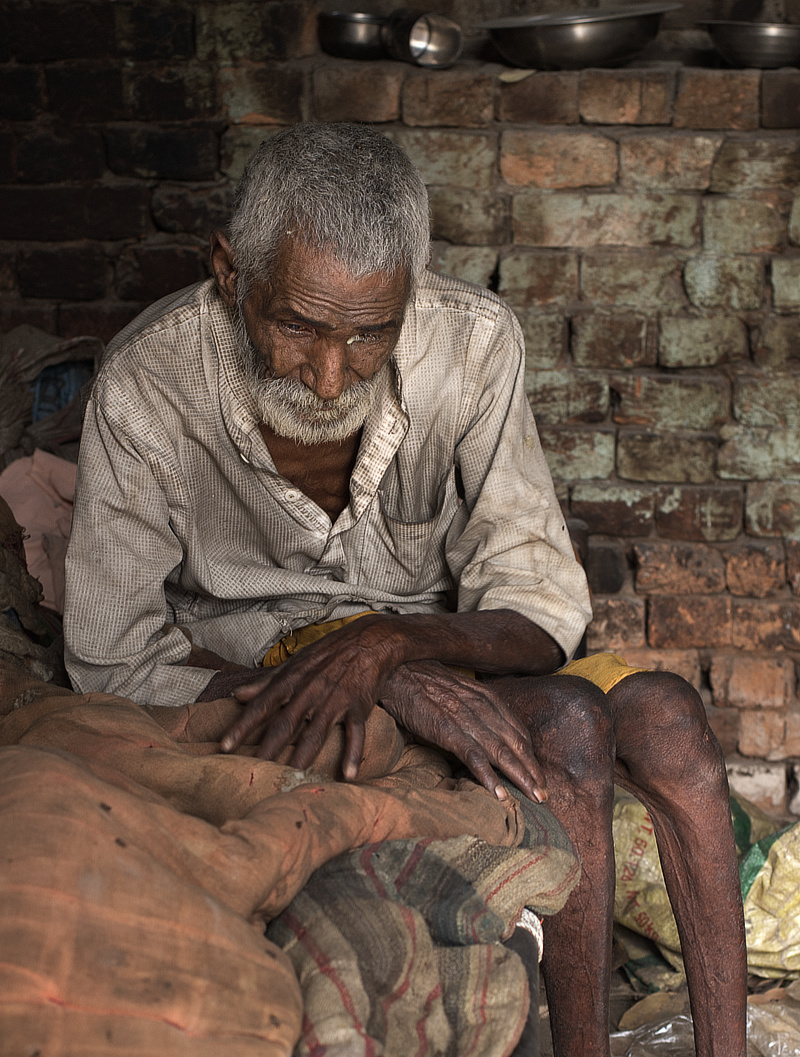
(The sad old man! Photographed with Nikon Df and a Nikkor 50mm f/1.8 lens. Post-processed on Affinity Photo)
The Scene
The photograph above is part of a series capturing an old man sitting with his back hunched and looking down. This posture alone conveys a sense of despair and defeat, a common motif used by sculptors and artists to evoke such emotions. The slight downward tilt of his head is a natural response when a person feels emotionally heavy, perhaps evolutionary—when one loses the strength to hold their head up or to allow their hands to easily reach their face to hide their expression. Whatever the reason, a bent head and hunched back typically symbolize sadness and despair.
His eyes convey a dejected look. One eye, barely visible, stares blankly into the distance, while the other is obscured, with a white discharge at the corner hinting at poor health. The old man was nearly blind when I photographed him.
In addition to his posture, the open hands contribute to the overall sense of desolation. They suggest he has nothing to hold onto—no hopes, no dreams, no future. His hands simply rest there, empty.
His legs, drawn together, highlight the weakness of his limbs and his malnourished state. The bony structure accentuates his frailty.
The light falls from the right side of the frame, side-lighting that enhances the texture of his aged skin and emaciated legs. This lighting effectively brings out the textures, making the folds on his shirt and the dirt on it more pronounced. There was a door on the right side, allowing natural light to flow in, so I didn’t need any artificial light sources.
His unkempt face and dirty clothes further emphasize his poverty. The dirt is more visible on what was once a white shirt, and the heap of clothes in front of him is also dirty and torn.
The dark spots on the brick wall indicate the use of fire to keep warm during the winters, likely from smoky branches or whatever he can find. The bare bricks add to the sense of impoverishment.
Some manipulation of the scene was also necessary. Among the steel vessels on the shelf behind him, I asked one of the team members to place a glass sideways. This subtle detail adds a sense of emptiness that isn’t immediately noticeable but becomes apparent after spending some time observing the main subject, the old man. This is entirely ethical since the man genuinely lived in such conditions. Enhancing a photograph to convey emotions more effectively is sometimes necessary. Every step mentioned in this article contributes to achieving that goal. It’s similar to using a graduated ND filter in a landscape photo to retain the sky’s texture or converting a color image to black and white to remove distracting colors.
Post-Processing
Darkroom work or post-processing is an integral part of creating a compelling photograph. In this case, the first task was to adjust the saturation and color balance.
The yellow plastic bags behind him were too bright and detracted from the image’s impact, so they were desaturated. Some burning was needed on the already dirty areas of his shirt to enhance the texture, and a bit of dodging was applied to his face to emphasize his expression of despair. A graduated ND filter was used on the right side to reduce the brightness caused by the side lighting.
Although the photograph isn’t exactly low-key, reducing the overall brightness increased the sense of sadness. Low-key techniques are effective for evoking such emotions.
For color balance, I reduced the overall warmth and added a touch of blue and magenta. Cool to neutral colors help diminish any sense of comfort.
An Unsharp Mask was applied to his face and legs initially. After resizing the image as needed, a bit of overall sharpening was applied again.
(The photographs in this article have been toned down slightly to reduce the intensity of sadness. The original images evoked strong emotions, and I want readers like you to continue visiting my site and enjoying these articles. Some impact is also lost due to detail compression during the process. If you want to fully experience the original photographs, feel free to visit me sometime and take a look at the prints!)
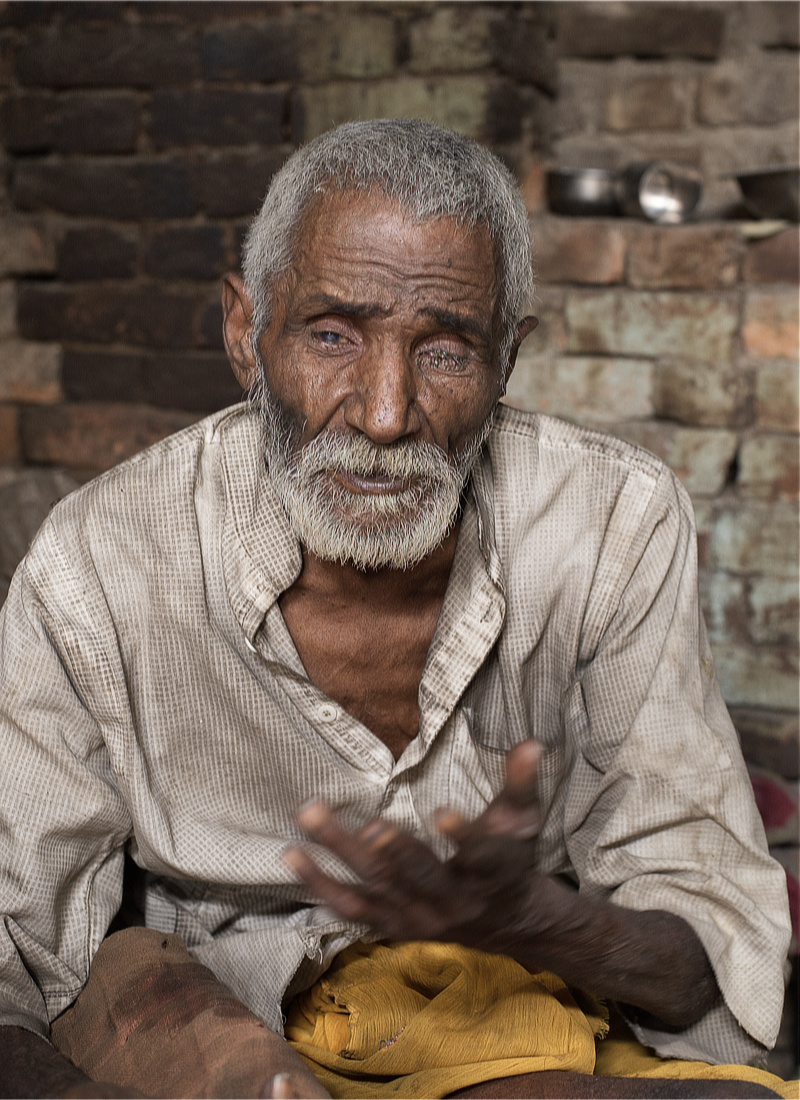
(Blind Man – Nikon Df with Nikkor 50mm f/1.8 lens. Post processed on Affinity Photo)
This is yet another photograph of the same man, who was actually begging for death to come to him. Here, he tries to look directly at me to tell me about his problems, with his eye condition clearly visible. The sadness is present but in a different way. Instead of the dejected and depressed feeling of the first photograph, this one evokes a sense of pain due to the visible problem on his face. The motion blur of his hand adds to the sense of an active, ongoing conversation. A sharply focused hand would have failed to convey this dynamic interaction.
In such photographs, to depict an animated conversation, some motion blur adds to the drama. Among the images I captured with his hand in motion, this one stands out. His open hand aligns with his plea (begging to God) for death, enhancing the emotional impact of the photograph.
Post-processing was done on the same lines as for the first image.
What happened after the photography?
The photographs evoked a deep sense of sadness in many viewers. Even as I was capturing the images and learning his story, I was close to tears—it was quite overwhelming. Street photography can be emotionally challenging at times. Although I altered the scene slightly, I did so minimally. In essence, this remains street photography and, to some extent, anthropology.
However, the story didn’t end with the photography. Here is another photograph that shows what happened next. The community health worker from the team that accompanied me examined the old man, and the eye hospital running the health project in the area will soon perform a sight-restoring surgery on him.
The old man used to be a gravedigger but had to quit due to his failing health and poor eyesight. Soon, however, he will receive the help he needs and will be able to see again.
This is proof that this was not just a heartless street-photography session. I hope this satisfies you, Kenny, my friend. I am naming you because you were the most vocal about photographers being heartless at times when I showed you the original images.
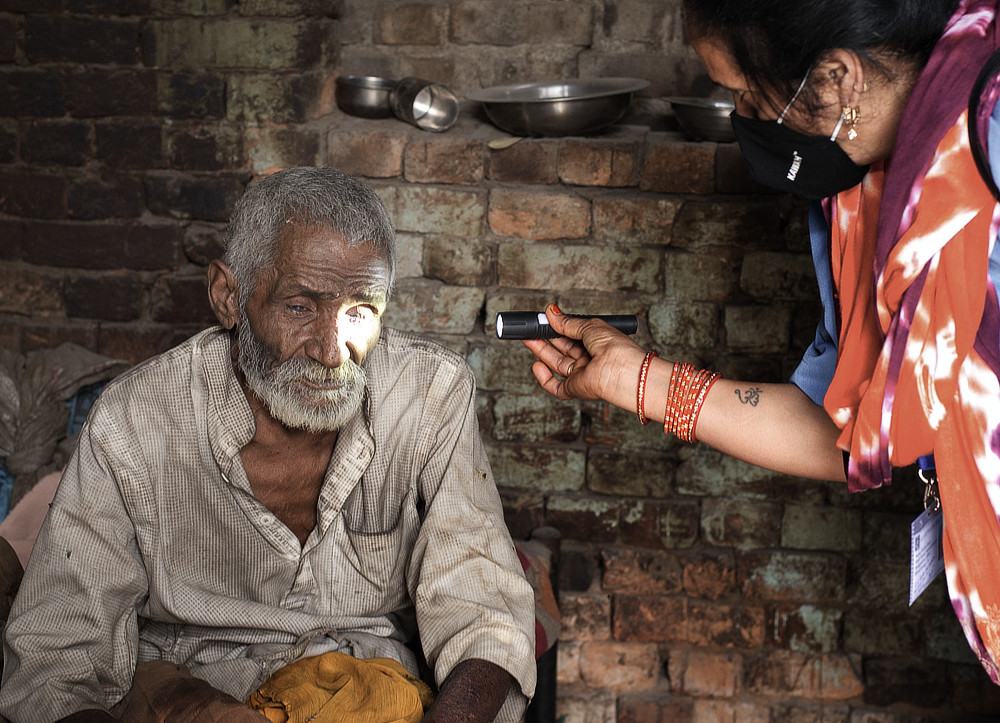
(A torch-light primary eye-examination being done by a community health worker.)
Kevin Carter : Vulture and The Little Girl
Recently, there has been yet another discussion about Kevin Carter’s famous photograph, a topic that has sparked debate for decades. It was an impactful image, but some people criticize Carter for not following the child’s fate to the end. In reality, a UN plane picked up Carter shortly after he took the photograph, giving him little time to spend with the child. The child, identified as a beneficiary by the UN mission (hence the wristband), was already in the care of aid workers, but the photograph made a significant impact on the public and raised awareness.
During my photography session with the old man, I encountered many other subjects in similar situations. It is nearly impossible for a photographer to follow up on every subject and check the outcomes. This work can be incredibly depressing and overwhelming. I have seen colleagues break down on such assignments, and one even fell into a long period of depression.
Even Kevin Carter, a renowned photographer, eventually committed suicide, partly due to the depression brought on by his work in that region.
To know more about the organizations helping the old man:
Operation Eyesight Universal – The Canadian NGO that is running such health projects at various locations, and is primarily involved in providing eye care services.
C L Gupta Eye Institute – The hospital in the region where one such project is being implemented and will be helping out this old man.
This article, originally published on my photography site, is now archived here; while some details may have lost their original context over time, it still offers an intriguing read.
Complete list of archived content – Photography Articles
Discover more from Maini's Hill Cottages
Subscribe to get the latest posts sent to your email.

Touching shots. Very sad indeed. I also appreciated their backstory 😔
The power of photography. Thanks❣️ 😀
LikeLike