
Winter has almost ended, and over the past few weeks, I managed to get a lot done around the house and garden. The fruit trees are now covered with blossoms, though a few lazy ones are still waking up from their winter hibernation. Today, for the first time in a long while, I woke up early to go on a forest trek and do some bird-watching.

(With the winters coming to an end, the snow-peaks are also starting to get covered with haze. Nowadays, only the tops are visible. Soon, they will disappear behind the haze, only to become visible again during autumn.)
Right on time, our resident Blue-Whistling Thrush woke me up. It was still a bit dark outside, and the warmth of the bed was intoxicating, yet I managed to throw the sheets aside and get up. I opened the window slightly and took a deep breath, filling my lungs with the cold forest breeze. This works better than even a strong cup of coffee—try it if you feel lazy in the morning.
My old Sigma 150-500 mm lens had been quietly resting in the almirah. When I took it out and mounted it on the camera, I could almost sense it thanking me. Perhaps I’ve been reading too much Marie Kondo.
Tugging the heavy lens and camera, I stepped out of the house and soon found myself trekking through the forest. The air was crisp and cool, though quite dry. Lately, there hasn’t been any rain, and the winter saw very little snowfall. Leaves crumpled under my feet, creating noise that could easily scare away the birds. In the forest near my place, they are still not used to much human activity and are easily frightened.
There are two different schools of thought when it comes to walking quietly in the forest. One believes in moving as quietly as possible to approach the birds without disturbing them. This approach is based on the idea that birds are easily startled and require careful, silent movement. The other school of thought suggests that birds are now accustomed to human presence and activity. According to this view, walking normally and chatting with friends helps the birds become aware of your approach without being suddenly spooked.
In the forest near me, I’ve observed that both approaches have merit. Small, shy birds fly away regardless of how often they’ve seen me. Foxes and martens, on the other hand, stay put and sometimes observe with curiosity. Jays and magpies seem to happily ignore my presence. So, when photographing small birds, I try to be as quiet as possible to avoid startling them with sudden noises or movements. However, when trekking through the forest, I walk normally, allowing the forest dwellers to sense my approach without being scared.
I spotted an early riser. A Rufous Breasted Accentor was happily chirping away on top of a wild rose bush. Looking towards the sun, it seemed as happy as me, bathing in the early morning sun. One of my friends tells me that these are not quite common, however here they are plenty.
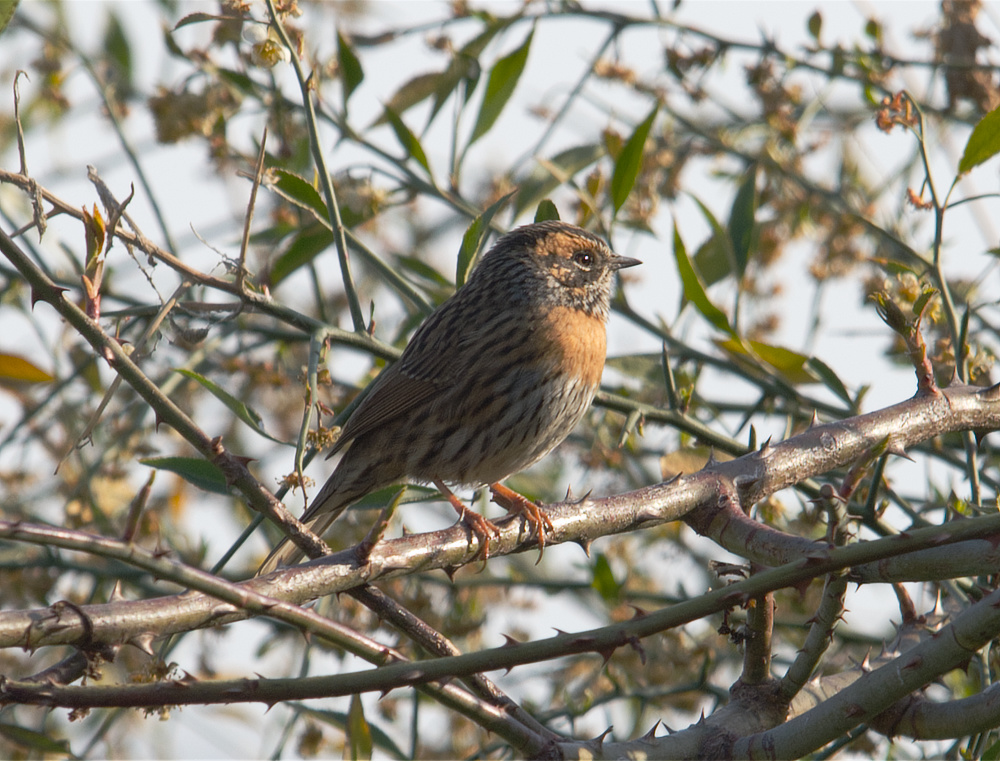
(The little fella was enjoying the early morning sun. Captured at f/11 at 1/500 shutter speed and 800 ISO. I used a f/11 aperture to compensate for the softness of my lens and to hide any focusing errors)
I prefer starting my trek by going as far uphill as I can, so I won’t get tired later on. My neighbor, on the other hand, likes to walk downhill first and then slowly climb back up. The Blue Whistling Thrush that wakes me up flies downhill at dawn in the winter and uphill in the summer. Bees also prefer flying uphill to collect nectar. Foxes are unpredictable—they run along the road, sometimes uphill, sometimes downhill, then suddenly stop to look around before continuing their erratic morning run.
By the time I reached the top of the hill, I had walked about a kilometer. The sun was up, and its light filtered through the tall trees. The birds were becoming more active. Six magpies flew by me and settled on a tree about a meter away. My lens couldn’t capture the whole bird even when completely zoomed out, and I didn’t want to take close-ups of their faces. They created quite a racket with their loud calls, disregarding my presence. After a few seconds, they all flew to another distant tree. Although there are many magpie photos out there, spotting them at such close quarters is exhilarating. And oh boy, these orange and red-billed blue magpies are huge!
I saw some acorns lying on the pathway, reminding me of the squirrel from Ice Age. Maybe one day, I’ll sit close to these acorns with my camera ready, hoping a cute red squirrel will come and pose for me. However, it’s quite possible that instead of a squirrel, a wild boar might come for the acorns. They love them too, and in groups, they can be quite dangerous.
I moved on, slowly walking and enjoying the forest. I listened to various bird calls, the crackling leaves under my feet, gusts of wind fluttering the leaves on tall trees, and the distant sound of gurgling water from a nearby mountain creek. Call me crazy, but I love the forest. It revives me and makes me happy.
Some distance away, I spotted a Grey-Bushchat. Their bright underbelly and grey-blue hue of the wings is quite attractive to look at. These are also not easily scared. I approached quietly. I was able to grab a couple of nice shots before it flew away.
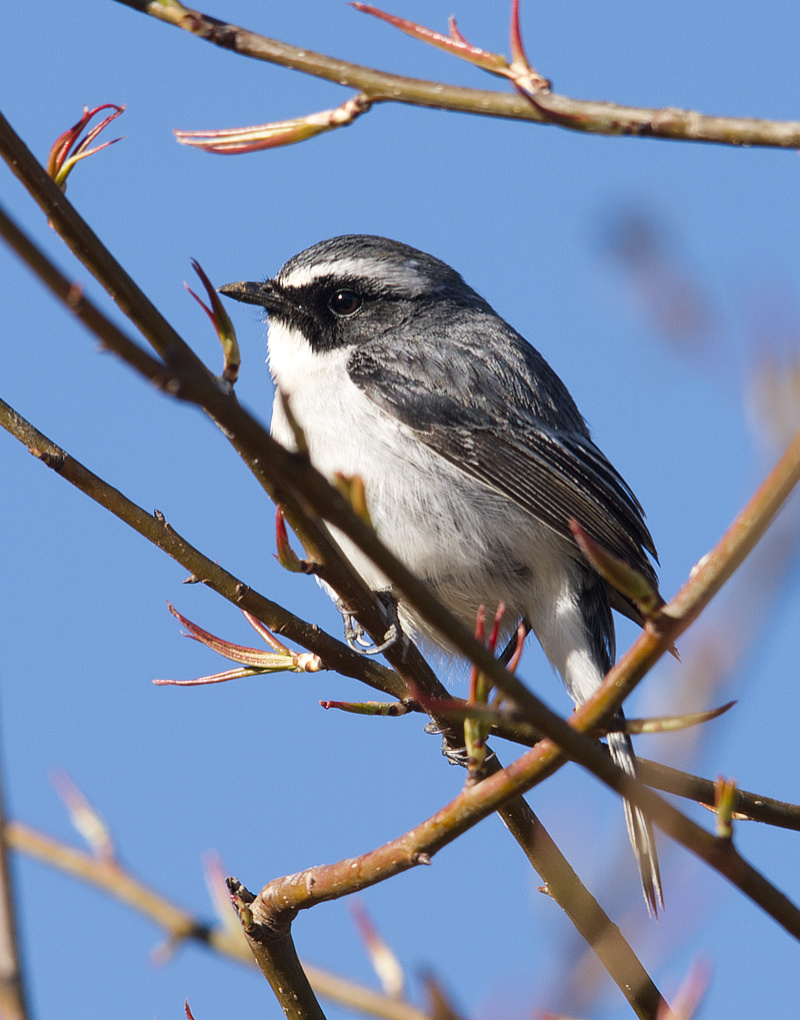
(Grey Bushchat – Early spring season is a good time to spot birds. The lack of leaves on many of the trees makes spotting them easy. Captured at f/11, 1/500 sec, 800 ISO.)
Sometimes, while photographing birds, I dream of purchasing a sharper lens. Perhaps something fast and precise with a fixed focal length, or maybe even another camera body with higher resolution and lower sensor noise to mount that lens on. And then I fantasize about buying an island in the sea and building a second home there… there’s no end to my wants! But for now, the lens will have to wait. I still can’t justify buying a long and expensive lens when I dislike the weight and size of these howitzers (a term I occasionally borrow from a street-photographer friend).
As the sun climbed higher and the heat increased, I knew it was time to head home. There was plenty of work waiting for me: watering the plants, repairing the fence that fell last night when a wild animal banged against it, cleaning one of the storm drains, fertilizing the lawn, and staking some of the new apple plants. I dislike these dwarf cultivars, but they’re the only ones available in nurseries nowadays. With so much to do, I bid farewell to the forest and walked back. Tomorrow, I’ll venture out again and explore more of the wonderful world of the forest.
Further Reading:
Bird-Photography : The Ethical Way!
This article, originally published on my photography site, is now archived here; while some details may have lost their original context over time, it still offers an intriguing read.
Complete list of archived content – Photography Articles
Discover more from Maini's Hill Cottages
Subscribe to get the latest posts sent to your email.

Thanks for the morning walk Dr Maini.
Great photos of the birds- I’m a huge fan of the little guys- and I NEVER, EVER, tire of those mountains❣️❣️❣️
LikeLiked by 1 person