
Coo..coo…coo…tweet…tweet…coo…coo…
It’s 5:45 AM, and I’m gently awakened by the melodious song of a Blue Whistling Thrush. This particular bird made a nest near my roof last year. Its call is perfectly timed to wake me for the early morning light on the Himalayan peaks.
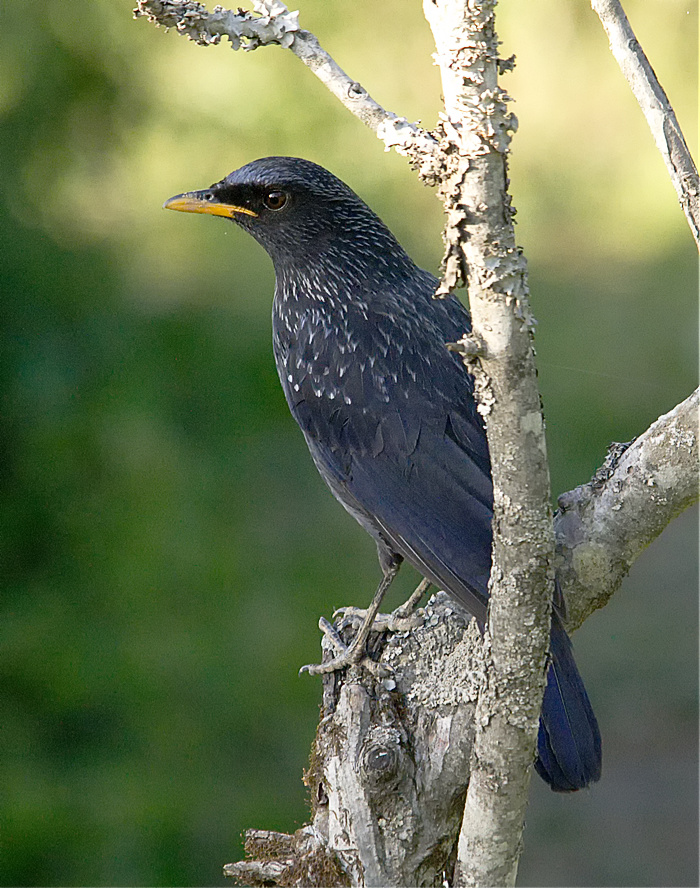
(An old photograph of another blue-whistling thrush. Its color varies from grey-blue to deep blue depending on the type of lighting)
This bird is quite a busy one. It wakes up my neighbors at 5:35 AM, then flies to my place to wake me up ten minutes later. As far as I know, it visits most homes in this neighborhood, waking each one up. Today, my neighbors and I had planned a forest walk after visiting a nearby temple early in the morning. I didn’t need to set an alarm. Before sunrise, I was already wide awake and getting ready for the trek. I had also planned to capture some photographs of the peaks in the early morning light.
By the time I stepped out, the dawn was beginning to light up the snow-capped peaks. The orange-pink hues of the peaks resembled the late evening alpenglow but with a softer, more pastel touch.
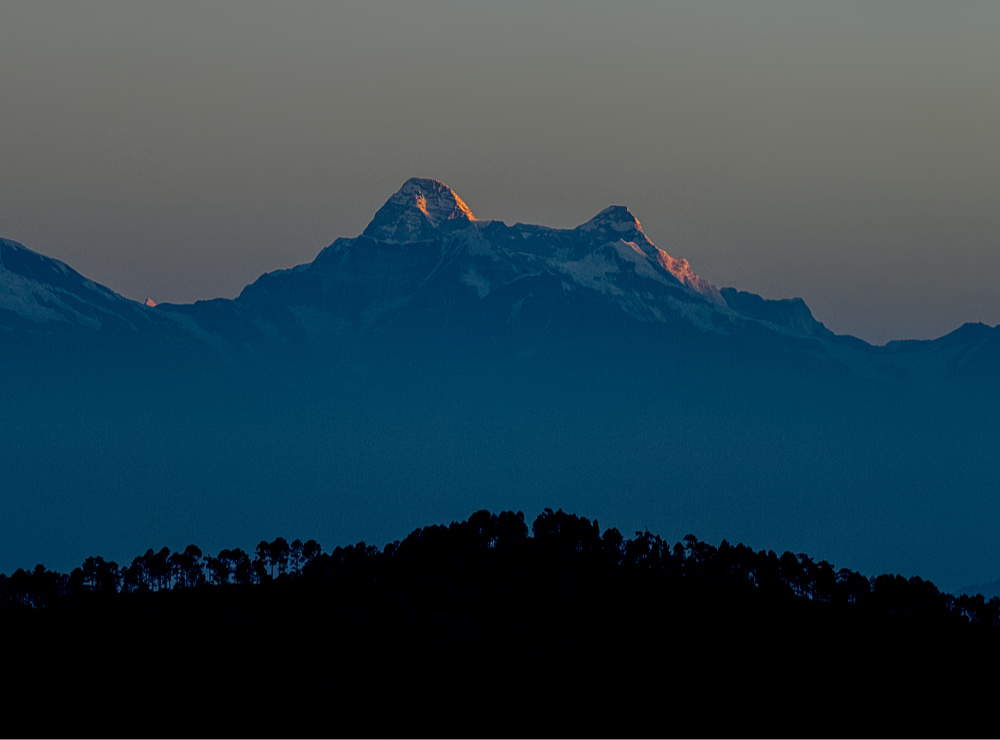
(Everything was still dark while the first rays of sunlight lit up the Trishul peak. Nikon Df with Zeiss 135mm lens at f/5.6, shutter speed 1/125 sec, 100 ISO, mounted on a tripod. Post-processed in Affinity Photo.)
The light was changing rapidly, so I decided the trek could wait a little longer. The mountain range, sprawling across the horizon, presented a perfect opportunity for a panoramic shot, which is always an enticing challenge. Captivated by the scene before me, I decided to create a panorama as well.
To capture the panorama, I took multiple shots in manual mode. For those interested in the technical details, you might find this article helpful: Panoramas, Snow, & Coffee.
I snapped another series of shots, mindful of the common pitfalls in panoramic photography. A single poorly focused shot or slight camera movement can ruin the entire panorama. Therefore, it’s wise to take an extra set of images to ensure quality. Although modern software can correct minor errors, especially while using RAW format, it’s better not to take unnecessary risks.
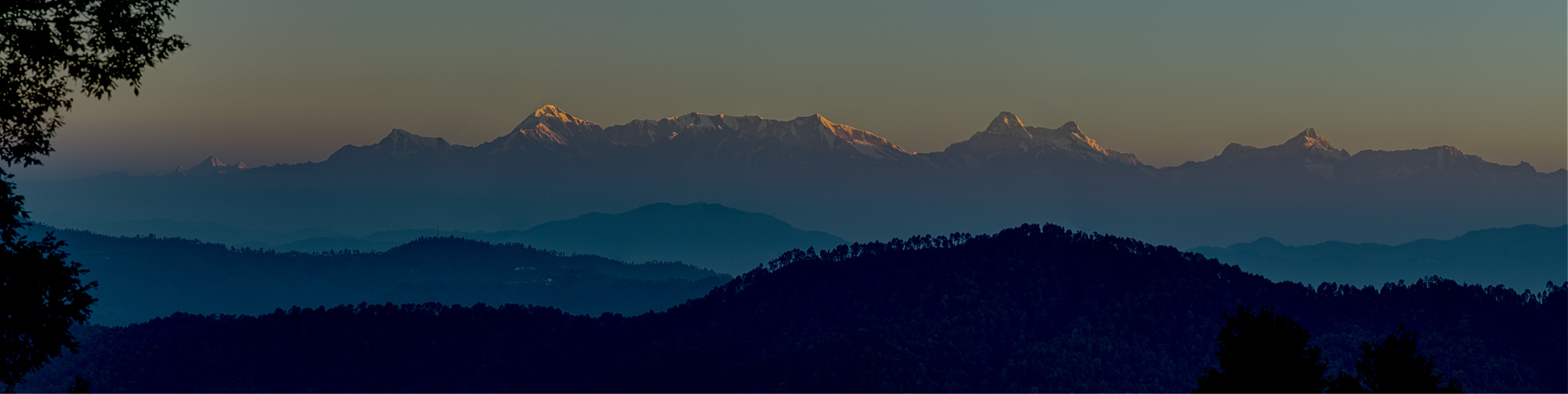
(The foreground was still dark and the snow-peaks were slowly and slowly starting to light up.)
The song of the blue whistling thrush filled the air once more. In the distance, another thrush began a new melody, creating a beautiful call-and-response. Perhaps they were signaling that my friend was already waiting for me near the temple. It was time to pack up. I removed the camera from the tripod, leaving the tripod behind, hoping to spot something interesting on our trek.
The meeting point, the temple, was just a short walk from my place. When I arrived, I realized I was early. I could have taken another series of shots before leaving, but now there was no time to go back. The sun was starting to light up the smaller peaks as well. While waiting for my friend, I took another shot of the Panchachuli peaks, which are lower in height compared to the Nanda Devi and Trishul peaks I had photographed earlier. Unfortunately, the image was blurred due to an unsteady hand at 1/125 seconds. Despite always advising others to take a backup shot, I sometimes forget to do so myself—a leftover habit from the film days when I had to be economical with my clicks.
My friend arrived at the temple a few minutes later. Although he is my neighbor, his house is about 200 meters down the valley from mine, requiring him to take a much longer route to reach the temple. That’s the nature of living in the hills. Once he arrived, we sat in the warm sun and meditated for a while, a practice I’ve recently started.
By the time we finished meditating, the sun was high in the sky. The sky was a clear blue, and the snow-capped peaks shimmered in their full white glory.
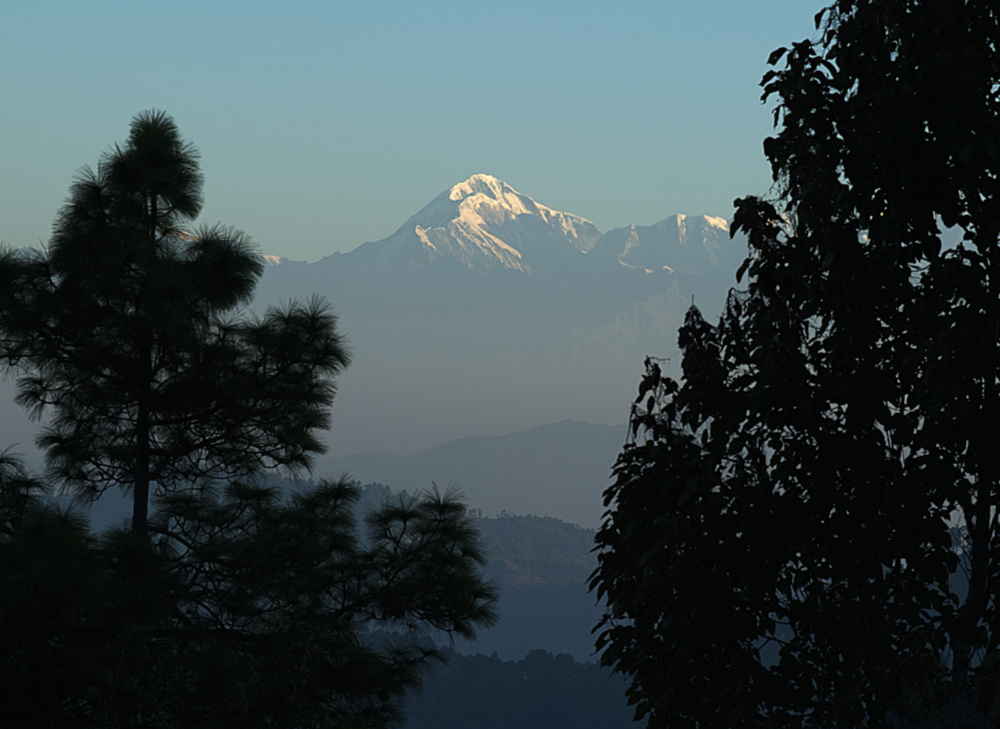
(Trishul peak in early morning light, visible in a gap between an old pine and an oak.)
The light was getting stronger, and once again, the long melodious call of the blue whistling thrush echoed through the air. Perhaps someone in our little village was still asleep, with the thrush serving as a substitute for the roosters that work like morning alarms in other villages. We do have some roosters, but they are lazier than some of the humans.
One interesting thing about the hills is that once you focus on the call of a particular bird, it seems to stay with you. Amid the symphony of various bird calls, that one voice stands out. Today, it was the thrush’s day.
I mentioned this to my friend, and he nodded in understanding. Did the bird wake him up this morning too? He nodded again. Every day at 5:35, like clockwork! Birds can be fascinating to observe. I wished I had brought a long telephoto lens, but the one mounted on my camera was always the wrong one (Murphy’s Laws in Photography). Anyway, the 135mm lens was good for landscapes and hills.
As we began our trek, the forest grew denser, and the snow-peaks disappeared from view. The air had the crisp winter smell. If you want to know how winter smells in the forest, join me for a walk someday. We trekked for about an hour through the forest. My friend, though much older than me, was full of energy. He walked fast, and I had to keep up with his pace. Mushrooms grew here and there, a hare jumped in front of us and hurried to the nearby bushes, and a parakeet flew by. But I was too busy keeping up with him to photograph anything.
After about an hour, we reached another hilltop with a good view of the snow-peaks. My friend sat down on a rock and took out his small tiffin box. It was time for his morning snack, and an opportunity for me to capture more photographs.
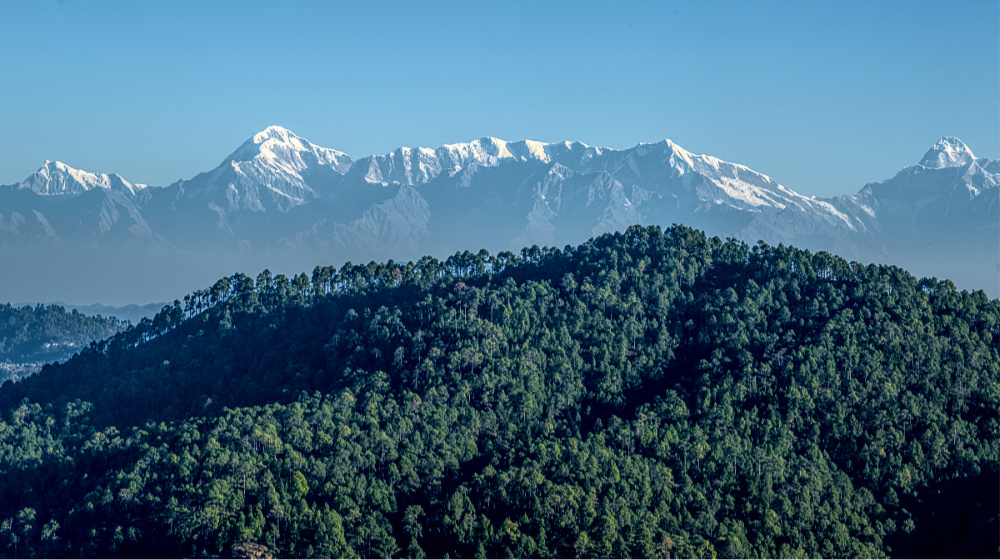
(Just another snapshot of the hills. The forest in the foreground is the one that we had trekked)
The photographs in this article are just placeholders, as the experience itself was far more memorable than a photowalk. These early morning treks are truly wonderful. Next time, I’ll bring a long lens to capture some birds—it’s been a long time since I indulged in bird photography.
Further Reading:
Saim Devta Temple (the temple where me and my friend had planned to meet.)
This article, originally published on my photography site, is now archived here; while some details may have lost their original context over time, it still offers an intriguing read.
Complete list of archived content – Photography Articles
Discover more from Maini's Hill Cottages
Subscribe to get the latest posts sent to your email.

What a beautiful way to start a day, bird-song and that stunning view! You’re post reminds me I should go to bed earlier, so I can get up earlier – before a bird wakes me … mine is a noisy but beautiful little Straited Parodlite, like clockwork too! Enjoy your day.
LikeLike
Beautiful write up. People generally meditate to shut out the outer world chaos and delve into inner peace!!!! I doubt I could do that in Natadol. You must be onto something new. Will find out in my next visit. Thanks
LikeLike
A slice of heaven. Thanks for sharing a piece.
What’s a wonderful alarm. The blue whistling thrush is a stunning bird. I’ll have to do a search to hear their song! Nice way to start the day.
I never tire of the Himalayan snapshots. For me it’s like Monet’s garden. Always different in subtle ways. 😃
LikeLike